Collin County museum exhibit highlights 64 tornadoes, including 4 EF4s
A Collin County museum exhibit turns local storm history into a warning: the county has logged 64 tornadoes, including four EF4s, as growth keeps pushing outward.
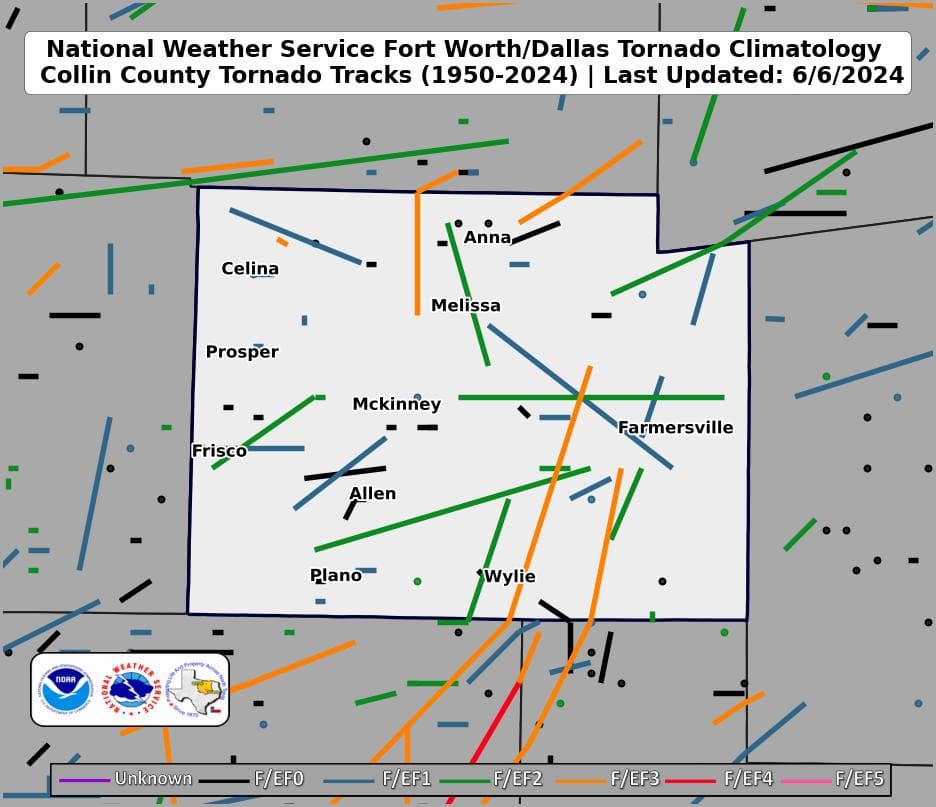
The Collin County History Museum’s extreme-weather pop-up exhibit puts a hard number on what longtime residents already know: Collin County has logged 64 tornadoes from 1880 to 2024, including four EF4 storms. In a county that stretches from McKinney and Anna to fast-growing Plano, Frisco, Allen and Melissa, that history is not a side note. It is part of where people build, how cities plan and what new arrivals need to know before storm season turns violent.
What the museum is showing
The exhibit sits inside the museum’s pop-up exhibits program, a format the institution uses to move local history into temporary displays. Here, the point is not nostalgia. The display uses the county’s tornado tally to show that severe weather is a recurring feature of life in North Texas, not an occasional anomaly.
On the Enhanced Fujita scale, EF4 tornadoes are classified as violent and can produce wind speeds of 166 to 200 mph. That matters because the county’s record includes four of them, a level of intensity that helps explain why storm shelter conversations, warning systems and siting decisions still matter in a county that keeps growing outward.
The tornado that puts the record in focus
NOAA’s Storm Events Database gives the county one of its clearest case studies. A Collin County F3 tornado struck on May 9, 2006, beginning near Anna at 9:37 p.m. CST and ending at 9:47 p.m. CST. The storm traveled 4 miles, was 300 yards wide and caused two deaths.
That single event does what a raw count cannot: it connects the county’s long storm archive to a place residents know, a time of day people remember and a physical footprint that is easy to picture. For communities like Anna and McKinney, and for newer suburbs farther south, it is a reminder that violent weather has already crossed the county line and left a documented mark.
The official record is local, not abstract
The National Weather Service Fort Worth office maintains a Collin County tornado climatology page, which makes the county’s storm history part of a standing federal record rather than a loose memory bank. The office also has a page on the Dec. 26, 2015 North Texas tornado outbreak, another sign that Collin County’s risk sits inside a broader regional pattern of severe weather.

That local framing matches how residents talk about the county. A 2024 Sachse News story described Collin County as “no stranger to severe storms,” and the phrase fits the data: tornadoes are only one slice of a longer severe-weather record that also includes damaging hail and other storm impacts across North Texas. The museum exhibit works because it turns that broad familiarity into a count, a map and a timeline.
Why the history matters now
The county’s recent storm history shows how quickly that record becomes present tense. On May 26, 2024, after deadly North Texas storms, Gov. Greg Abbott added Collin County to the state disaster declaration. NBC 5 Dallas-Fort Worth reported that the broader storm damage included 320 buildings destroyed or damaged and about 100 injuries.
That kind of event lands differently in a county that has spent years absorbing new residents and new subdivisions. When population grows in places like Plano, Frisco, Allen, Melissa, McKinney and Anna, the severe-weather risk does not disappear; it spreads across more rooftops, more roadways and more school districts. The exhibit’s historical count is useful because it shows that today’s development pattern is being built on top of a long-established hazard profile.
What local planning has to account for
Collin County’s own emergency-management page says the county will be updating its Hazard Mitigation Action Plan in 2027. That gives the storm history a direct policy link, because hazard mitigation planning is where county and municipal leaders set priorities for reducing losses before the next major event arrives.
For residents, the practical takeaway is straightforward. The museum’s exhibit, the NOAA record, the National Weather Service’s climatology pages and the 2024 disaster declaration all point to the same conclusion: tornado risk in Collin County is not buried in the past. It is documented, recurring and baked into the decisions that shape where the county builds next.
This article was produced by Prism’s automated news system from verified source data, official records, and press releases, then run through automated quality and moderation checks before publishing. The system is built and supervised by the people who set the standards it runs under. Read our full AI policy.
Did this article answer your question?