Vineland Puerto Rican Festival marks 60 years with weeklong celebration
Vineland's Puerto Rican Festival turns 60 with a July 19-26 celebration built around Landis Park, a city hall flag raising and a downtown-to-park parade.
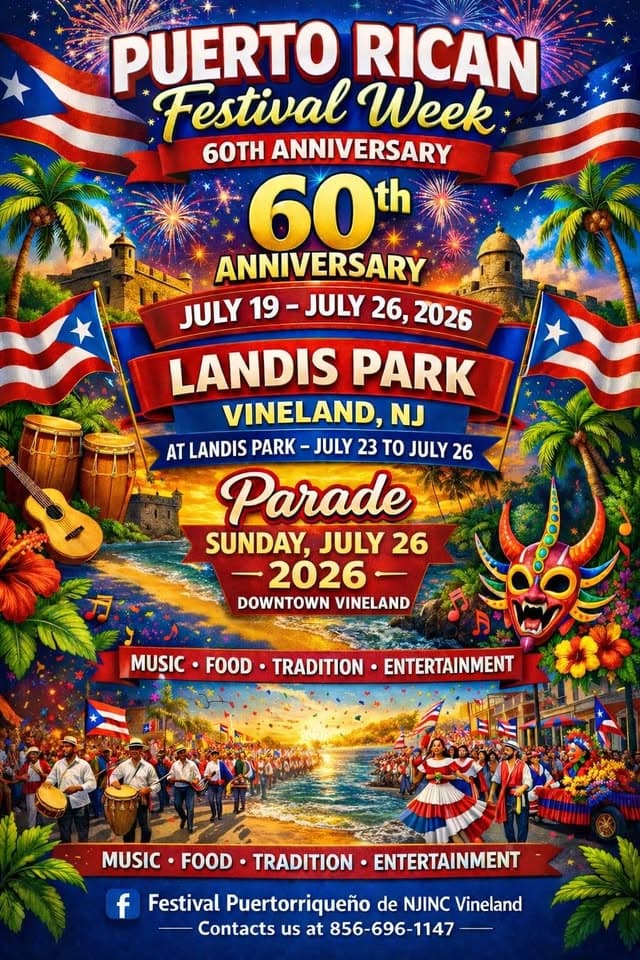
Vineland’s Puerto Rican Festival reaches a milestone that is bigger than a summer calendar date. The 60th anniversary celebration runs July 19-26, anchored by a flag raising at Vineland City Hall and a closing-day parade that carries the festival from downtown into Landis Park.
A 60-year anchor in Vineland
The festival has become one of the largest annual celebrations of Puerto Rican culture in New Jersey, and its reach in Cumberland County now goes well beyond a single weekend in the park. El Festival Puertorriqueno de New Jersey Inc. says it has existed since 1968 and identifies itself as a New Jersey-registered 501(c)(4) nonprofit with a mission to enlighten the community and young people about Puerto Rican heritage, culture and ethical values.
That mix of heritage work and civic organizing is what has kept the festival in public view for decades. The event is built not just as a celebration, but as a way to preserve identity, support volunteer effort and keep local cultural memory active in Vineland rather than letting it fade into nostalgia.
How the anniversary week is set up
The 60th anniversary week begins on Saturday, July 19, with a flag raising at Vineland City Hall at 1 p.m. The festival then continues through Saturday, July 26, with programming centered around Landis Park, where much of the cultural activity, food, music and gathering space is concentrated.
The closing-day parade is scheduled for Sunday, July 26, and recent festival history shows why that day draws such attention. A 2024 city listing put parade day at 1 p.m. at Landis Park, with rides open at noon and closing ceremonies running from 4 p.m. to 9 p.m. That structure has helped turn the final day into a full community outing rather than a narrow ticketed performance.
Why the festival still pulls a crowd
The festival’s staying power comes from the way it blends public celebration with practical access. The parade, food vendors, product booths and live music allow families, older residents and visitors to take part without needing to buy an expensive ticket, which is part of why the event remains so visible in Vineland’s summer life.
Attendance has also been a major part of the festival’s footprint. Prior coverage of earlier years says tens of thousands of people have attended in some festivals, a scale that reflects how deeply the event is woven into local identity. For many residents, the festival is not simply an annual gathering, but one of the clearest expressions of Puerto Rican presence in Cumberland County.
Tradition built on themes, not just a single day
The week is traditionally organized with day-by-day themes, which gives the celebration a rhythm that extends beyond the parade itself. Past schedules have included youth-focused programming and folkloric evenings, showing how the festival has tried to reach different generations with different pieces of the culture.
That approach matters in a city where the festival has long functioned as both a social event and a cultural classroom. The organizing group has framed its work around education and empowerment, and the themed programming gives that mission a public face, especially for children and teens who experience the festival through school, family and civic organizations.
City hall, schools and civic leaders have all been part of it
The festival’s public profile is reinforced by the institutions that show up around it. The 2024 flag raising at Vineland City Hall opened a week of events and included local officials and community leaders, among them Dennis Rivera, Dr. Elizabeth Arthur, Albert Vargas, Celeste Riley and Doug Albrecht.
Vineland Public Schools has also documented student participation in the parade, including students leading the Colors from Landis and West Ave to Landis Park. That kind of involvement shows how the festival reaches into the schools as well as the park, giving younger residents a visible role in a tradition that is otherwise easy to treat as just another summer event.
A tradition that kept expanding
Historic coverage shows that the organization incorporated in 1978 and later expanded its programming beyond the parade and main festival grounds. At one point, the festival added a six-mile race and a Puerto Rican art exhibit at Vineland Public Library, both signs that the event has long been tied to more than entertainment alone.
That broader record helps explain why the anniversary matters now. The festival has survived through decades of planning, fundraising and volunteer effort, and organizers continue to treat it as a community institution rather than a one-year milestone. Raffle tickets are still available, and sales help support the tradition that has carried from one generation to the next.
In Vineland, the 60th anniversary is not just a marker of age. It is proof that a Puerto Rican festival can still serve as a civic anchor, a family gathering and a public expression of identity all at once.
This article was produced by Prism’s automated news system from verified source data, official records, and press releases, then run through automated quality and moderation checks before publishing. The system is built and supervised by the people who set the standards it runs under. Read our full AI policy.
Did this article answer your question?