Dunbar Store marks Decatur County's crossroads history in Bath Springs
Dunbar Store still shows how Bath Springs worked as a crossroads, with a post office slot, Civil War lore, and a marker that ties it to Decatur County’s road-and-river past.
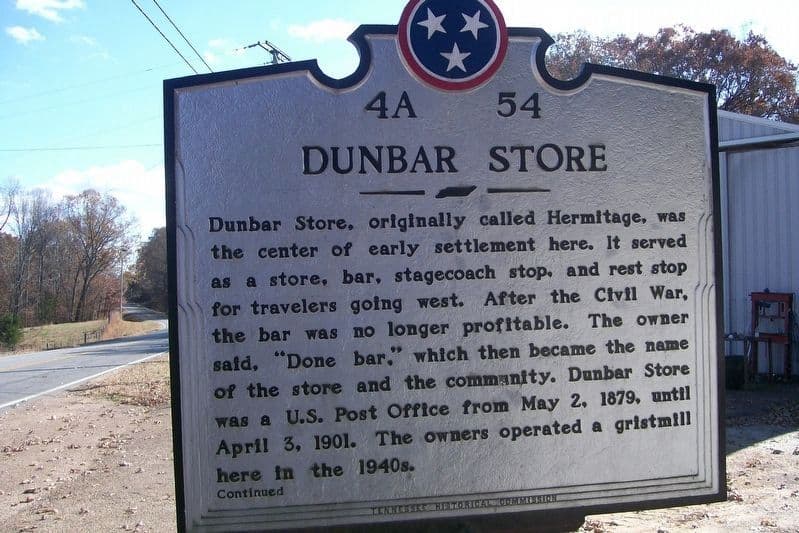
At the junction of Dunbar Road and Tennessee 114 in Bath Springs, Dunbar Store still reads like a working map of old Decatur County. The log building stood at the center of a place where travelers stopped, mail changed hands, news spread, and local politics played out in public. Today, the site preserves that crossroads role in plain view, from the old post office slot in the door to the historical marker that records how much one rural store once carried.
A crossroads that did the work of a community
Dunbar Store began as more than a place to buy supplies. Local history identifies the site as the former community of Hermitage before the name Dunbar took hold after the Civil War, and the marker says the building served as a store, a bar, a stagecoach stop, and a rest stop for travelers heading west. That mix of uses mattered in a county where roads, not institutions, often organized daily life. One building could handle food, drink, mail, conversation, and shelter because the next town was not always close enough to matter.
The setting helps explain why. The store sits on what local history calls the old stage road, a route that linked Bath Springs to wider travel patterns across the region. TNGenWeb’s Keeton family account says stagecoach service through the community began before 1845, which places the store inside the earliest years of Decatur County settlement. Decatur County itself was formed in 1845, after the land had been opened for settlement by the 1818 Jackson-Shelby purchase from the Chickasaw for $300,000, a reminder that the county’s road network grew out of a much older shift in control and migration.
Mail, merchants, and the post office slot still in the door
The store’s clearest surviving clue to its past is the letter slot still visible in the door. The historical marker says Dunbar Store operated as a U.S. Post Office from May 2, 1879, to April 3, 1901, and TNGenWeb notes that a rural route was later established and Bath Springs became the post office. That transition tells a larger story about how service patterns changed as the county moved from isolated road stops to more formal postal delivery.
The same local history identifies several of the store’s owners over time, including Bob Keeton, W. C. Fanning, and W. D. Johnston. Bob Keeton is said to have operated the store for more than 25 years, which suggests how closely the place was tied to one family’s long stewardship. The history also says the owners ran a gristmill there in the 1940s, adding another layer to a building that kept adapting as the needs of the community changed.
Civil War traffic, election-day crowds, and the politics of a public place
Dunbar Store’s public role was never limited to commerce. The marker says it was used as a mustering station during the Civil War, and that Gen. Nathan B. Forrest and his men stopped there after crossing the Tennessee River at Clifton. Local tradition preserved on the marker says neighborhood women, including members of the Keeton family, cooked through the night and fed the soldiers under the shade trees in front of the store. That detail turns the site into more than a waypoint: it was a place where civilian life and wartime movement met in one yard.
The building later kept serving public life in peacetime. TNGenWeb says Dunbar Store was for many years an official polling place, and local history says Bob and Alf Taylor stopped there during the 1866 gubernatorial race. That makes the store a witness to the rough-edged politics of the postwar era, when candidates still traveled the countryside and election day drew people to familiar community centers. The same account says whiskey was once sold by the drink there in the early years, another sign that the store functioned as a social hub as much as a commercial one.
Bath Springs, the spring water, and the river economy around the store
The store’s importance becomes even clearer when you look at Bath Springs itself. The Decatur County Historical Society says the community was named by Dr. William Hancock after he discovered sulphur water and built a health resort there. Hancock’s medical office also served as an early post office, showing how thin the line could be between health care, mail service, and local enterprise in a small settlement.
Bath Springs also had a pre-Civil War tanning factory that shipped hides by river boat, which adds a commercial dimension beyond the stage road. The town sat at the edge of both land and water networks, and that combination helped make a place like Dunbar Store useful to people moving goods, visiting the spring, or crossing between the river and the road. TNGenWeb’s history even notes that the old Clardy School once stood between the store and the spring, placing education, commerce, and recreation within a very small footprint.
Why the site still matters now
Dunbar Store survives as a compact lesson in how Decatur County once worked. It shows a time when a crossroads store had to cover multiple jobs: selling provisions, hosting stagecoaches, handling mail, serving as a gathering place, and anchoring elections. It also captures Bath Springs as a layered community built around sulphur water, river shipping, and road travel rather than around one single institution.
The preservation story is part of the appeal. The Tennessee Historical Commission launched its historical markers program in the late 1940s, and the state now has more than 2,000 markers, placing Dunbar Store within a much larger effort to mark places where local memory and transportation history meet. For visitors moving through Bath Springs today, the store remains one of the clearest places to see how Decatur County’s early life was organized, not by wide civic infrastructure, but by a few essential buildings at a road junction.
This article was produced by Prism’s automated news system from verified source data, official records, and press releases, then run through automated quality and moderation checks before publishing. The system is built and supervised by the people who set the standards it runs under. Read our full AI policy.
Did this article answer your question?