Dolores’ Southern Hotel stands as town’s oldest surviving railroad landmark
Dolores’ Southern Hotel is the town’s oldest building and a working railroad-era landmark that once served as the only hotel and eating house between Durango and Telluride.

Dolores’ Southern Hotel still tells the story that tourism later obscured: rail travel built this town first. Constructed in 1893 and expanded in 1902, the building began as Dolores’ first hotel and for years stood as the only place to stay in town, as well as the only railroad eating house between Durango and Telluride. That rare combination of age, continuous use, and railroad function makes it one of the clearest surviving proofs that the arrival of the line changed Dolores before recreation and archaeology became the county’s better-known draw.
Rail built the town before the hotel built the story
The Southern Hotel rose after the railhead moved to the present site of Dolores in 1891. When that happened, residents of Big Bend, a community that had reached a peak population of about 100 in the 1880s, moved lock, stock and barrel to the new townsite at 6,982 feet and took the river’s name with them. The town’s street life, business core, and travel patterns all shifted around that decision, which turned Dolores from a river-valley settlement into a rail town serving the western San Juan region.
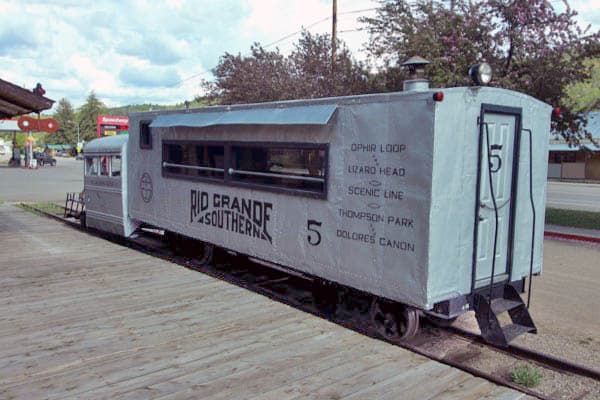
That shift mattered because the Rio Grande Southern Railroad was not an isolated branch line. Incorporated in 1889 and operating from 1890 to 1950, it connected Durango, Hesperus, Mancos, Dolores, Rico, Telluride and Ridgway, with Dolores serving as a division point from construction in 1891 until abandonment in 1952. The railroad’s early revenues came from silver and gold mines near Telluride, Ophir and Rico, and the hotel’s location on that corridor made it part of the movement of miners, passengers, freight, meals and mail that kept the line useful.
Why the Southern Hotel mattered then
History Colorado identifies the Southern Hotel, also known as the Rio Grande Southern Hotel and at times Benny’s Hogan, as the oldest building in Dolores and the town’s first hotel. For many years it was the only hotel in town, which meant it was doing more than taking in travelers. It was anchoring a small but strategically placed commercial district where rail passengers, railroad workers, merchants and local residents all crossed paths.
The Library of Congress calls it a “true railroad hotel” and the “first and finest hostelry in Dolores,” and that description captures the building’s real role in the town’s economy. A railroad hotel was not simply a place to sleep. It was a service point on the line, a place where movement slowed long enough for commerce to happen, meals to be served, and the town to make a living from traffic passing through rather than from one industry alone.
What remains on the block today
The building standing in Dolores today is a 2½-story frame hotel with a two-story original structure and a smaller 1902 frame addition. The Society of Architectural Historians describes it as recently restored, and that restoration matters because the structure is not a hollow relic. It remains in continuous use as a boarding house and hotel, which preserves the building’s original function even as the town around it has changed.
A 1913 fire changed the exterior but not the building’s identity. SAH Archipedia says the fire destroyed the hotel’s ice house and stables, along with other downtown buildings, after which the hotel was stuccoed to comply with a new ordinance. That detail helps explain why the Southern Hotel looks the way it does now: its fabric records both the optimism of the railroad era and the practical changes that followed a downtown fire in a growing town.

How to read the hotel as a local landmark
The Southern Hotel is listed on the National Register of Historic Places, the federal list of historic places considered worthy of preservation. That listing gives the building national recognition, but its strongest value is local. In Dolores, the hotel is a physical reminder that the town’s origins were tied to rail logistics, not just scenic landscape or outdoor access.
A useful way to understand the building is to see it in three layers:
- As a town builder, because the railhead moved Dolores to its present site in 1891.
- As a commerce node, because it served travelers on the Rio Grande Southern line and functioned as the only railroad eating house between Durango and Telluride.
- As a preserved working building, because it has stayed in use as a boarding house and hotel since construction.
That mix is rare in small mountain towns, where many historic structures survive only as facades or museum pieces. The Southern Hotel still carries its original purpose in its daily life, which is part of why it reads as more than architecture. It is a record of how a railroad corridor shaped lodging, movement and street-level commerce in Montezuma County.
Why the railroad story still matters in Dolores County
Dolores County’s public identity often turns toward archaeology, the river, and outdoor recreation, but the Southern Hotel keeps the railroad story visible in the middle of town. The hotel ties together the arrival of the railhead, the relocation of Big Bend, the rise of the Rio Grande Southern, and the commercial needs of a small mountain community inserted into a much larger mining network.
That history still has a place in the present-day townscape. The Southern Hotel stands as the oldest surviving building in Dolores because it outlasted the rail boom, the fires, the changes in transportation, and the shift in how the region markets itself. In a county where other narratives can easily dominate, the hotel remains the most direct evidence that rail mobility helped make Dolores into a town at all, and that the line’s influence still survives in the building’s frame, its site and its use.
This article was produced by Prism’s automated news system from verified source data, official records, and press releases, then run through automated quality and moderation checks before publishing. The system is built and supervised by the people who set the standards it runs under. Read our full AI policy.
Did this article answer your question?