How the Dolores Project supplies water, power and recreation
McPhee Reservoir is Dolores County’s shared water bank, feeding farms, towns, fish flows and boating. In drought, the same supply forces hard choices.

McPhee Reservoir is the shared water bank behind Dolores County’s farms, towns, fishery and boating season. When inflows tighten, the same project that supplies irrigation and municipal water also determines how much can be left in the river for trout, whitewater and downstream habitat.
What the Dolores Project does
The Dolores Project is not a single-purpose reservoir. It uses water from the Dolores River for irrigation, municipal and industrial use, recreation, fish and wildlife, hydroelectric power, flood control and economic redevelopment. It serves the northwest Dove Creek area, the central Montezuma Valley area and the Towaoc area on the Ute Mountain Ute Indian Reservation, with a full and supplemental irrigation supply available for 61,660 acres. The Dolores Water Conservancy District’s current count is slightly higher, at roughly 63,000 irrigated acres, because it groups together the project’s full-service area, Montezuma Valley Irrigation Company classified lands and the Ute Farm and Ranch Enterprise. The system carries 8,700 acre-feet of municipal and industrial water for future growth.
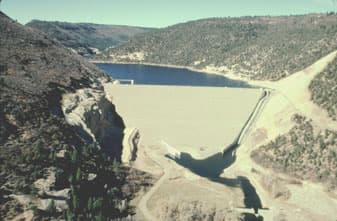
McPhee Reservoir was created by McPhee Dam and the Great Cut Dike on the Dolores-San Juan Divide, with a total capacity of 381,195 acre-feet, including 229,200 acre-feet of active storage, 151,900 acre-feet of inactive storage and 95 acre-feet of dead storage. When full, the reservoir covers 4,470 acres at an elevation of 6,924 feet and extends about 10 miles up the Dolores River. DWCD rounds the reservoir to 381,000 acre-feet total.
Who controls the water
The project’s day-to-day structure is split among several public entities. The Dolores Water Conservancy District operates McPhee Reservoir and administers project and joint-use facilities within its boundaries, while the Ute Mountain Ute Indian Tribe and the Bureau of Indian Affairs administer the reservation-serving facilities. The project also includes powerplants at McPhee Dam and the Towaoc Canal, with 12.8 megawatts of installed generating capacity. McPhee Dam Powerplant runs year-round on fishery releases, while the Towaoc Canal Powerplant runs from April to October on irrigation water conveyed through the canal.
That structure grew out of a long political fight, not just an engineering plan. The Dolores Project was authorized in 1968, and DWCD says local voters approved the concept by a 94 percent margin. Initial construction began in 1977, while construction of McPhee Dam began in 1980 and ended in 1986 after President Jimmy Carter delayed the project in 1978 amid settlement of Indian water rights and pressure tied to the Ute Mountain Ute Tribe. The Colorado Ute Indian Water Rights Final Settlement Agreement, dated Dec. 10, 1986, entitled the Ute Mountain Tribe to Dolores Project water for municipal, industrial, irrigation and fish and wildlife purposes with a priority date of 1868, and by 1986 irrigators in Montezuma Valley, the Ute Tribe and Dolores Project farmers had a long-term dependable supply of water.
How irrigation, fish and recreation share the same reservoir
The project’s hardest balancing act happens below the dam. Water is released downstream year-round for the fishery, with semi-regular controlled releases during runoff season. In higher-water years, those releases can turn into a 30- to 60-day recreational window timed for whitewater boating, native fish needs and geomorphology of the river. That is the central tradeoff of the Dolores system: one release can help boaters, sustain a fishery and shape the river channel, but it also draws down the same storage that irrigators depend on later in the season.
The river itself has changed because of that management. The hydrology, geomorphology and biology of the channel below McPhee Reservoir have all been altered by the dam and the changed flow and sediment supply it created.
Who argues over the releases
The main forum for those arguments is the Dolores River Dialogue and its affiliated native-fish work. The Dolores River Native Fish Monitoring and Recommendation Team addresses protection and ongoing management of fisheries and is made up of diverse stakeholders interested in native fish and whitewater boating. The Dolores River Dialogue is a coalition of diverse interests whose purpose is to improve ecological conditions downstream of McPhee Reservoir while honoring water rights, protecting agricultural and municipal supplies and preserving rafting and fishing. The Native Fish Monitoring and Recommendation Team was formed in July 2011, while the operating agreement and carriage contract between Reclamation and DWCD were signed in 2000.
DWCD manages the local delivery system; Reclamation owns and oversees the federal project framework; the Ute Mountain Ute Tribe has a direct stake in reservation water and fish-and-wildlife uses; and the stakeholder process is where downstream river management is debated.

What changes in a dry year
Dry years expose the system’s limits quickly. McPhee inflows have averaged 327,000 acre-feet over the past 30 years, but the range has been wide, from just 79,757 acre-feet in the 2002 drought to 516,457 acre-feet in 2005. Inflows come entirely from seasonal snowpack, which is why the spring forecast matters so much for both irrigation and recreation.
The consequences are immediate for growers. Limited McPhee water supplies were forcing hard choices for local growers in June 2026, while municipal supplies were protected.
This article was produced by Prism’s automated news system from verified source data, official records, and press releases, then run through automated quality and moderation checks before publishing. The system is built and supervised by the people who set the standards it runs under. Read our full AI policy.
Did this article answer your question?