Douglas County explains property value appeals and key filing deadlines
A higher Douglas County value can swell a household budget, but the appeal fights the county appraisal, not the tax rate. Deadlines, comparable sales and the notice itself are what matter most.
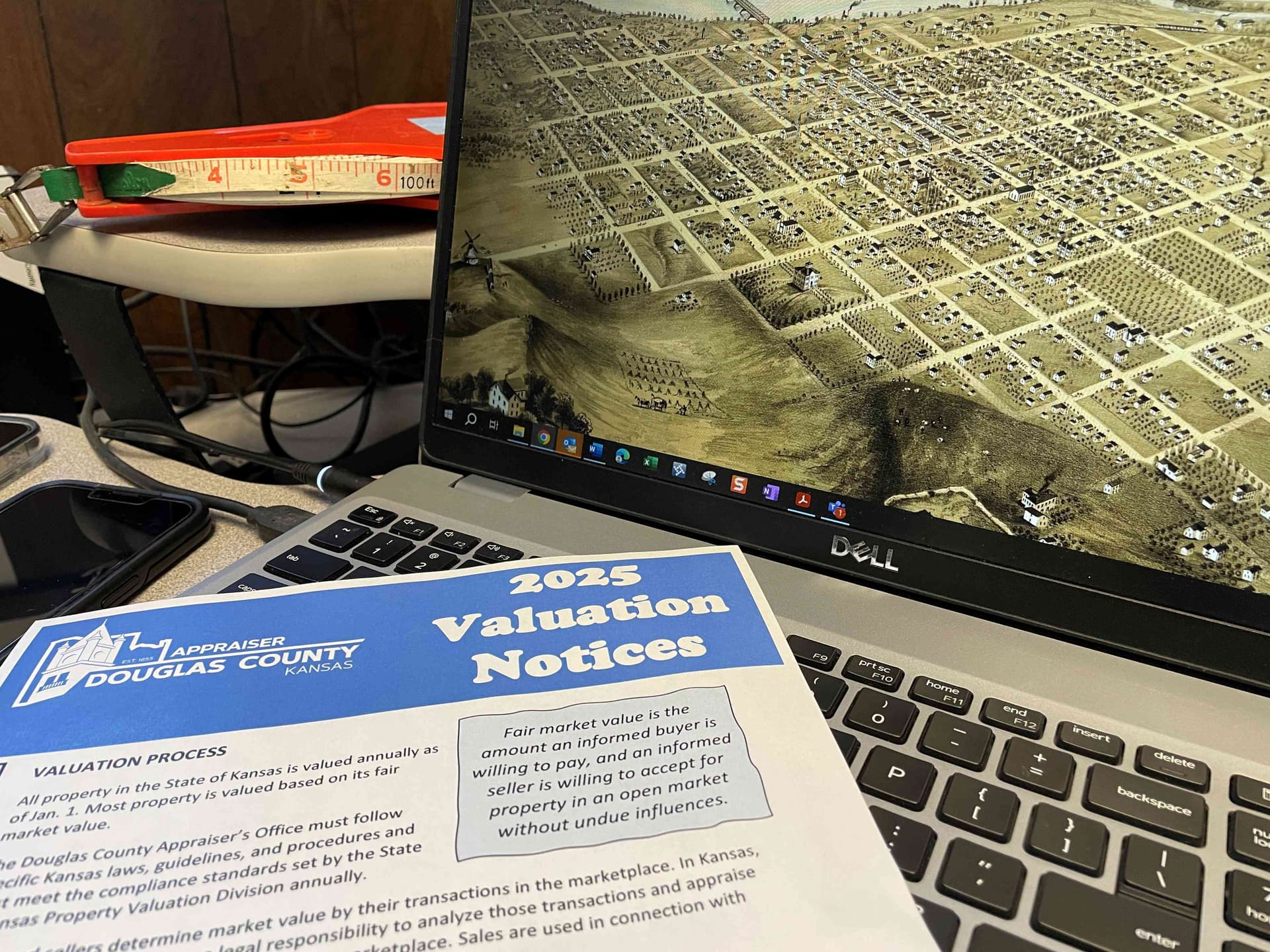
Douglas County mailed the 2025 Annual Notice of Value for real estate on Feb. 28, 2025, starting a short appeal window that can affect a home budget before any tax bill arrives. The appeal is about the county’s appraised value, while local taxing authorities later set budgets and mill levies that determine the tax bill.
What the county is actually valuing
Douglas County appraises real property as of January 1 each year, then typically mails Change of Value notices around March 1. Fair market value is the amount an informed buyer is willing to pay and an informed seller is willing to accept in an open market without undue influences. That matters in a county that mixes fast-changing Lawrence neighborhoods, established suburban areas and rural townships, where the right comparable sales are not always obvious.
Property taxes for most assets are ad valorem, meaning based on value. The valuation process is separate from the mill levy and property tax bill calculation, and once 2025 values were certified, the budget process began to establish the 2025 mill levies, Douglas County said in its July 25, 2025 appraisal newsletter. Lowering an appraisal can help, but it does not by itself change the tax rate chosen later by schools, cities, townships, counties and other taxing bodies.
The deadlines that control the appeal
Property owners have 30 days after the Change of Value notice is mailed to file an informal appeal, and all informal appeal results must be mailed by May 20. That makes the notice date itself the trigger, not the date the homeowner first opens the envelope.
The 2025 Annual Notice of Value added a Valuation History section showing the four most recent years of value, along with larger font sizes, updated taxpayer resources and an easier appeal form. Property owners need to fill out the request form on the notice to appeal their value, so the paperwork is built into the notice rather than buried elsewhere.
The county calendar works like this:
1. The property is valued on January 1.
2. Change of Value notices go out around March 1.
3. The informal appeal must be filed within 30 days of mailing.
4. Informal appeal results must be mailed by May 20.
In its June 30, 2025 appraisal newsletter, Douglas County said the county prepares and certifies the appraisal roll to the County Clerk each year by June 1. That helps explain why the appeal window closes before summer budgeting is finished.
What evidence actually helps
Useful evidence is market evidence, not frustration with the bill amount. Douglas County’s Property Value Appeals Board uses recently sold properties similar to yours in location, size and quality as a clear example of useful evidence. The county’s online appeal system also lets owners review current property data and compare parcels in the area, which makes the county’s own records part of the starting point.
For many homeowners, the most useful comparison is not a headline sale price from across town. It is a recent sale of a similar house in the same part of Lawrence, Eudora, Baldwin City, Lecompton or a nearby rural area, especially when the home’s size, condition and lot characteristics line up closely with the parcel being appealed. If the county’s value is far above what similar nearby properties have actually sold for, that is the kind of mismatch that can matter.
Who should consider appealing
Not every higher notice means a winning appeal, but some properties are more worth a close look than others. Homes with obvious mismatches between the county record and the real property, or parcels in areas where recent sales have shifted quickly, deserve the most attention. That is especially true in Lawrence, where market movement can be sharper than in more stable parts of the county, and in rural townships where comparable sales are thinner.
In February 2026, most Douglas County residential and commercial property owners would see valuation increases of 1% to 8%. A modest increase is not automatically wrong, but a jump that does not line up with recent neighborhood sales is worth checking against the county’s own data before the deadline runs out.
How Kansas appeal rules fit into Douglas County
Kansas gives taxpayers two opportunities to appeal property value. The spring filing is called an equalization appeal, and a later filing at tax payment time is a payment-under-protest appeal. Under the Kansas Department of Revenue’s appeal guide, the county appraiser bears the burden of proof for residential property appeals, which gives homeowners a concrete legal protection when they challenge a valuation.
Under the same state guidance, Kansas residential property is generally assessed at 11.5% of market value, so the county’s estimate of market value is the central dispute.
Why the process matters locally
Douglas County has tried to make the system more usable. Its 2025 notice redesign added larger type, updated taxpayer resources and a Valuation History section, and in February 2025 the county announced that the Appraiser’s Office would host information sessions. Brad Eldridge, the county appraiser, has also been the public face of recent valuation messaging, including a March 2025 appearance on KLWN to discuss property valuation.
This article was produced by Prism’s automated news system from verified source data, official records, and press releases, then run through automated quality and moderation checks before publishing. The system is built and supervised by the people who set the standards it runs under. Read our full AI policy.
Did this article answer your question?