Douglas County maps out who maintains roads, bridges and parks
Douglas County’s map shows which roads, bridges and parks are county-run and which belong to cities, townships or the state. Knowing the split can speed up fixes and cut office runaround.

A pothole, a downed sign or storm debris in a park does not all go to the same office in Douglas County. The county’s Public Works Department maintains 224 miles of county roads, 158 bridges, 1,100 culverts, Lone Star Lake and seven county park sites, but much of the rest of the local road network belongs to cities, townships or the state.
Who handles what
The first question on any road or bridge complaint is location. Roads inside the city limits of Lawrence, Baldwin City, Eudora and Lecompton are maintained by those cities, while township roads are handled by township officials. State roads and highways fall to the Kansas Department of Transportation, and the Kansas Turnpike Authority handles the turnpike system.
That means a broken pavement edge on a county road belongs to Douglas County Public Works, but the same problem one block later may belong to a city public works crew. The county’s road-maintenance map helps residents sort that out, although the county warns that the map data are provided “as is” and are not guaranteed for accuracy, timeliness or completeness.
- County roads, bridges, culverts, Lone Star Lake and county park sites: Douglas County Public Works.
- Design questions, entrance permits and work within road rights-of-way: the Engineering Division.
- Streets inside Lawrence, Baldwin City, Eudora and Lecompton: the city that owns the street.
- Township roads: township officials.
- State highways and turnpike lanes: KDOT or the Kansas Turnpike Authority.
For residents trying to decide where a complaint belongs, the split is straightforward:
What Public Works actually does
Douglas County Public Works is more than a patch crew. It handles road and bridge maintenance, road signage, roadside mowing and vegetation control, snow and ice removal, park maintenance and fleet maintenance. All of its crews help with snow and ice removal, storm and emergency response and rural drop-off recycling.
Its crews are organized by function: asphalt, bridge, engineering, fleet maintenance, parks and vegetation, rock road, sign and surveying. A washed-out shoulder, a bridge approach or a culvert issue does not go to the same part of the department as a park complaint at Lone Star Lake, even if the same trucks and staff end up working the scene.
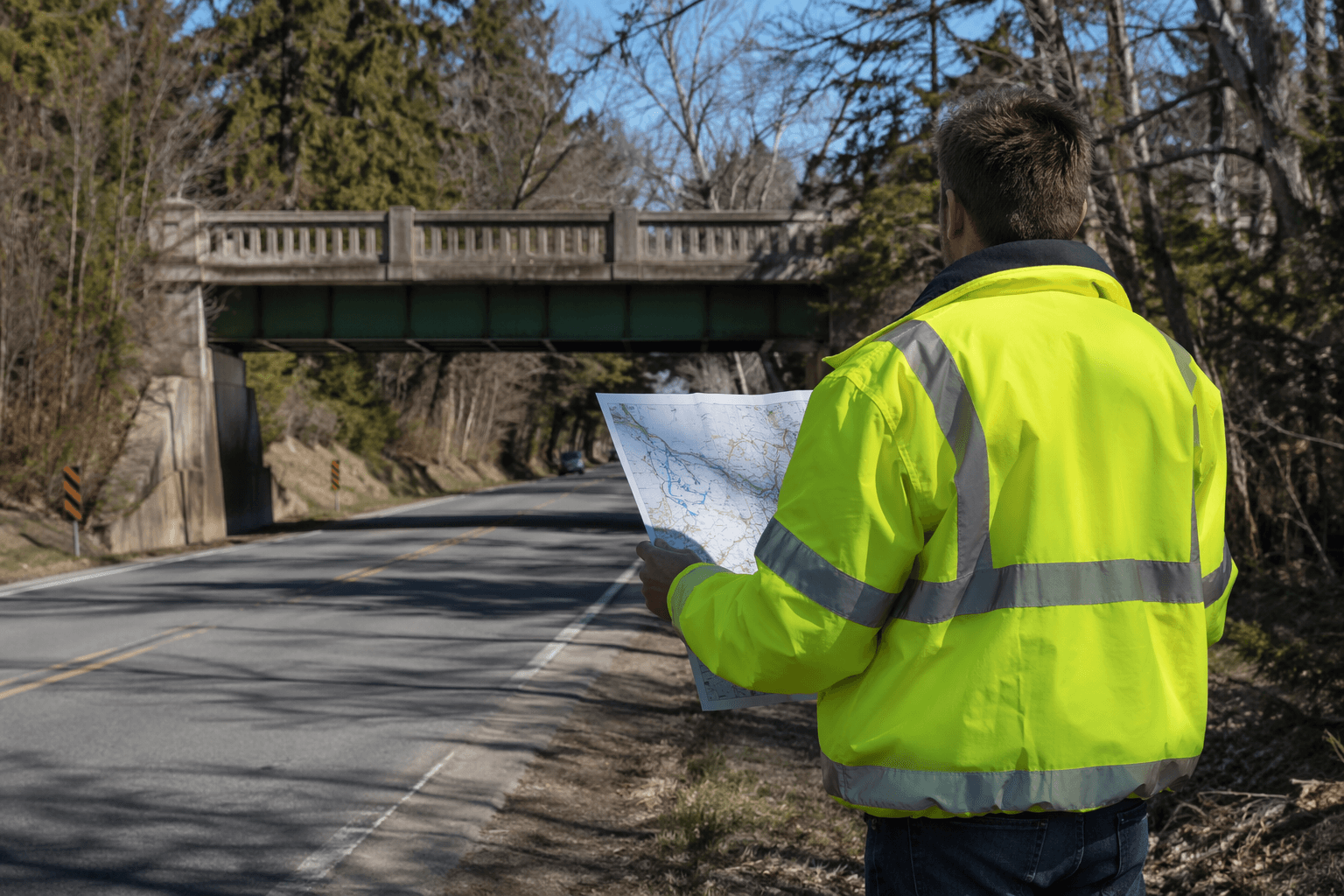
The Engineering Division is the part of county government that tends to matter when a problem involves paperwork as much as pavement. It handles design, surveying, construction contracting and inspection, along with permits for work within road rights-of-way. It also handles National Bridge Inventory compliance and state and federal funding.
County bridges carry their own inspection rhythm. All county bridges are in the National Bridge Inventory and are inspected every two years. Kansas Department of Transportation provides bridge inventory administrative assistance and inspection support to all counties in Kansas.
How county decisions and records work
When a road problem turns into a county-government problem, the County Administrator helps keep the system moving. The administrator is the chief executive officer responsible for implementing County Commission goals, preparing the budget, coordinating county operations with other local governments and agencies, and developing proposals to improve county operations. County code gives that office authority to organize county operations, subject to law and the supervision and discretion of the Board of County Commissioners.
Sarah Plinsky became county administrator in September 2019 after serving nine months as interim administrator. Before that, she served as assistant county administrator beginning in December 2010. Citizens with county-related problems may contact the administrator.
The Board of County Commissioners is the five-member elected body that sets county direction and serves four-year terms. Open-records requests should receive a response within three business days, though fees may apply.
Emergency response and storm season
Douglas County Emergency Management’s mission is to mitigate against, prepare for, respond to and recover from disasters. The office organizes that work around support systems, stakeholder readiness, community resilience and operations, and the county’s Emergency Operations Plan was completely updated in 2024 and approved by state and local officials. The plan is reviewed on a five-year cycle.
Emergency planning in Douglas County is shared across jurisdictions. The county’s mitigation plan was adopted by Douglas County and the cities of Eudora, Baldwin City and Lecompton. The county’s emergency-response structure also includes the Sheriff’s Office, the Emergency Communications Center, Emergency Management and three fire districts.
The Emergency Communications Center uses the Medical Priority Dispatch System and serves as the communications link between people needing emergency response and the agencies that answer. For non-emergency contact, the ECC lists 785-843-0250 and 785-832-7509.
Why the budget matters
Property taxes help fund roads, public safety, libraries and other local services, and each local government sets its own mill levy each year to fund the next year’s budget. The county collects property taxes on behalf of all taxing entities and distributes the revenue based on each entity’s mill levy.
Douglas County also launched Open Budget Douglas County as an interactive platform for residents and stakeholders to explore the annual operating budget. Bridge work, drainage fixes and park upkeep all compete with public safety and other county obligations.
In September 2024, KDOT awarded Douglas County $1.4 million through the Kansas Local Bridge Improvement Program to replace Bridge 1800-1124 on North 1800 Road, known as the Farmer’s Turnpike, northwest of Lawrence near Baldwin Creek.
This article was produced by Prism’s automated news system from verified source data, official records, and press releases, then run through automated quality and moderation checks before publishing. The system is built and supervised by the people who set the standards it runs under. Read our full AI policy.
Know something we missed? Have a correction or additional information?
Submit a Tip