Wells Overlook Park ties Douglas County views to Free-State history
Wells Overlook Park pairs a quick hilltop escape with a direct link to Free-State Kansas, where the Wells family story and county views meet at one 17-acre site.
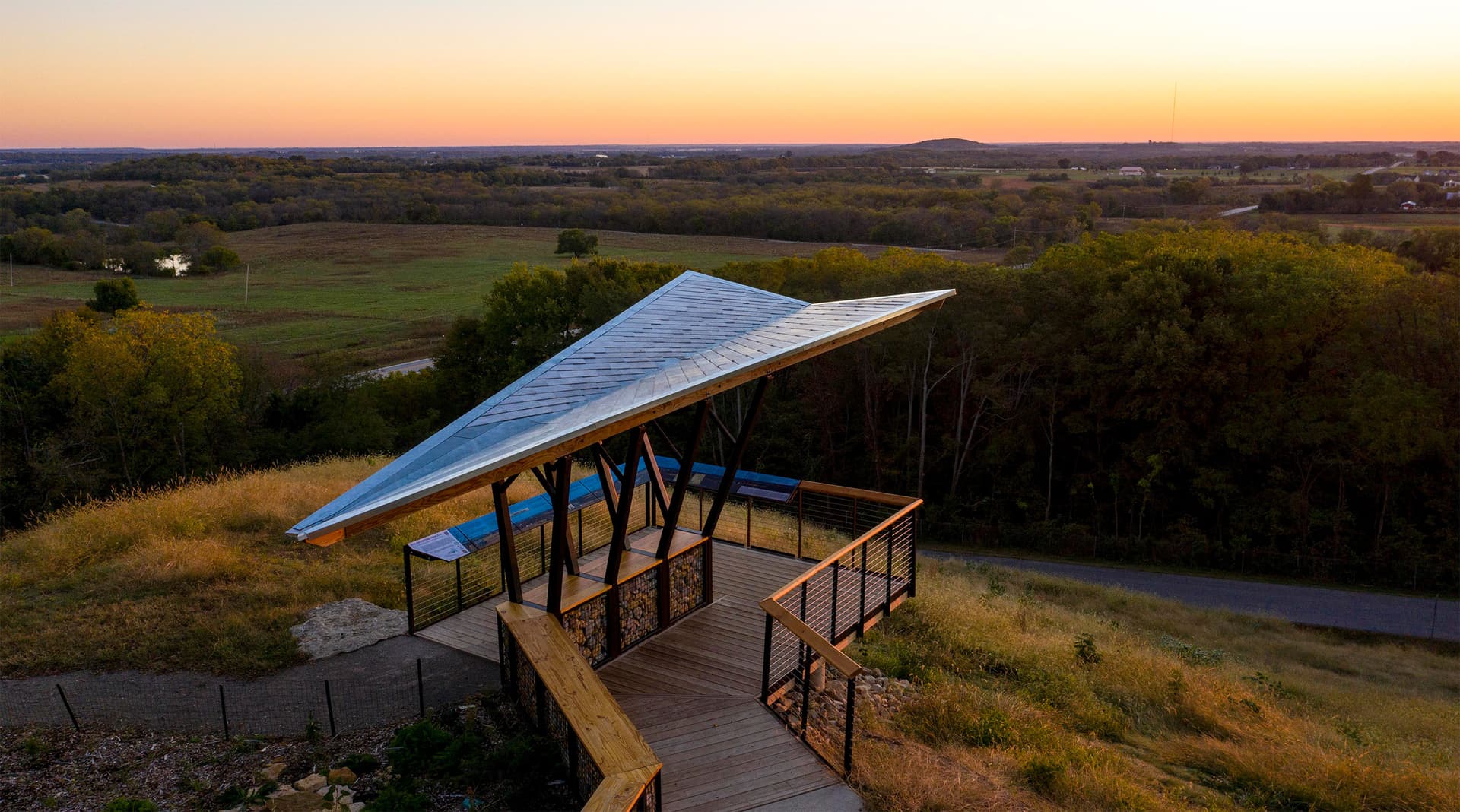
Wells Overlook Park gives Douglas County something rare: a short drive to a broad hilltop view that also carries the imprint of Kansas Territory history. The 17-acre park sits three miles south of Lawrence, opens at 6:00 a.m. and closes at 10:00 p.m., and was intended to preserve a natural setting for taking in the landscape. From the overlook, visitors can see the Wakarusa River Valley, Mount Oread, and the surrounding hills, valleys, and farmlands that make the county’s western edge feel both close to town and distinctly open.
A view that explains the county
The park’s main appeal is immediate. The original multi-story observation tower still gives visitors a higher perch, while the newer ADA-accessible viewing platform makes the same panorama easier to reach. That combination turns Wells Overlook into more than a roadside stop: it is one of the simplest ways to understand how Lawrence sits within the broader sweep of the Wakarusa Valley and the terrain around it.
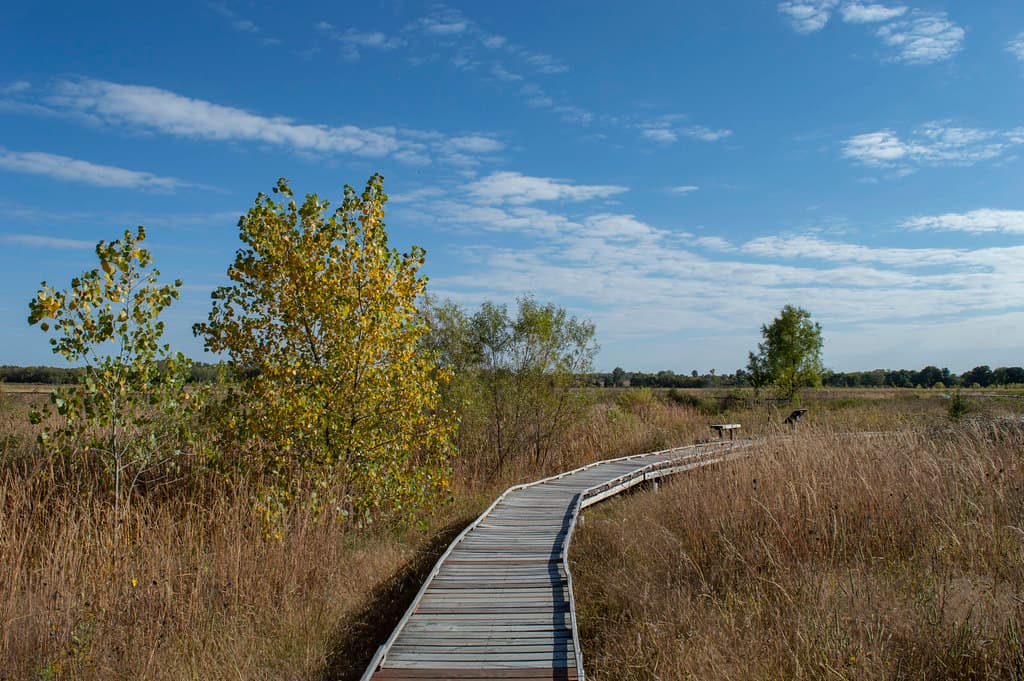
Douglas County has built the site around that experience rather than around heavy development. Alongside the tower and platform, the park includes prairie restoration, a quarter-mile nature trail, picnic areas, a second shelter, and the Polaris Pavilion, which provides wheelchair-accessible shelter and dining space. The result is a county park that works for a quick sunset visit, a longer family outing, or a low-key walk through restored prairie.
The Wells family story is part of the ground underfoot
The overlook’s historical value comes from the family that gave the land to Douglas County. County materials say the park was donated in 1971 by William Wells, and that the gift honored his parents and grandfather. Other county records identify the donor as William H. Wells, who gave the land in memory of William D. Wells and Charles W. Wells. However the family name is recorded, the lineage is the same: the site was preserved by a family that wanted its history tied to a public place.
That history reaches back to William Dougal Wells, who came to Kansas Territory in October 1854 as part of the New England Emigrant Aid Society’s third party. His arrival places the park squarely in the Free-State era, when antislavery settlers entered Kansas during the political struggle over whether the territory would enter the Union free or slave. Douglas County’s own heritage materials connect the Wells family to that larger story, and the park becomes a visible reminder that the Free-State era was not an abstract chapter confined to textbooks.
The broader organization behind that movement, the New England Emigrant Aid Company, was formed in 1854 after the Kansas-Nebraska Act to encourage antislavery settlement in Kansas Territory. That context matters here because Wells Overlook is not simply named for a donor family. It sits on land tied to one of the migration efforts that helped shape Kansas politics, settlement patterns, and the identity of Douglas County itself.
What the newer improvements add
The park’s most recent additions make the history easier to read and the landscape easier to use. The Passerine Pavilion, completed with Douglas County funding and a Land & Water Conservation Fund grant, was the centerpiece of a collaborative project that began in January 2020. The ADA viewing-platform work was backed by a $44,000 grant from the Kansas Department of Wildlife, Parks and Tourism that was described as covering 50 percent of eligible expenses up to $44,790.
The ribbon cutting for the Passerine Pavilion was held on October 14, 2021, at 5:30 p.m. The pavilion’s bird-inspired design fits the park’s prairie setting, and its wayside panels add three layers of context in one stop: historic, geological, and astronomical information. That makes the pavilion useful even for a short visit, since it gives families, school groups, and casual sightseers something to read while they are already looking out over the valley.
Ken Lassman, a Douglas County resident, spearheaded the Passerine Pavilion project. His role matters because it reflects how the park has continued to evolve through local initiative rather than through major commercial development. The site keeps its rural character, but it now has more ways for visitors to experience it comfortably and with context.
How to make the most of a visit
Wells Overlook works best as a flexible outing. A morning stop can catch the first light over the Wakarusa River Valley, while an evening visit gives a broad view of the county as the light changes over Mount Oread and the farmland beyond Lawrence. The park’s hours, from 6:00 a.m. to 10:00 p.m., leave plenty of room for both quick visits and slower walks.
- A climb to the original observation tower for a higher view
- A stop at the ADA-accessible viewing platform for an easier approach to the overlook
- A walk on the quarter-mile nature trail through the prairie restoration area
- Time at the Passerine Pavilion to read the historic, geological, and astronomical panels
- A picnic at one of the shelter areas, including the Polaris Pavilion
A simple visit can include:
Because the park is only three miles south of Lawrence, it fits easily into a day that otherwise stays close to town. Yet it gives back more than a standard park stop because the view is tied to the Free-State story, the Wells family donation, and the county’s effort to preserve a natural setting for public use.
Wells Overlook Park remains one of Douglas County’s clearest places to see how landscape and history occupy the same ground. The view stretches across the county, but the story embedded in the hilltop reaches all the way back to Kansas Territory and the families who helped define it.
This article was produced by Prism’s automated news system from verified source data, official records, and press releases, then run through automated quality and moderation checks before publishing. The system is built and supervised by the people who set the standards it runs under. Read our full AI policy.
Did this article answer your question?