Huntingburg Mayor Elkins Guides Residents on Reporting Train Blockages
Huntingburg Mayor Neil Elkins has issued step-by-step guidance telling residents to skip 911, use County Road 400W as an alternate route, and contact federal lawmakers to pressure Norfolk Southern for broader relief.

Residents who have been caught waiting at blocked railroad crossings in Huntingburg finally have a formal playbook from City Hall. Mayor Neil Elkins, speaking directly from his office, has released guidance addressing what he describes as an escalating problem: a recent surge in the frequency and length of Norfolk Southern train blockages that are cutting off streets and disrupting daily life across the city.
"Over the past several weeks, many of you have reached out to me about the increase in train blockages across Huntingburg," Elkins wrote in a statement published by the Dubois County Free Press. "I want you to know that I hear you, I share your frustration, and I am actively working to address these concerns."
Why the City's Hands Are Tied
The frustration driving residents to the mayor's door is compounded by a hard legal reality. Federal law limits what Huntingburg can do at the local level, and a Supreme Court decision from 2018 prevents the city from enacting ordinances or issuing fines related to blocked train crossings. That ruling traces directly to a Norfolk Southern challenge: the 2018 Indiana Supreme Court decision found that the 1995 Interstate Commerce Commission Termination Act preempted the state's 1865 law allowing governments to fine trains for stopping too long, and the 1995 act broadly prohibits states from enacting any law or rule that manages or governs rail transportation.
In short, the city cannot legally compel a train to move. Mayor Elkins has reached out to Norfolk Southern's Government Relations Department but, so far, has not received a response. This is not the first time Huntingburg has brought the issue to the railroad's attention. The Huntingburg City Council previously held a direct discussion with Norfolk Southern on the crossing blockage problem, a conversation that resulted in the railroad's regional vice president promising to take community concerns back to its transportation department, though no binding commitments emerged.
The mayor acknowledges the tension embedded in the city's history with the rails: "Rail transportation has always been an important part of our city's history and growth. However, the frequency and length of these blockages are creating real challenges for our residents, visitors, and local businesses."
What to Do When a Crossing Is Blocked
Mayor Elkins' guidance centers on three immediate, practical actions for anyone caught at a blocked crossing.
1. Do not call 911. The mayor's office is explicit: "Please do not call 911 to report train blockages." Emergency lines exist for life-threatening situations, and flooding 911 with crossing complaints diverts those resources.
If you want to escalate a blockage, the guidance directs you toward other channels described below.
2. Use alternate routes, particularly County Road 400W. The mayor specifically names 400W as an example of a detour worth taking.
County Road 400 West is among the established crossings in and near Huntingburg on the Norfolk Southern corridor, and city records confirm its use as an alternative path around the rail line. When a crossing on a main thoroughfare like U.S. 231 is blocked, swinging west to 400W can help drivers get where they need to go without sitting idle. The guidance frames this as a collective responsibility: use alternate routes "when possible."
3. Turn around safely and respectfully. If you arrive at a blocked crossing and an alternate route is not immediately viable, the mayor asks that you execute any U-turn or reversal with care for other drivers around you.
The exact language from his office: "If you need to turn around, do so safely and respectfully."
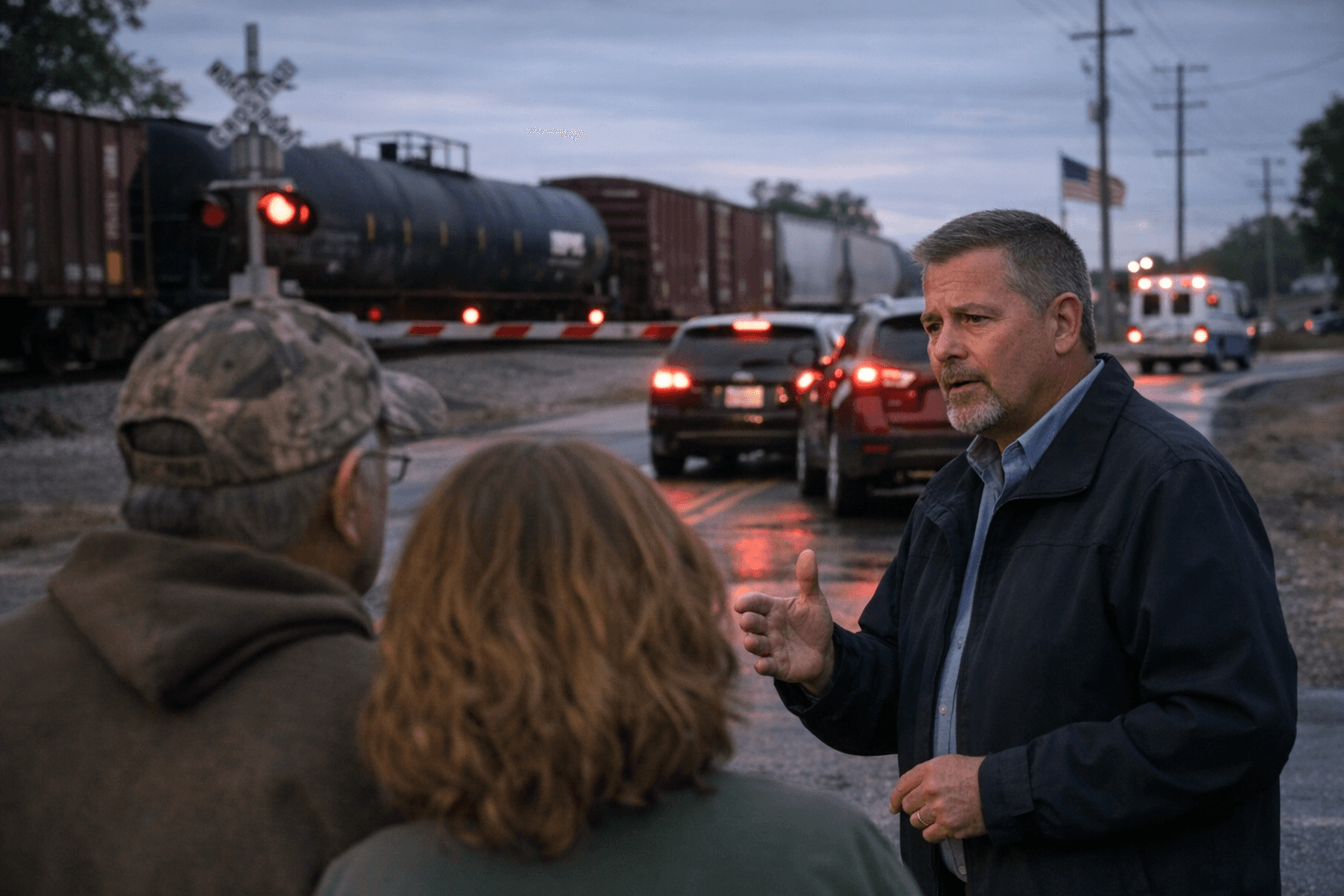
The blockages have caused traffic to back up on roads including U.S. 231, the main thoroughfare through the city, and have pushed vehicles, including large trucks, to seek alternate routes through neighborhoods not designed for that kind of traffic. Elkins' call for respectful and careful maneuvering reflects an awareness that frustrated drivers cutting through residential streets compound the disruption.
How to Report Blockages and Escalate Complaints
Beyond managing the immediate inconvenience at the crossing, Mayor Elkins is calling on Huntingburg residents to help build a documented record of the problem. One tool already established through prior city-railroad discussions is the blue placard system: each crossing has a blue placard with a code and number that can be called to report issues directly to Norfolk Southern or the Federal Railroad Administration. If you are stopped at a blocked crossing, look for this placard at the crossing itself and use the number listed to log your complaint with the appropriate federal or railroad channel.
The mayor's guidance also points toward a broader escalation strategy: contacting Indiana's federal representatives. "Another important step is reaching out to our federal representatives," Elkins wrote. "The more they hear from our community, the stronger our voice becomes." The three officials named in the mayor's guidance are:
- Senator Todd Young
- Senator Jim Banks
- Representative Mark Messmer
Mayor Elkins has already reached out to federal elected officials himself to advocate for action at the federal level. Constituent calls and messages to these offices reinforce that advocacy, making it harder for the issue to be deprioritized in Washington. Proposed federal legislation has included provisions that would make it easier for communities to access grant money to build bridges over or tunnels under routinely blocked railroad tracks, and would create a formal process for communities to report blocked crossings directly to railroad companies. Amplifying Huntingburg's voice in that national conversation starts with residents picking up the phone and calling Senator Young's, Senator Banks', and Representative Messmer's offices.
The Bigger Picture
The blocked crossing problem is not unique to Huntingburg; state senators from northern Indiana have reported hearing about similar traffic interruptions in their jurisdictions. Train lengths have been growing as a business model trend, with longer trains helping railroad companies maintain operational efficiencies, a trajectory the industry has indicated will likely continue. That structural reality means the pressure Huntingburg residents apply to their federal representatives carries genuine weight: local voices are part of a national conversation about whether and how Congress acts to give communities new tools.
Mayor Elkins closes his guidance with a call for solidarity that reflects how Huntingburg has historically handled its hardest problems: "Huntingburg has always been a community that comes together to solve problems, and this is no different. I truly appreciate your patience, your understanding, and your willingness to help be part of the solution. We are in this together, and I will continue doing everything I can to advocate for our community."
The path forward runs through federal offices and documented complaints, not 911 dispatch. Every call placed to Senator Young, Senator Banks, or Representative Messmer, and every blockage logged using the blue placard at the crossing, adds to the file that gives Huntingburg's elected advocates something concrete to act on in Washington.
This article was produced by Prism’s automated news system from verified source data, official records, and press releases, then run through automated quality and moderation checks before publishing. The system is built and supervised by the people who set the standards it runs under. Read our full AI policy.
Did this article answer your question?