Huntingburg moratorium on commercial solar faces legal hurdles, council told
City Attorney Phil Schneider told the Huntingburg City Council on Dec. 29, 2025, that the November moratorium aimed at pausing approval of the AES Crossvine solar project may be legally ineffective and could invite costly litigation. The dispute over timing, vested rights and battery storage safety exposes potential delays for a multimillion-dollar project and raises questions for residents about safety, land use and local control.

Huntingburg’s attempt to halt approval of the AES Crossvine commercial solar development through a November moratorium encountered serious legal doubts at a council meeting on Dec. 29, 2025. City Attorney Phil Schneider advised the council that Indiana case law treats moratoria as zoning ordinance amendments, meaning they require plan commission hearings and public notice before adoption, steps the city did not take.
“Unless we follow that procedure, any kind of a moratorium on approval and development plans is ineffective. It is not a valid ordinance or not a valid city action,” Schneider told the council, warning that the moratorium could be “an unlawful taking of their property without due process because you’re essentially depriving developers of the investment that they made in their development.”
The legal complications extend to Indiana’s vested rights statute, which Schneider said prevents municipalities from changing rules retroactively for at least three years after a proper application is filed. “Once an applicant files a petition for one of these types of permits or approvals, you can’t change the rules on them. You have to use the rules that were in place at the time they filed the application,” he said. Schneider acknowledged he had not been aware of the statute when he advised the moratorium.
AES Crossvine has signaled it will challenge the city’s position. The company reported it began construction in August 2023 after approval and said it invested $72 million in equipment and $230 million in lease acquisitions. Schneider noted that those investments strengthen AES’s legal footing. “They’ve got over $230 million invested in this,” he said. “They are not going to walk away from this. They’re not going to let the City of Huntingburg to tell them they can’t do what they want to do when they know we can’t prohibit it.”
The council directed the planning director to determine whether AES failed to meet permit timeframe requirements in Huntingburg’s extraterritorial jurisdiction and therefore must refile construction permits. If required to refile, the moratorium would effectively pause permitting until it is lifted or new procedures take effect. AES plans to appeal to the Board of Zoning Appeals on Jan. 2; Schneider explained that “If they did not reverse your decision, they (AES) would appeal to the circuit or superior court.”
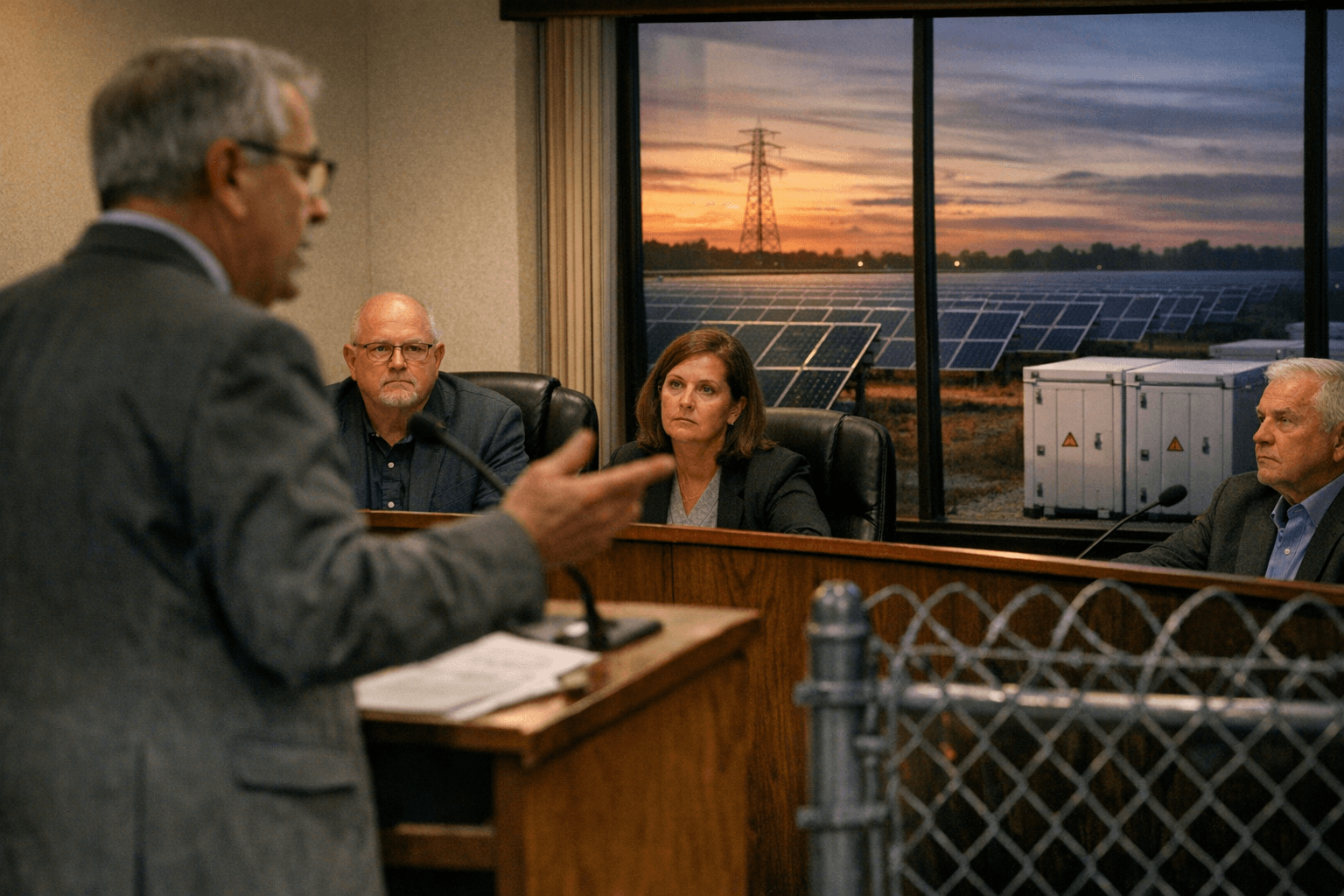
Residents and some council members raised safety and transparency concerns about the project’s Battery Energy Storage System, which lies outside the city’s extraterritorial jurisdiction and so would not be affected by the moratorium. Mechanical engineer Kevin Schnell warned of fire and contamination risks from lithium batteries, saying that battery fires “cannot be extinguished and will continue to burn without oxygen,” and that such incidents leave contaminants across wide areas. “It is essentially non-radioactive fallout. It’s a bunch of heavy metals that will get deposited over a very large area when one of these batteries goes up,” Schnell said. “Even something just the size of a car can contaminate, like, 10 miles away because of the plume of smoke.” He added that a large BESS “is a massive amount of chemical hazardous waster that has the potential to scatter itself uncontrollably.”
The council agreed to seek a second legal opinion before reversing the moratorium, in part because Schneider disclosed a potential conflict of interest from earlier representation of landowners. “Because that is an apparent conflict of interest that I have, I would encourage you to get a second opinion and not rely on my opinion,” he said.
Meanwhile the council passed a resolution to amend zoning rules so future commercial solar projects must obtain special exception permits from the Board of Zoning Appeals, a change that will require public hearings but cannot be applied retroactively to the AES Crossvine development. For Huntingburg residents, the outcome will determine whether a major regional energy project proceeds on the current timetable, whether local land leases and investments remain intact, and how the city balances renewable energy goals with safety and community input.
This article was produced by Prism’s automated news system from verified source data, official records, and press releases, then run through automated quality and moderation checks before publishing. The system is built and supervised by the people who set the standards it runs under. Read our full AI policy.
Did this article answer your question?