SpaceX Falcon 9 Launch Lights Up Fresno Skies With Starlink Satellites
A SpaceX Falcon 9 carrying 25 Starlink satellites lit up Fresno skies Monday night, leaving thousands of Central Valley residents stunned and reaching for their phones.
A glowing streak crossed the Central Valley sky at roughly 7:50 p.m. Monday, and thousands of Fresno-area residents who saw it had one immediate question: what was that?
The answer was a SpaceX Falcon 9 rocket, which lifted off from Space Launch Complex 4 East at Vandenberg Space Force Base near Lompoc and carried 25 Starlink V2 Mini satellites into low-Earth orbit. The launch, originally scheduled for Sunday evening, was delayed one day before proceeding April 6.
Timing made all the difference in visibility. The rocket lifted off just after sunset, meaning it had already cleared the horizon's shadow and was still catching direct sunlight at high altitude even as the ground below had gone dark. Clear skies across the Central Valley amplified the effect, sending a luminous plume sweeping across a broad swath of Fresno and surrounding counties.
About two and a half minutes after liftoff, the Falcon 9's first and second stages separated. The second stage continued carrying the satellite payload toward orbit while the first stage turned back toward Earth, ultimately landing on a drone ship off the coast of Baja California, Mexico. The staged separation and the sequential deployment of 25 satellites produced the distinctive train of lights that flooded local social media feeds with photos and video.
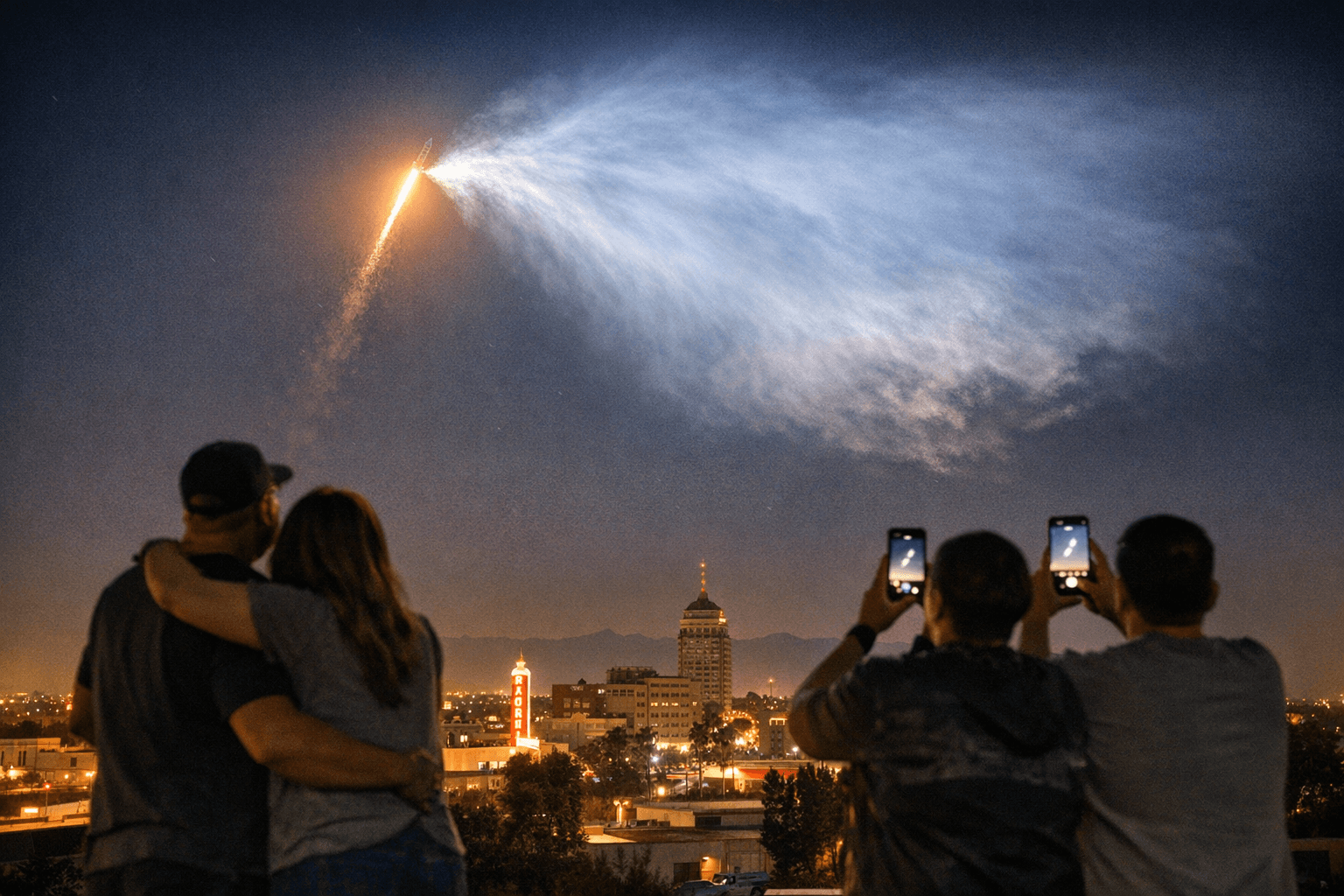
Social-media posts and tips to local news outlets poured in from residents who described the sight as bright and disorienting. Many initially feared an explosion or some kind of aerial emergency before amateur astronomers in comment threads identified the familiar signature of a Starlink launch.
SpaceX launches from Vandenberg roughly once a week, but the combination of timing, clear skies, and viewing angle made this one stand out. The Starlink constellation now numbers in the thousands of satellites, orbiting at roughly 550 kilometers altitude to deliver broadband internet capable of supporting video streaming, gaming, and calls in areas with limited ground infrastructure.
For anyone hoping to catch a future launch, SpaceX posts upcoming launch windows and viewing maps publicly. Given Vandenberg's cadence, the Central Valley will almost certainly get another light show before long.
This article was produced by Prism’s automated news system from verified source data, official records, and press releases, then run through automated quality and moderation checks before publishing. The system is built and supervised by the people who set the standards it runs under. Read our full AI policy.
Did this article answer your question?


