The research notes appear to be cut off before providing enough detail to write an accurate headline. Could you please share the complete research notes so I can craft a proper headline about the Valley Link Transmission project?
A proposed $1 billion, 100-mile transmission line could carve a 200-foot corridor through Goochland and eight other Central Virginia counties, displacing 2,500 acres of forest and farmland.
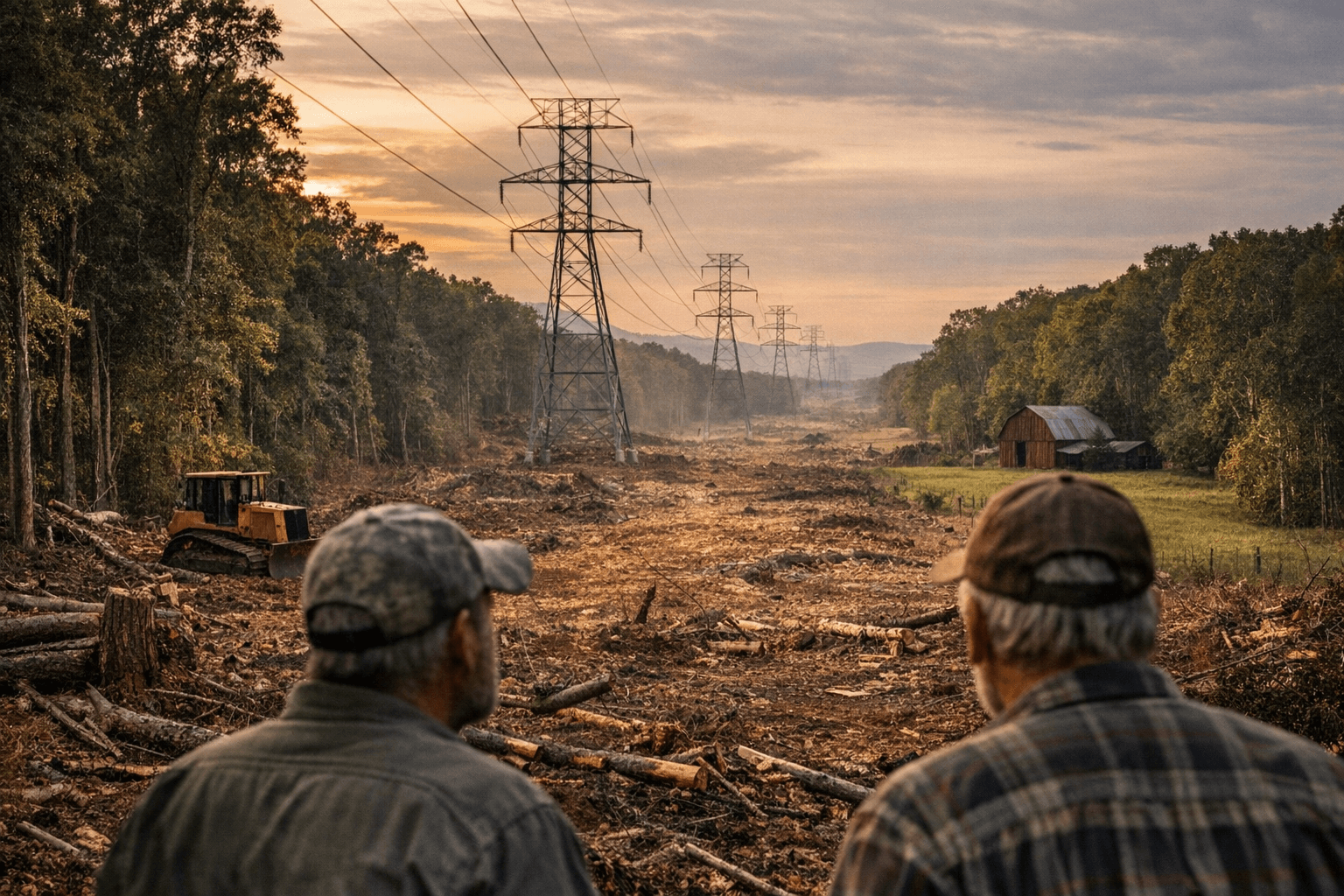
A roughly $1 billion transmission line proposal is cutting across Central Virginia's rural landscape, and Goochland County sits squarely in the crosshairs of one possible route. Valley Link Transmission wants to build more than 100 miles of new 765-kilovolt power lines stretching from Campbell County toward Spotsylvania County, threading through as many as nine counties and potentially affecting some 450,000 Virginians. The company has already mailed notification letters to approximately 120,000 residents and businesses whose addresses fall within one mile of the proposed corridors, signaling the project has moved well beyond the conceptual stage.
What Valley Link Is Proposing
The line would operate at 765 kilovolts, the highest-voltage transmission standard used anywhere in the United States. For comparison, 500 kV lines are currently the highest voltage Dominion Energy operates in Virginia; a 765 kV line can move up to 3,500 megawatts of power over long distances, roughly three times the capacity of a 500 kV line covering the same distance. That raw capacity is central to Valley Link's argument for the project: Virginia officials project the state will need significantly more electricity by 2035 as demand continues to climb.
The physical footprint of that capacity is substantial. The project would require clearing a 200-foot corridor along the entire route, much of it running through forested and agricultural land. Mike Barber, Senior Energy Infrastructure Policy Analyst at the Piedmont Environmental Council, estimates that if the line is built, "over 2,500 acres of land that is currently forested, farmed, providing valuable habitat and contributing to the rural economy and character of the region would be cleared and converted to utility right-of-way."
Where the Lines Would Run
Two distinct preliminary and conceptual route corridors are currently under consideration, each with several smaller variations. Regardless of which main route is ultimately selected, the transmission line would run through Appomattox, Buckingham, Fluvanna, Louisa, and Orange counties, as well as Culpeper and Campbell counties. Depending on which route is chosen, the path may also include parts of Goochland and Spotsylvania counties, making this a live concern for Goochland property owners and local officials.
In Louisa County, the orange route corridor has been described in detail. That alignment would cross I-64 near the Ferncliff area, one of the county's recognized growth zones. From there, the line would stay west of Courthouse Road, co-locate with the existing Belcher Solar facility and a substation west of the Town of Louisa, continue north across undeveloped tracts, and eventually reach a junction where both primary proposed routes converge.
What It Means for Landowners
Valley Link says it is seeking voluntary easements from landowners and would compensate property owners at fair market value. The company has framed its outreach as relationship-building rather than compulsory acquisition, but the scale of the notification campaign, letters to 120,000 addresses within one mile of the proposed lines, has unsettled many of the recipients.
Louisa District resident Melissa Young put the financial anxiety plainly: "I wouldn't buy a home if the line was already there. Why would I expect someone to purchase mine later?" Her concern about home marketability reflects a worry shared widely along the potential corridors, where property values, agricultural livelihoods, and long-term land management plans all hang on a routing decision that won't be finalized for months.
The Case for the Project
Valley Link Transmission spokesperson Scott Blake has defended the project's necessity and its potential economic logic. "With this line we'll be able to deliver more reliable power to the area, not just for data centers but to realistically enable growth throughout the region," Blake told WSET. He has acknowledged that rate impacts remain uncertain but offered a conditional optimism: "The direct impact on customer rates is too early to tell. What we can say is: as more usage comes onto the system, it can help diminish everyone's cost."
The data center dimension of that framing has drawn pointed scrutiny locally. At a Louisa Board of Supervisors meeting, Louisa District resident Adam Combs alleged that the board hadn't "looked at the data," specifically citing the Amazon Web Services North Creek Technology Campus off Route 33 and the scale of energy that facility would require to operate. Combs also thanked Green Springs District Supervisor Rachel Jones for attending an informal community meeting held March 1 at Southern Revere Cellars, where Jones later said residents were "rightfully" filled with "passion, fear, and anger" over the project.
Community Response
The emotional temperature has been high at every public gathering on the subject. Nearly 300 people packed a community meeting in Appomattox County seeking answers about the proposed line. In Louisa, Mineral District residents Robin Horne and Colby Horne joined Louisa District resident Jerl Purcell in voicing objections; Purcell said he understands the case for a reliable electric grid but is troubled by routing the line through "actively managed forestland."
Tammy Purcell of Engage Louisa reported that at a recent Louisa Board of Supervisors meeting, residents and supervisors alike raised concerns touching on land preservation, the proximity of the corridor to local schools, and potential health impacts.
Environmental and Regulatory Concerns
The Piedmont Environmental Council has raised a procedural alarm that goes beyond the local land impacts. Despite the project's scale, crossing nine counties and affecting nearly half a million Virginians, Dominion Energy and its partners do not anticipate that the project will require any substantive federal-level review for environmental, cultural, or historic resources. The council has called that expectation "deeply concerning."
Valley Link plans to file with Virginia's State Corporation Commission for route approval by the summer of 2026, with installation and energization of the line targeted for the end of 2029. The SCC will have the final say on whether the project proceeds and which route it follows.
What Comes Next
Valley Link has committed to additional community meetings before it submits a final route proposal to the SCC. For Goochland residents whose properties sit within a mile of either proposed corridor, the window to engage is now: Valley Link's project map features a GeoVoice commenting system that allows residents to submit concerns directly to the company before a route is locked in.
The stakes are real and the timeline is moving. A summer 2026 SCC filing leaves limited runway for the communities along the proposed corridors to shape what gets built, where it gets built, and under what conditions landowners are compensated. For a county that has worked carefully to balance growth pressure with its rural identity, the Valley Link proposal represents exactly the kind of consequential infrastructure decision that rewards early, informed participation.
Know something we missed? Have a correction or additional information?
Submit a Tip