Lay Park marks the legacy of Traverse City's namesake founder
Lay Park is a small Old Town stop with a big clue to Traverse City's name, linking Albert T. Lay's 1853 postal pitch to the Boardman River landscape.
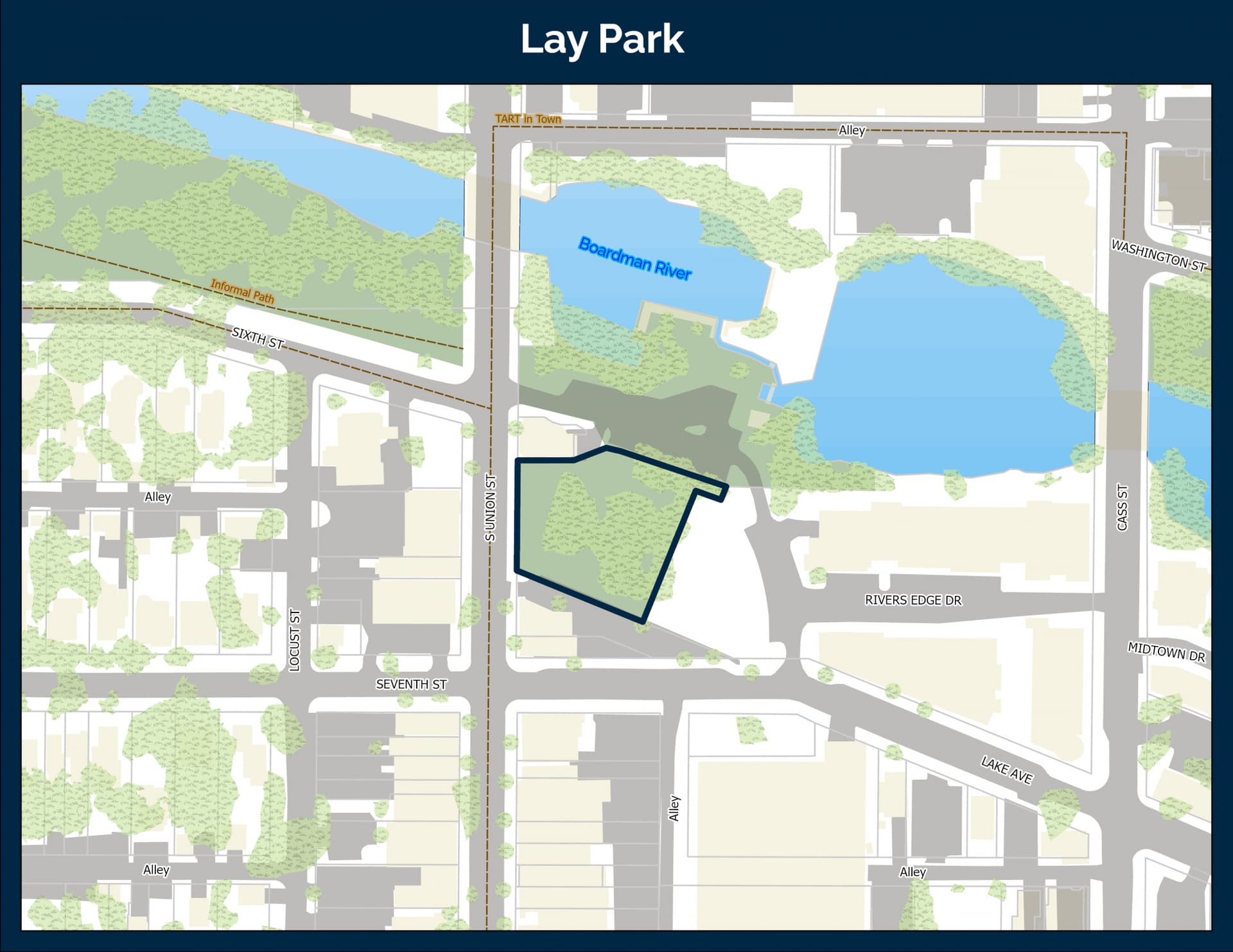
Lay Park is easy to miss and hard to understand without the backstory. Tucked in the center of the Old Town District near the Boardman River, the small park points directly to the man behind Traverse City's name, Albert T. Lay, and to the landscape that made the city possible.
A small park with a large civic clue
If you stand in Lay Park, you are standing in one of the clearest place-markers in downtown Traverse City’s identity. The City of Traverse City says the park sits in the center of Old Town, near the Boardman River, which makes it a useful starting point for reading the city’s original geography instead of just its street names.
That location matters because this is not a decorative pocket park detached from the city’s past. It sits in the historic core, where the river, the old neighborhood pattern, and the city’s naming story meet in one compact space. For a walk through Old Town, Lay Park works like a caption under the landscape: it tells you who mattered, where the settlement grew, and why the city’s name settled into its final form.
How Traverse City got its name
The park takes its name from Albert T. Lay, the man credited with naming Traverse City. The city says Lay was seeking a postal route in 1853 when he proposed the name Grand Traverse to officials in Washington, D.C. The word Grand was removed, leaving Traverse City, and City was added later.
That detail turns a dry administrative request into a founding moment. A postal route was not just a mail matter in 1853, it was a signal that the settlement needed recognition, organization, and a fixed identity. Lay’s naming proposal helped give the community a permanent label at the same time it was still taking shape.
Local historical writing places Lay even more firmly at the center of that origin story. A historical biography source says that in 1853, with help from a civil engineer named Wlielpley, Lay laid out the town of Traverse City and became the “virtual founder” of the municipality. Grand Traverse Journal similarly treats Lay as a central figure in the city’s founding history, which is why the park that bears his name functions as more than a memorial plaque in green space.
What the landscape still reflects
Traverse City developed first as a lumber town, and that older economy still explains why the city sits where it does. The city lies at the mouth of the Boardman River on the east and west arms of Grand Traverse Bay, a setting that tied the settlement to water, shipping, and the movement of goods long before the modern downtown took shape. The Boardman River was formerly known as the Ottawa River, another reminder that the region’s geography carried more than one name before Traverse City settled on its own.
A local history source says the Boardman River watershed drains about 295 square miles through roughly 130 miles of river and tributaries. That scale helps explain why the river corridor remains such a powerful organizing feature in the city: it is not a narrow scenic creek, but a drainage network that helped shape settlement, commerce, and later planning decisions.
The old transport pattern still shows up in the way the city connects its public spaces. Early growth depended on water transportation and later railroads, so today’s walk through Old Town still traces the logic of access and connection that defined the settlement from the beginning. In that sense, Lay Park is not just near the river. It sits inside the same physical system that made the city legible in the first place.
A walking guide to the historic core
Lay Park works best as the opening stop for a short walk that connects naming history to visible geography. The park is in the Old Town District, and the surrounding street pattern still reflects a compact downtown that grew out of an earlier settlement footprint rather than a sprawling modern subdivision. If you want the city’s origin story in one route, this is where to start.
A few things to notice on the ground:
- The park’s placement in Old Town ties it to the city’s earliest civic geography rather than a newer residential edge.
- Its proximity to the Boardman River makes the relationship between downtown and water easy to see, even before you reach the river itself.
- The 18-block Boardman neighborhood is connected by sidewalks to Lay Park and Hannah Park, which turns the area into a readable historic network instead of an isolated landmark.
- The nearby river corridor has also been part of modern planning. A 2022 conceptual design for the Boardman-Ottaway Downtown Riverfront proposed two new pedestrian bridges and a more naturalized riverbank, showing that the Boardman remains central to how Traverse City imagines public space.
That last point matters because it connects the city’s oldest story to its newest planning. The same river that helped define the lumber town and the postal-era naming decision is still shaping how residents move through downtown and how planners think about access, habitat, and the public realm.
Why this small park matters now
Lay Park gives Traverse City something many cities lose over time: a place where the name, the geography, and the founding story still line up in one walkable setting. It anchors the story of Albert T. Lay, but it also points outward to Perry Hannah and the other figures tied to the city’s early development, to the Boardman River corridor, and to the old industrial geography that began at the mouth of the river.
That is why the park matters beyond local history. It helps explain why Traverse City is called what it is, why the downtown sits where it does, and why the river still sits at the center of civic planning. On a simple walk through Old Town, Lay Park turns the city’s origin story into something you can see, not just read about.
This article was produced by Prism’s automated news system from verified source data, official records, and press releases, then run through automated quality and moderation checks before publishing. The system is built and supervised by the people who set the standards it runs under. Read our full AI policy.
Did this article answer your question?