Traverse City officer honored for homeless outreach and mental health work
Traverse City police Officer Krista Fryczynski helped enroll more than 20 people in withdrawal treatment this year, a sign of the city’s growing outreach model.
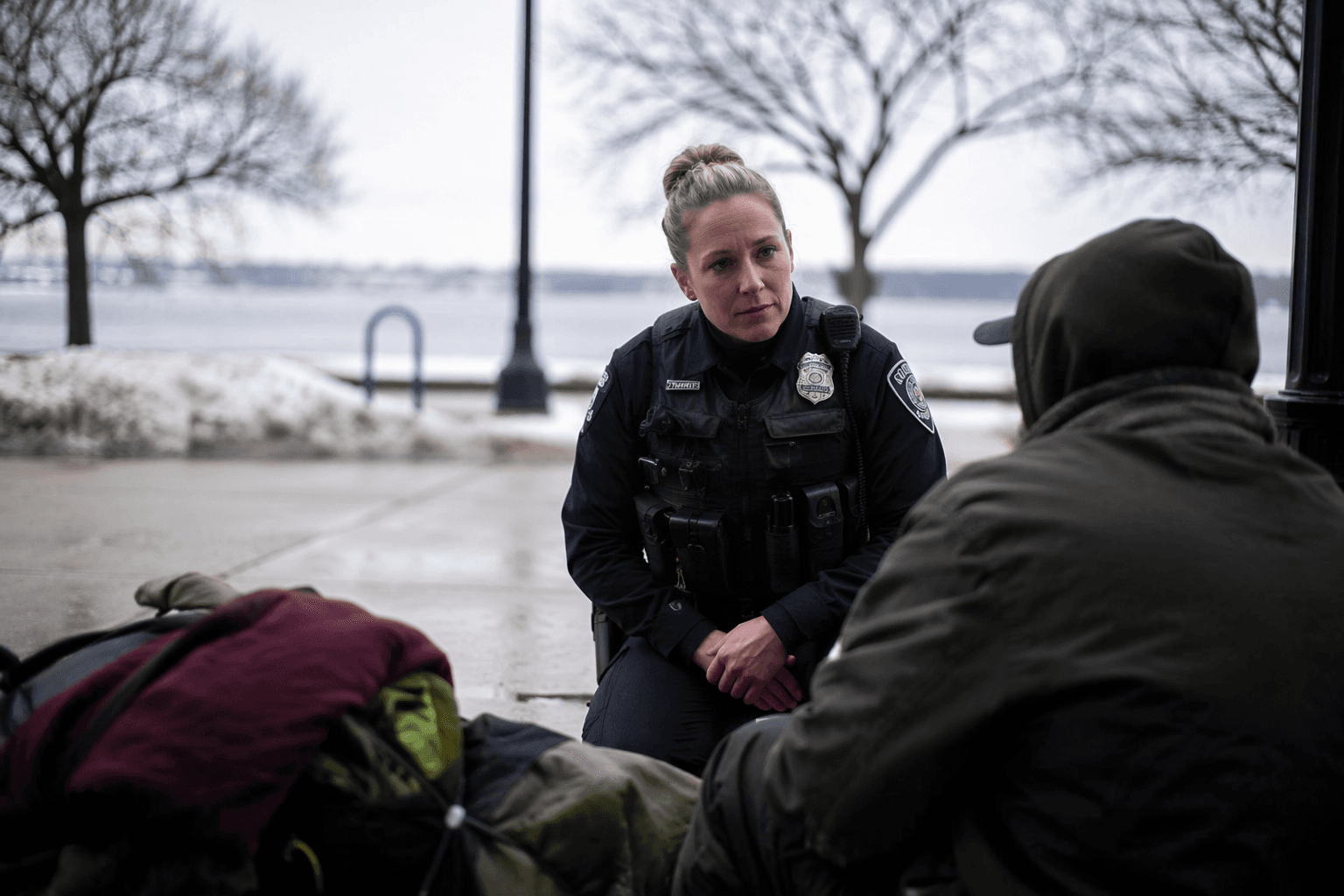
Traverse City police Officer Krista Fryczynski was honored Thursday morning with the NAMI Michigan 2025 Law Enforcement Officer of the Year Award, but the recognition pointed to a bigger shift in how the city handles homelessness and mental illness. Fryczynski, who serves as the North Boardman neighborhood community affairs officer and the department’s LGBTQ+ liaison, helped enroll more than 20 people into withdrawal treatment programs in 2025.
Kate Dahlstrom of NAMI Grand Traverse presented the award during a TCPD Resilience Program meeting on July 3. The honor is reserved for officers who show commitment to awareness, training and understanding for people living with mental illness and substance use disorder, and Fryczynski’s work has become one of the clearest examples of that approach in Traverse City.
Her job is built around repetition, trust and follow-through. Dahlstrom said Fryczynski is present at the homeless shelter every day, knows people staying there and many who are unsheltered in the community, and keeps working with them over time. Jennifer Holm, the police social worker coordinator who developed and now facilitates the RESILIENCE Program, has framed that kind of outreach as difficult but essential, while Chief Matthew Richmond has described Fryczynski as a major part of the department’s effort to help people get healthy and get the help they deserve.
The award also spotlights the city’s broader RESILIENCE Program, an interdisciplinary network of more than 60 community partner agencies. City materials say the program is designed to reduce law-enforcement calls on vulnerable people by interrupting the cycle of arrest and addiction through care coordination and fewer barriers to service. It is voluntary and open to Traverse City residents who are in crises tied to at least two of these issues: substance use, mental health, homelessness or a recent overdose.
The partner network reaches far beyond police work alone. Agencies involved include Addiction Treatment Services, Grace Episcopal Church’s Jubilee House, Goodwill Northern Michigan, Munson Family Practice, Northern Lakes Community Mental Health and Jail Diversion, Northwest Michigan Community Action Agency, Northwest Michigan Supportive Housing, Safe Harbor and Traverse Health Clinic. The city has also tied the program to overdose response, naloxone tracking and referral tools that connect officers to treatment and housing providers instead of cycling the same people through jail and the emergency room.
The program has expanded quickly. A city update on March 1, 2024 said the earlier Quick Response Team had built relationships with 42 community partners, and a February 2026 report said the team was rebranded as RESILIENCE because some participants were confused by the old name. Local reporting also said a University of Michigan study in 2024 found a significant reduction in negative law-enforcement contacts for participants.
Fryczynski’s role reaches beyond homelessness outreach. The city says her work as the LGBTQ+ liaison is meant to build mutual trust and serve as a point of contact for both community members and officers. In a region where the Northwest Michigan Coalition to End Homelessness counted 251 people living without shelter in June 2025 and statewide HUD data showed 9,739 unsheltered people in Michigan, the award underscored a policing model built less on enforcement alone and more on sustained coordination with social services.
This article was produced by Prism’s automated news system from verified source data, official records, and press releases, then run through automated quality and moderation checks before publishing. The system is built and supervised by the people who set the standards it runs under. Read our full AI policy.
Did this article answer your question?