Greensboro businesses The Art Shop and Schiffman’s endure for more than a century
The Art Shop and Schiffman’s Jewelers survived by changing just enough to keep their identity. Their century-plus run offers a clear playbook for Greensboro businesses still trying to outlast the market.
In a downtown market where chains, online shopping, and changing tastes can erase a business in a few seasons, The Art Shop and Schiffman’s Jewelers have done something much rarer: they turned longevity into a competitive advantage. One began in 1899 as the only art store of its kind in Greensboro; the other opened in 1893 after a German watchmaker spotted a jewelry shop for sale between train rides on Elm Street. More than a century later, both are still part of Greensboro’s commercial identity, and both show how a local business can survive by adapting without losing its roots.
A Greensboro story that predates Greensboro’s modern economy
The setting matters. Guilford County was established in 1771, long before Greensboro was founded in 1808, and the city is now North Carolina’s third-largest. That longer arc helps explain why businesses like The Art Shop and Schiffman’s matter beyond nostalgia. Greensboro grew through layers of settlement, trade, manufacturing, and transportation, shaped early by Scotch-Irish, Quaker, and German influences, and those same local networks still show up in the city’s most durable family firms.
In the early 1890s, Schiffman’s says Greensboro was emerging as an important Southern textile center and transportation hub. That combination made downtown foot traffic valuable, and it gave a jeweler enough recurring demand to build something lasting. The city has changed dramatically since then, but the lesson has not: a business survives when it is anchored in a place people already move through, trust, and return to.
The Art Shop’s survival plan: change the offering, keep the name
The Art Shop began in 1899, when N.D. Andrews bought an art store in Greensboro and gave it a name that fit the era. It was the only shop of its kind in town, which meant the business was not just selling goods, it was defining a category for local customers. That kind of first-mover position can be powerful, but the real test comes when the market catches up.
The store’s next major turn came in 1923, when Charles Farrell bought it and gave it deeper ties to Greensboro’s visual life. Farrell was not only a shop owner, but also an avid photographer and the first staff photographer for a Greensboro newspaper. He is also believed to have captured the image used for the Camel cigarette brand, and the shop is believed to have hosted the first amateur photography club in North Carolina during the 1930s. Those details matter because they show The Art Shop was never just a retail counter; it was part of the city’s creative infrastructure.
By 1963, the business had shifted toward framing while keeping its original name. In the 1990s, Andy McAfee pushed the operation further into art curation, sales, and online outreach, including a website built to connect with international clients. Today, The Art Shop still buys and sells art from around the world while handling both large and small framing projects, a mix that helps it serve collectors, homeowners, designers, and anyone looking for a frame shop that can still answer a local need.
McAfee has said the business survived wars, recessions, and COVID, and that survival points to a practical formula. The shop did not freeze itself in time. It kept the brand, but evolved the service line as customer habits changed.
The archive behind the storefront
The Art Shop’s staying power is visible not only in the business itself, but in the historical record surrounding it. Greensboro History Museum archives say the Farrell family also operated the Book Shop in Greensboro, and that Charles and Anne McKaughan Farrell photographed people and places in Greensboro and throughout North Carolina from the mid-1920s through the mid-1940s. The museum’s holdings include an Art Shop Photograph Collection with several thousand Farrell images, and additional Farrell material is preserved at the North Carolina State Archives and the University of North Carolina at Chapel Hill.
That archive gives the store a significance that goes beyond retail. It links a downtown business to the city’s visual memory, from commercial work to documentary photography to the everyday life of the region. FOX8 WGHP also noted that Farrell took the cover photo for the children’s book Tobe, a reminder that local commercial businesses can quietly shape broader culture as well as local commerce.
Schiffman’s and the power of family continuity
If The Art Shop shows how a business can evolve, Schiffman’s Jewelers shows what continuity can do. Simon Schiffman came to Greensboro in 1893, saw a jewelry shop for sale on Elm Street while traveling between trains, and bought it on the spot. The first location opened at 306 Elm Street in downtown Greensboro, and the company says Elm Street has been home ever since.
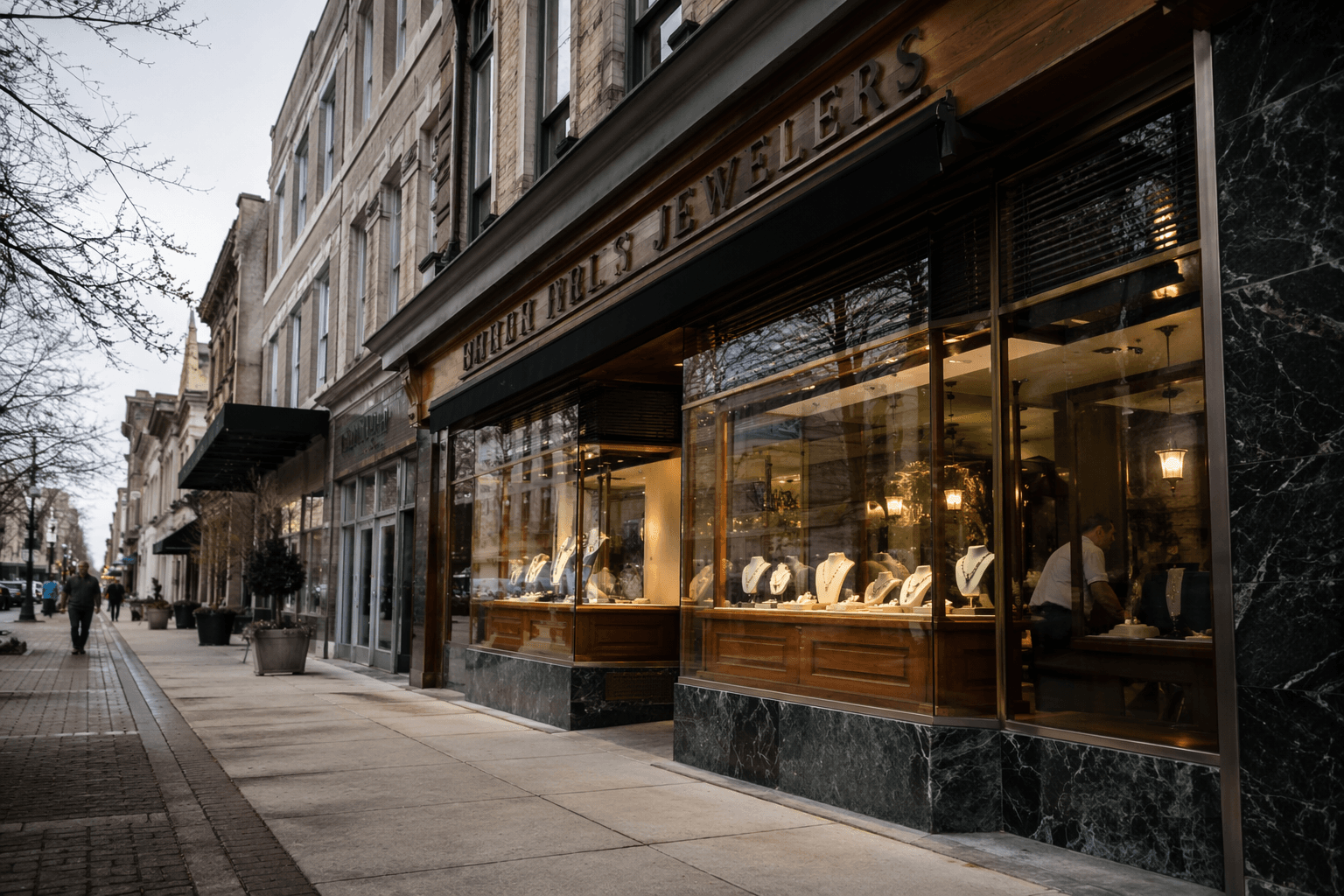
That kind of origin story says a lot about the economy of the time and the instinct of the founder. He recognized a business opportunity in a city that was growing because of manufacturing and transportation, and he moved quickly. More than a century later, Schiffman’s says it remains in fifth-generation family ownership, a rare feat in any retail category and especially in jewelry, where customer trust, inherited taste, and repeat service are central to the model.
Today, Schiffman’s says it operates three stores across Greensboro, Winston-Salem, and Lexington, Kentucky, while keeping its downtown Greensboro headquarters at 225 South Elm Street. That footprint suggests a business that has expanded carefully, rather than abandoning its core market. The downtown address is still a symbol of identity, but the additional locations show the company has adapted to a broader regional customer base.
What today’s small-business owners can learn
The survival playbook from these two Greensboro institutions is not complicated, but it is demanding. Both businesses show that longevity comes from a mix of local trust, timely reinvention, and a clear sense of what should never change.
For small-business owners in Guilford County, the lessons are practical:
- Keep the core identity recognizable, even when the product mix changes.
- Use local history as an asset, not a museum piece.
- Build relationships that survive generational turnover.
- Treat archives, photographs, and community memory as part of the brand.
- Expand only when the original customer base is still being served well.
The broader economic question is whether age still confers an edge in Guilford County’s current market. In an era when national chains can standardize prices and e-commerce can flatten geography, a century-old name still carries weight. It signals stability, and in categories like framing, jewelry, and art, stability is often part of what people are buying.
The Art Shop and Schiffman’s are not surviving because Greensboro stayed still. They survived because they moved with the city while remaining visibly tied to it. In a county where new development often gets the headlines, these two institutions show that some of the strongest economic assets are the businesses that have already learned how to endure.
This article was produced by Prism’s automated news system from verified source data, official records, and press releases, then run through automated quality and moderation checks before publishing. The system is built and supervised by the people who set the standards it runs under. Read our full AI policy.
Did this article answer your question?