Animas markers trace Mormon Battalion, smugglers and outlaw trails
Three Animas markers turn one Hidalgo County corridor into a map of Mormon Battalion travel, smugglers and the Clanton Gang.

Three historical markers in Animas turn one stretch of Hidalgo County into a landscape of military crossing, contraband routes and outlaw hideouts. The story is not just that the frontier passed through here, but that several very different frontier histories overlap in the same ground, from a Mormon Battalion descent near the summit to the Skeleton Canyon route and the Clanton Gang’s dugouts. That layered past is still visible enough to guide how people read Animas today.
Three markers, one corridor
Animas sits in a border corridor where the geography itself helps explain the history. Skeleton Canyon links the Animas Valley of New Mexico with Arizona’s San Simon Valley, creating a natural passage for wagons, riders, mule trains and armed men moving between the two sides of the border country. The Historical Marker Database places three separate Animas markers in that same landscape, each one pointing to a different chapter: the Mormon Battalion Trail, the Smugglers’ Trail and the Clanton Hideout.
Read together, the markers show that this was never an empty stretch of desert waiting for a single Old West story to be attached to it later. It was a working route, a contested route and, at times, a violent route. That matters in Hidalgo County because the places locals can still identify today are the same places that keep the county’s borderlands identity legible to visitors, historians and families who know the country by name.
The Mormon Battalion crossing near the summit
The Mormon Battalion marker gives the clearest date stamp of all: November 28, 1846. On that day, the marker says, the Mormon Battalion of the U.S. Army West crossed these mountains near the summit on the way to California during the Mexican War. The inscription also describes scouts sent ahead to find a pass through steep terrain, and it records a dramatic detail that brings the scene to life, wagons being lowered down a 40 percent grade by ropes.
That crossing belongs to a larger military story. The Mormon Battalion was a U.S. Army volunteer unit of roughly 543 to 559 men recruited from members of The Church of Jesus Christ of Latter-day Saints, and its march from 1846 to 1847 remains one of the singular episodes in American military history. Supplies were packed onto 150 mules so the emptied wagons could make the descent, a reminder that the route was as much an engineering problem as a military one.
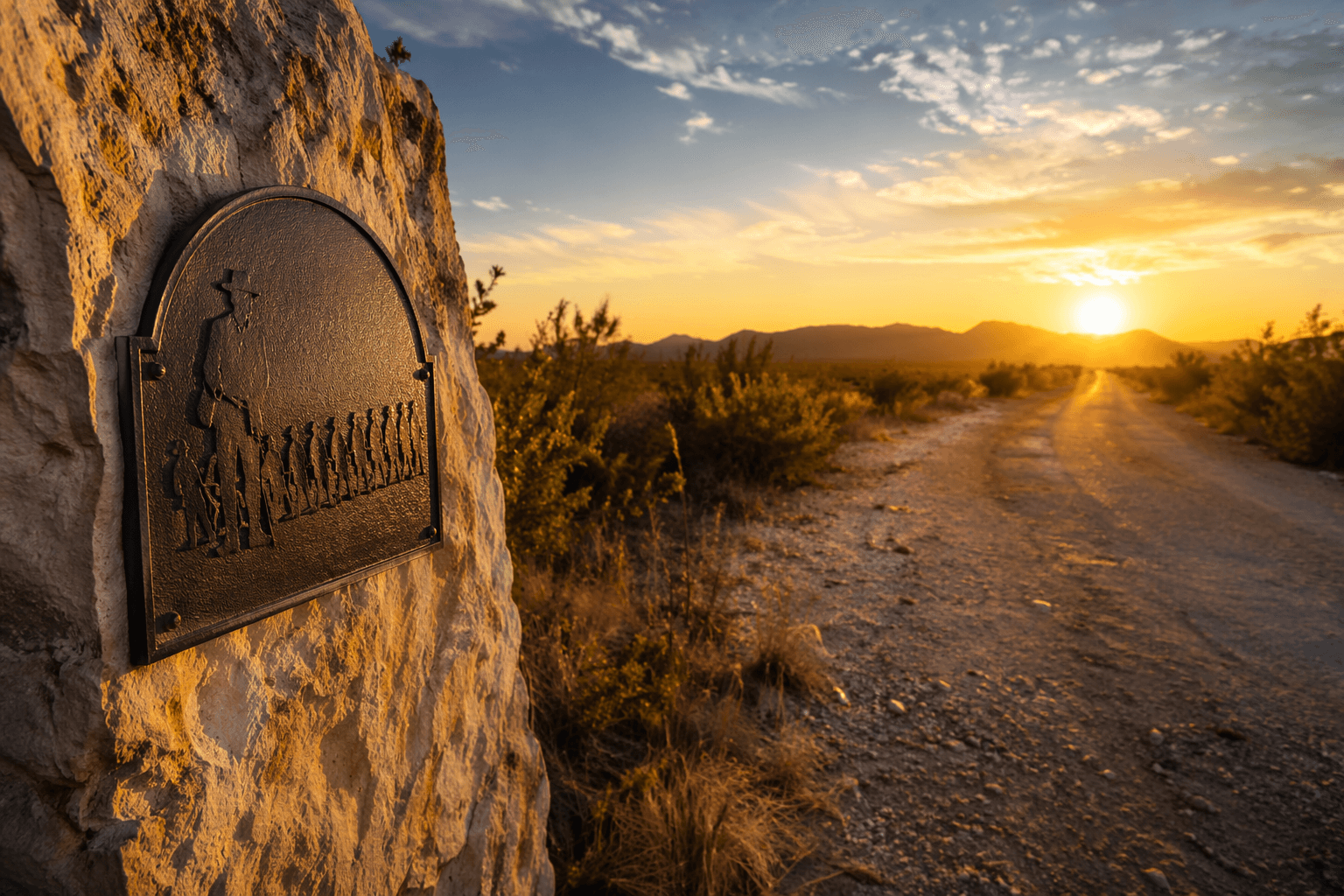
For Animas, that detail matters because it gives the landscape a precise point of reference. The summit crossing is not an abstract “trail site”; it is a place where steep ledges, ropes, scouts and wagons all converged on a single day as the battalion moved west toward California.
From contraband to the Skeleton Canyon killings
The Smugglers’ Trail marker shifts the focus from army movement to illicit trade. It says mule trains once crossed this area carrying contraband from Mexico to be traded for merchandise in Arizona. That alone places Animas in a larger border economy, one built on exchange, concealment and the practical use of difficult country to move goods where they were wanted.
The marker also ties the trail to the 1881 Skeleton Canyon killings, when a group of Mexican smugglers was killed in the canyon by members of the Clanton gang. The names attached to that episode are part of why the route still carries such weight: Old Man Clanton, Ike Clanton, Billy Clanton and Curly Bill. Historical accounts identify Newman Haynes Clanton as Old Man Clanton, the rancher and patriarch whose family became central to the borderlands outlaw reputation.
That connection gives the Smugglers’ Trail a different kind of specificity than the battalion crossing. It was not only a path for goods; it was also a route where smuggling, retaliation and violence blurred together. In that sense, the marker preserves a piece of border history that is both logistical and human, showing how commerce and conflict often occupied the same road.
The Clanton hideouts in the Animas Valley
The Clanton Hideout marker deepens the outlaw story by moving it from the canyon into the valley itself. It says the Clanton Gang had two crude dugouts in the 1880s and used them as hideouts and as a base for wider outlaw activity across the Animas Valley. Those dugouts matter because they turn the legend into a set of physical locations, however rough and temporary, that can still be tied to a specific place in the county.
Together with the Smugglers’ Trail marker, the hideout site shows how the Animas Valley functioned as more than a scenic backdrop. It was a working zone for people trying to move across the borderlands without being seen, and for gangs using the country’s remoteness to their advantage. The result is a landscape where the outlaw story is not generic Wild West shorthand but a local pattern built on caves, dugouts, canyon cuts and open valley routes.
Smugglers’ Roost and the travel story that survives
The present-day travel angle comes into focus at Smugglers’ Roost in Animas. New Mexico Tourism & Travel says it sits on the original Butterfield Overland Stagecoach Winter Route, and describes the site as a place for history, rockhounding and hiking. It is also identified as being at the site of the infamous Clanton Gang hideout along Smuggler’s Trail.
That combination gives Hidalgo County something especially useful: a place where heritage travel and landscape reading meet. Visitors are not just looking at a sign in a vacuum. They are standing in a corridor where the Butterfield route, the Mormon Battalion crossing, the smuggling trail and the Clanton hideouts all overlap in the same wider country.
For the county, that overlap is the point. Animas is worth understanding because it keeps three frontier routes in view at once, each one tied to a different kind of movement and conflict. The markers preserve that complexity, and the land around them still lets people trace it with their eyes.
This article was produced by Prism’s automated news system from verified source data, official records, and press releases, then run through automated quality and moderation checks before publishing. The system is built and supervised by the people who set the standards it runs under. Read our full AI policy.
Did this article answer your question?