Animas school district highlights ranching roots and Shakespeare Ghost Town
Animas uses its school district page to keep the Bootheel visible, tying local identity to ranching, Shakespeare Ghost Town, and the district’s two campuses.
In Animas, the school district’s community page does more than introduce a town. It acts like a public self-portrait for a remote ranching and farming community in the far southwestern corner of Hidalgo County, one that is trying to stay visible to families, educators, and anyone deciding whether the Bootheel is worth a visit, a move, or an investment.
That matters in a county with 3,438.6 square miles of land area and just 4,178 people counted in the 2020 Census. With so much open space and so few residents, identity is not automatic. It has to be maintained through the school system, through local history, and through places like Shakespeare Ghost Town and the Lordsburg museum that tell outsiders this landscape still has a story to sell, preserve, and pass down.
A school page as a civic anchor
Animas Public Schools describes the community as more than a dot on the map. It says this is a place where people raise their children together, celebrate together, and mourn together, language that captures the intimacy of a rural social fabric where schools often function as the center of public life. The district’s decision to put that identity online is not a small thing in a place this isolated: it is a way of saying that Animas is still here, still coherent, and still worth knowing.
The district says it maintains two campuses: Animas Elementary School, which serves preschool through 4th grade, and Animas High School, which serves grades 5 through 12. In a small community, those buildings carry more than academics. They are where families form routines, where children grow up together across grade levels, and where the district can make a case that living in a remote part of Hidalgo County still offers a stable educational path.
That public-facing description also shows how local identity is being curated through the school system itself. The community page is not just informational; it is part of a broader effort to share who the district and community are. In a county where population is thin and distances are long, that kind of presentation can help preserve memory, support enrollment, and signal to newcomers that Animas is not disappearing quietly.
Shakespeare Ghost Town and the county’s visible past
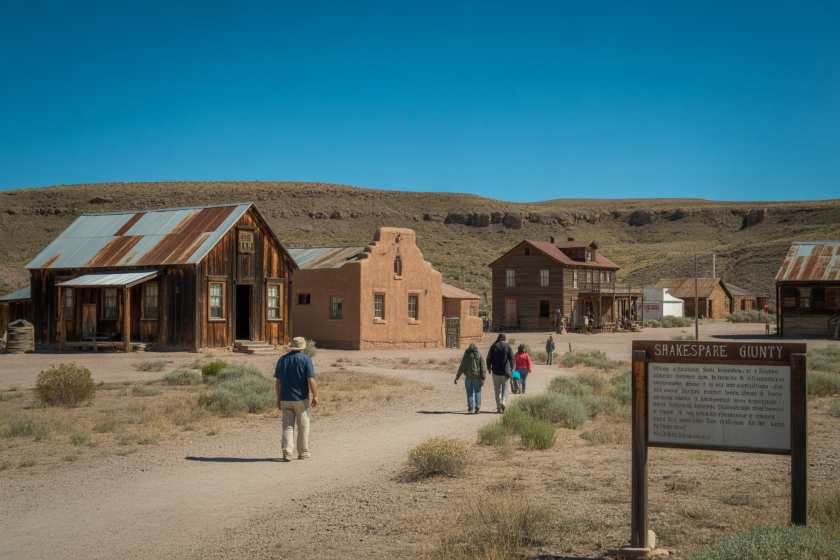
One of the strongest symbols on the page is Shakespeare Ghost Town, a reminder that the area’s story stretches far beyond the present school year. The site is described as one of the last remaining ghost towns along the Butterfield-Overland Stage Trail and as a former mining boom-town that survived until 1932. Its name, which the community page says means lost souls or spirit, adds to the sense that Animas and its surroundings are shaped by both desert geography and historic memory.
New Mexico Tourism & Travel identifies Shakespeare as a silver boom town that was later bypassed by the railroad. It says Frank Hill and Rita Hill purchased the town and its buildings in 1935 for use as a ranch, a detail that helps explain why the place still exists rather than vanishing entirely. The site is privately owned and recognized as a National Historic Site, with daily public hours from 10 a.m. to 5 p.m.
Visitors can still walk through that layered history. Admission is listed at $10 for adults, $5 for children ages 6 to 12, with a $20 minimum. The tourism page also notes regular tours and reenactments, which keeps Shakespeare from being a static ruin and turns it into a living interpretation of the region’s mining past. For Hidalgo County, that matters because places like Shakespeare give the Bootheel a face: a stop where heritage becomes visible on the ground.
Lordsburg, the railroad town down the road
The Animas community page also points toward Lordsburg, reinforcing how closely the town’s identity is tied to the county seat and to the county’s broader settlement history. Lordsburg’s official history says the town dates back to 1880, when the Southern Pacific Railroad came through from the west. The community grew with railroad workers, freighters, miners, cowboys, ranchers, gamblers, and merchants, a mix that mirrors the rugged, mixed-use economy that shaped this corner of New Mexico.
That history still helps define what the region values. Railroad access, ranching, mining, and trade were the forces that made the county legible to outsiders in the first place. Today, the same themes reappear in the way the area markets itself: through ghost towns, historic buildings, and a school district page that links daily life to a deeper frontier past.
The Lordsburg-Hidalgo County Museum extends that story in a more formal way. It is a nonprofit museum operated in part by volunteers, located at 710 E. 2nd St. in Lordsburg, and directed by Marsha Hill. Its exhibits cover the Lordsburg Internment/POW Camp, mining, railroad history, ranching heritage, and military history, a mix that shows how the county remembers not just one era but several overlapping ones.
Why visibility matters now
What stands out in Animas is not nostalgia for its own sake. The community page functions as an argument that the Bootheel is still a place of residence, education, tourism, and memory, not just an empty stretch between larger destinations. In a sparsely populated county, that kind of visibility can shape how families see school choice, how educators see the district, and how visitors see the region’s worth.
The page also points to practical local infrastructure and civic life beyond history alone, including resources such as Hidalgo Medical Services, the county library, the sheriff’s office, and the post office, along with community events like Fourth of July celebrations and cowboy poetry in February. Those details matter because they show a place where public life still has anchors, even when the population is small and the geography is wide open.
For Animas, the challenge is not simply to preserve the past. It is to make sure the past still supports a future, one in which families remain, students enroll, and people outside the Bootheel continue to see Hidalgo County as a place worth finding.
This article was produced by Prism’s automated news system from verified source data, official records, and press releases, then run through automated quality and moderation checks before publishing. The system is built and supervised by the people who set the standards it runs under. Read our full AI policy.
Did this article answer your question?