Holmes County traces roots from frontier settlement to historic courthouse
Holmes County’s Amish Country identity still runs through its frontier roads, Walnut Creek settlement pattern, and Millersburg’s sandstone courthouse.
The Holmes County story starts in the ground beneath its roads and town squares: a frontier landscape laid out by treaty lines, early settlements, and a county seat that still centers public life in Millersburg. The county was formed by the Ohio General Assembly in 1824 and formally organized on January 4, 1825, then named for Major Holmes, a War of 1812 officer from the generation that helped shape early Ohio.
From frontier line to county line
Long before Holmes County took its present shape, the land sat in the orbit of the Greenville Treaty Line of 1795 and the military movements associated with Mad Anthony Wayne. Those names still matter because they explain why the county’s earliest roads, claims, and settlement clusters followed patterns that can still be read in place names and travel routes today. The history is not abstract here: it is built into the county map, where frontier-era boundaries and later settlement paths helped determine where people lived, farmed, traded, and gathered.
The broader Ohio context also puts Holmes County’s namesake in perspective. Ohio furnished 1,759 officers and 24,521 enlisted men for the War of 1812, a reminder that the county’s name came from a military generation rather than a local founder. That connection links Holmes County to the state’s early civic identity, when veterans, land claims, and new township organization shaped how counties were carved out of the Ohio landscape.
The first settlement patterns still visible today
The first white settlers in the area that is now Holmes County arrived in 1809 and 1810. One of the clearest date points is Hannah Butler’s birth on February 4, 1810 near Big Spring, just north of Holmesville on the present State Route 83. That detail matters because it ties a family story to a road people still drive every day, showing how early settlement and modern geography overlap.
Another foundational line in the county’s history runs through Jonas Stutzman, who took up two quarter sections of land just south of present-day Walnut Creek. County history describes that act as the beginning of Amish settlement in the area. A scholarly translation of early Amish history places the Holmes County Amish settlement’s beginning in 1808, a slightly earlier marker that suggests how historians distinguish between first land claims, first arrivals, and the later formation of a community. However it is dated, the result is the same: the Walnut Creek area became the starting point for one of the largest Amish settlements in the United States.
That settlement pattern still shapes how Holmes County looks and feels. The Amish Country identity visitors recognize now did not grow from a single village or attraction. It emerged from clusters of farms, lanes, and market towns centered around places like Walnut Creek, with the county’s rural roads carrying that pattern into the present.
Millersburg becomes the county seat
Holmes County’s civic center took shape in Millersburg after Charles Miller planned the town. The county seat decision gave Millersburg a role that still defines it: government hub, historic town center, and the clearest place to read the county’s layered past in one walkable district. By 1834, Millersburg had about sixty buildings and a population of nearly 300, enough to show how quickly a planned county seat could become the county’s administrative and commercial core.
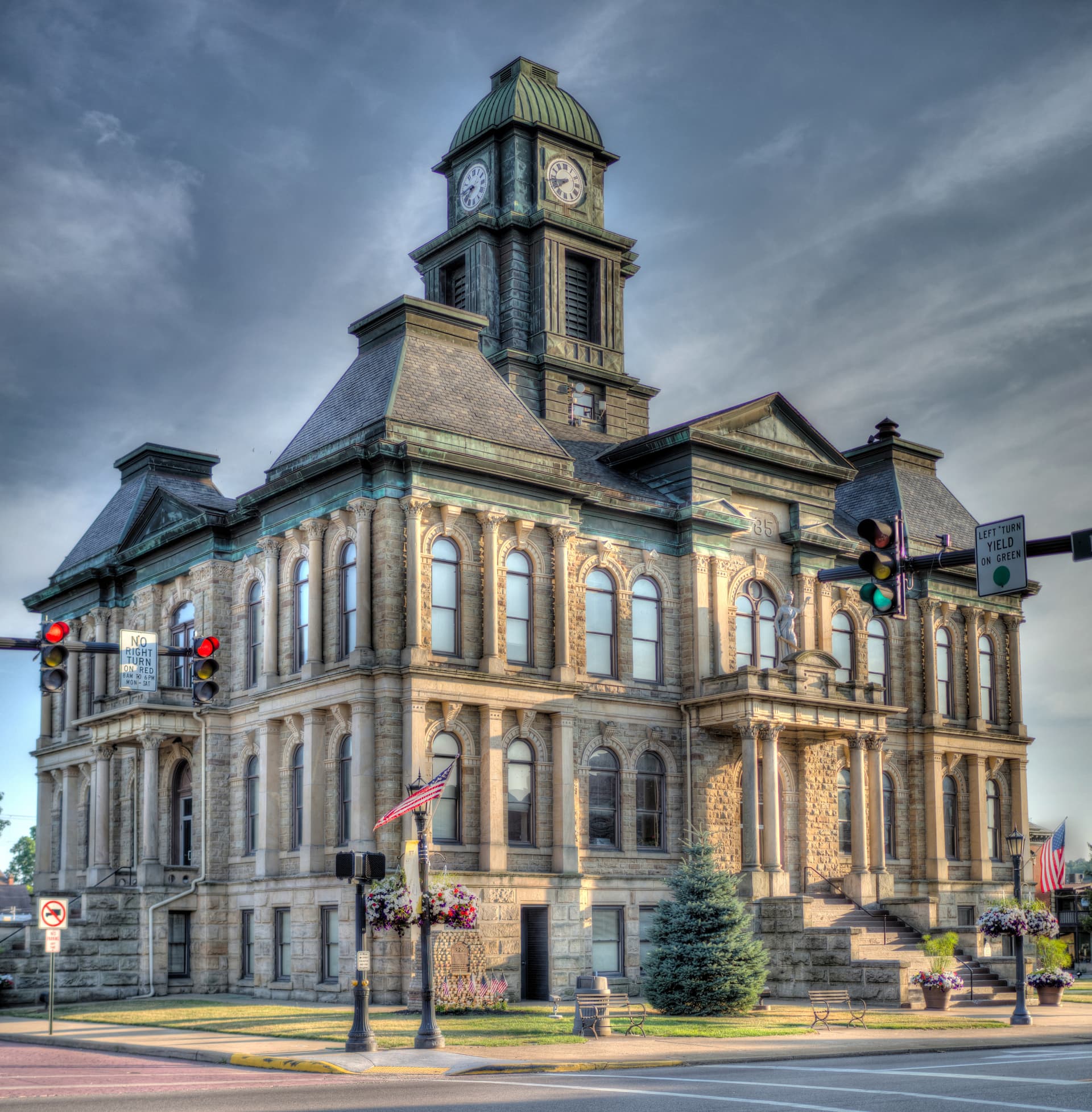
The town’s formal growth followed soon after. Millersburg was incorporated on February 17, 1835, and its courthouse history tracks the town’s own expansion. A log courthouse, the first of three on the same site, was built in 1825. The courthouse now standing downtown is the third courthouse built there, completed in 1886 after construction that ran from 1884 to 1886. It is also listed on the National Register of Historic Places, which places it firmly in both local government and preserved heritage.
That sandstone courthouse is more than a postcard image. It remains the visual anchor of the county seat, the building most likely to explain Holmes County’s civic identity to a first-time visitor and the one most residents recognize as the symbol of county government. Its endurance tells the story of a place that kept its administrative center in the same town while the surrounding county stayed deeply rural.
Why the roads and landmarks still matter
Holmes County’s history survives in the places people still use. Mad Anthony Street in Millersburg, the Big Spring area near Holmesville, the Walnut Creek settlement, and the county seat itself all show how the old geography still guides the new. The Killbuck Valley adds another layer, with one of Ohio’s largest wetlands helping define the county’s physical character and reminding visitors that this is not only a cultural landscape but an environmental one as well.
Other communities carry the same layered feel. Lakeville, Holmesville, Benton, and Walnut Creek each sit inside a county whose identity was built through settlement, agriculture, and town planning rather than through a single boom period. That is why the county’s historical story still shapes tourism: travelers are not simply looking at old buildings, they are moving through a landscape where the courthouse, road network, and Amish farms all point back to the same origin story.
What the historical society preserves
The Holmes County Historical Society keeps that story anchored in Millersburg at 484 Wooster Rd. Its work is not just archival. The society preserves county history and helps interpret local sites such as the Victorian House Museum and the Millersburg Glass Museum, giving residents and visitors a way to connect the courthouse square to the broader county story.
That local preservation effort matters because Holmes County’s identity is cumulative. The county’s formal organization in 1825, the rise of Millersburg as county seat, the early Amish land claims near Walnut Creek, and the courthouse completed in 1886 all still show up in the way Holmes County is mapped, traveled, and marketed today. The result is a county where the past is not buried under modern life, but built into it, from the sandstone on the courthouse wall to the rural routes that still link settlement clusters across the county.
This article was produced by Prism’s automated news system from verified source data, official records, and press releases, then run through automated quality and moderation checks before publishing. The system is built and supervised by the people who set the standards it runs under. Read our full AI policy.
Know something we missed? Have a correction or additional information?
Submit a Tip