Arcata Italian American children recall wartime fear and suspicion
Arcata’s wartime children did not just hear about suspicion, they lived it, as federal fear and local restrictions turned Italian family life into a lesson in belonging.
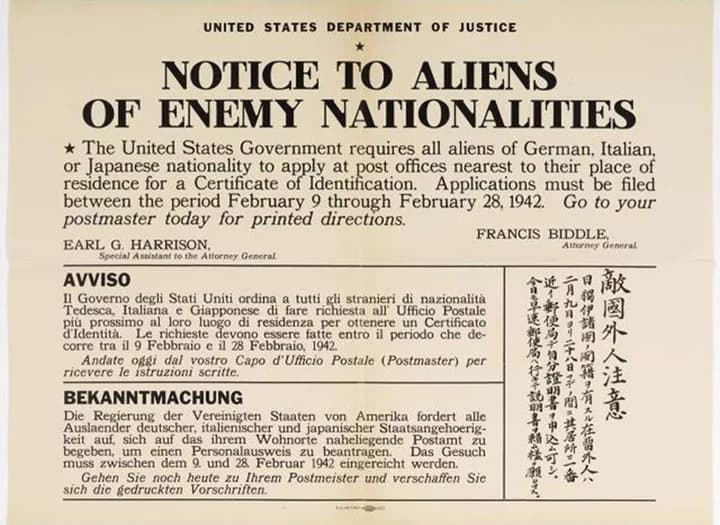
Wartime fear reached Arcata homes
The story of two Arcata children of Italian heritage shows how quickly national panic can settle into a neighborhood, a schoolyard, and a family routine. In Humboldt County, World War II was not only about military service or faraway battlefields. It also meant children growing up with the sense that their last name, their parents’ birthplace, or even where they lived could suddenly mark them as outsiders.

That local experience unfolded inside a much larger federal crackdown. After Pearl Harbor, President Franklin D. Roosevelt issued Proclamations 2525, 2526, and 2527, helping authorize the detention of suspected enemy aliens. National Archives and National Park Service histories say German, Italian, and Japanese nationals were swept into that designation, a reminder that the wartime machinery of suspicion did not stop at one group or one coast.
How fear became policy
The legal tightening came fast. On January 29, 1942, the U.S. Attorney General established prohibited zones from which enemy aliens were excluded. On February 4, 1942, the U.S. Army created restricted areas where enemy aliens had to observe curfews and could not travel more than five miles from home. By March 27, 1942, Public Proclamation No. 3 imposed an 8:00 p.m. to 6:00 a.m. curfew in Military Area No. 1, which included the West Coast.
Those rules had teeth. Violations of military-area restrictions could be punished as a misdemeanor, with a fine of up to $5,000 or up to one year in jail. The National Park Service has described this period as one in which the government declared hundreds of thousands of Japanese, Italian, and German people across the United States and Latin America to be enemy aliens, showing how quickly civil liberties can narrow when wartime fear takes over.
Even far from California, the policy was already visible. In December 1941, Ellis Island held 81 Italians detained as enemy aliens. The same facility also held Germans and Japanese removed from the East Coast, underscoring that the system was national in reach, not just a West Coast response.
What that looked like in California
The pressure on Italian families in California was immediate and concrete. KQED reported that roughly 10,000 Italian citizens in California were forced to leave their homes during the war, and that 50,000 Italian-Americans in the state were targeted as enemy aliens. Stephen Fox’s oral-history book, *The Unknown Internment*, adds another layer, saying that from February to December 1942 approximately 10,000 California residents were relocated from their homes and several hundred were interned.
Those numbers help explain the emotional climate in which Arcata families lived. This was not abstract policy; it was a system that could move people, isolate them, and make ordinary tasks feel risky. The National WWII Museum and other historical accounts have treated this as a little-known part of the war, but one that matters because it shows how fear can redraw the limits of belonging in a matter of weeks.
Arcata and Eureka were not immune
Local reporting makes clear that Humboldt County felt these rules at street level. The Lost Coast Outpost reported that Italian aliens who crossed designated lines or violated curfews in Eureka and Arcata risked arrest. It also reported that some residents were forced to move if they lived on the wrong side of a wartime line.
That detail matters because it turns a national policy into a map of daily life. In places like Arcata and Eureka, a wartime boundary could decide whether a family stayed put, whether a parent risked arrest walking after dark, or whether a home was suddenly on the wrong side of a line drawn by the military. For children, the result was not just confusion. It was the unsettling lesson that the places they knew best could become places of suspicion overnight.
Schools and neighborhoods carried that pressure too. When wartime nationalism labels a family as potentially disloyal, children absorb the message quickly. They notice who is watched, who is whispered about, and which families are made to explain themselves. In Arcata, the experience of Italian American children becomes a local case study in how prejudice lands close to home, where the effects can be felt in classrooms, on sidewalks, and in the way neighbors look at one another.
Why Humboldt County should remember this now
Local history is often told through roads, storms, timber, and elections, but it also includes the human cost of national panic. The Arcata story belongs in that fuller record because it shows how a federal security campaign reached ordinary children in Humboldt County and shaped identity at the most basic level. It asked families to prove they belonged in the same country they had already been living in, working in, and raising children in.
That is why the memory remains relevant. Wartime suspicion did not arrive as a single dramatic event. It came through proclamations, restricted areas, curfews, and the ordinary fear of being seen as foreign. For Italian American families in Arcata, that meant navigating not only law but stigma, not only movement restrictions but the social burden of being watched.
The Humboldt County Historical Society, which says it has preserved local historical materials since 1947, may hold family histories that can deepen this picture. In a county where so much memory lives in private households and neighborhood stories, that kind of archive matters. It can help keep intact the record of what children saw, what families endured, and how communities learned, painfully, how quickly belonging can be tested when fear becomes policy.
The value of this history is not nostalgic. It is civic. Arcata’s wartime experience shows that democratic rights are not only challenged in distant capitals or during headline-grabbing crises. They can be narrowed in familiar places, against familiar people, one curfew, one line, and one suspicious glance at a time.
This article was produced by Prism’s automated news system from verified source data, official records, and press releases, then run through automated quality and moderation checks before publishing. The system is built and supervised by the people who set the standards it runs under. Read our full AI policy.
Know something we missed? Have a correction or additional information?
Submit a Tip