Ferndale’s historic architecture reflects its dairy and shipping past
Ferndale’s Victorian streetscape was paid for by dairy wealth and shipping, and the preserved district still supports tourism, local business and civic identity.
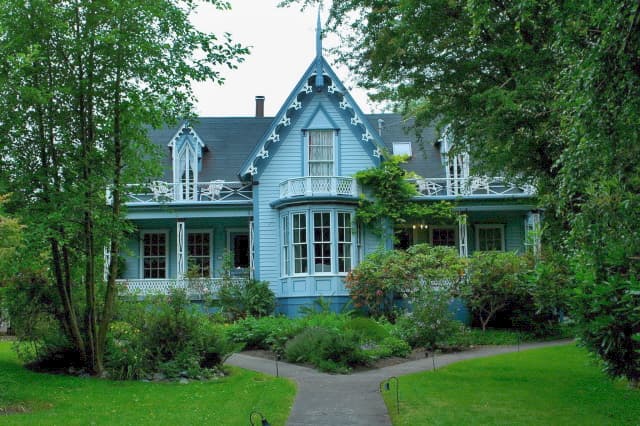
The Shaw House on Main Street dates to 1854, when Seth Shaw built the first large house in the area and named it Fern Dale. The creameries that made butter famous in San Francisco also financed the Victorian, Queen Anne and false-front buildings that still define the town today. In a community of about 1,372 people spread across roughly one square mile, preservation shapes the businesses, museums and landmarks that keep Main Street alive year-round.
Dairy wealth and shipping made the town
Ferndale was settled on August 25, 1852, when brothers Seth and Stephen Shaw crossed the Eel River and pushed up Salt River and Francis Creek to the future townsite. Stephen Shaw later sold his claim and moved to San Francisco, a reminder that the town’s earliest ties ran both to the valley and to the city that would become its market.
By 1879, Ferndale’s population already reflected a mix of native-born residents and immigrant communities, with 1,050 native-born people counted alongside 90 from Denmark, 111 from Switzerland, 72 from Germany, 34 from Nova Scotia and 34 from elsewhere in Canada. The town was becoming a working settlement with a regional role, first as a transportation center and later as a dairy town serving the larger North Coast economy.
The dairy expansion was decisive. By 1890, there were 11 separate creameries operating in the immediate Ferndale area, and Ferndale butter brought premium prices in San Francisco. The Central Creamery on north Main Street later became the mother plant of Golden State Creamery, tying this small Humboldt County town to one of the state’s larger dairy brands. Local creameries also produced innovations credited with the first sweet cream butter, the first butter wrapping and cutting machines, and the first dry-milk processing on the Pacific Coast.
What the architecture preserves
That economic history shows up in the built environment. Ferndale includes Victorian-Gothic residential buildings and false-front commercial architecture, a profile the California Office of Historic Preservation highlights. Downtown and nearby neighborhoods preserve Victorian, Queen Anne, Eastlake-Stick, Italianate, Neo-Classic, Bungalow and Mission styles.
The Main Street Historic District was registered by the National Park Service on January 10, 1994, and its nomination counted 39 contributing buildings and 13 noncontributing buildings.
Ferndale’s preservation culture also reaches back decades. California Historical Landmark No. 883 was placed on September 12, 1976, in cooperation with the Ferndale Chamber of Commerce Historical Committee and a community effort.
A town museum that keeps the story moving
The Ferndale Museum has spent more than 45 years gathering, interpreting, preserving and sharing the history of Ferndale and the Eel River Valley. Its exhibits include Victorian room settings, antique farming and dairy equipment, natural history displays and a working seismograph the museum describes as the oldest in the United States.

The Bosch-Omori seismograph was donated by the University of California in 1933, after a seismographic station was established in Ferndale, and it still records daily.
The broader landmark landscape extends beyond Main Street to the Ferndale Cemetery, Fernbridge, Fern Cottage and the Ferndale Library. Visit Ferndale describes Fernbridge, built in 1911, as the longest functional poured-concrete bridge in operation in the world; it stretches 1,320 feet. It also describes Fern Cottage as one of the few California houses still lived in by members of the same family since the 1870s, and the Ferndale Library, built in 1909, as the last Carnegie Library in northwestern California still functioning as a public library.
Why preservation matters to the local economy
Ferndale’s General Plan makes the economic logic explicit: historic and cultural resources support heritage tourism, economic development, community identity and pride. Visit Ferndale and the Chamber of Commerce both promote the Victorian Village as a travel destination and a business community.
In a place this compact, visitors come for the Main Street district, the museum, the landmark bridge and the historic houses, and those stops help support the shops, services and public institutions that keep the town active between tourist peaks.
This article was produced by Prism’s automated news system from verified source data, official records, and press releases, then run through automated quality and moderation checks before publishing. The system is built and supervised by the people who set the standards it runs under. Read our full AI policy.
Did this article answer your question?