Humboldt prepares to celebrate Eureka artist Duane Flatmo
Duane Flatmo's murals, machines and homemade oddities have become part of Eureka's daily landscape, and the city is now moving to honor him in the street itself.
A Humboldt artist now built into the landscape
Duane Flatmo has become one of those artists whose work people in Eureka do not just recognize, they live with it every day. The community is preparing to celebrate him as the city’s visual memory keeps expanding around murals, kinetic sculptures and the kind of theatrical imagination that makes Humboldt art feel inseparable from place.
That is why Flatmo’s latest recognition matters beyond a single profile. In a county where public art helps define the streets, his work has become part of the built environment, from a giant mural in Eureka to the flame-belching machines that made his name travel far outside Humboldt County.
Inside the Flatmo world
The portrait of Flatmo begins at home, where the objects around him seem to function like a private museum of invention. The house he shares with his wife, Micki Dyson Flatmo, is filled with repurposed and handmade pieces, including shrunken heads, a coffee table assembled from bolts and can openers, and colorful sculptural heads with mismatched features.
That scene tells readers almost everything they need to know about the artist’s visual language. Flatmo’s work leans into humor, scrap, surprise and transformation, turning discarded material into something theatrical and memorable. It is the same sensibility that made his art feel at home both in neighborhood streets and at Burning Man.
From sign painting to murals
Flatmo’s career in Humboldt began with sign painting before he moved into murals and larger-scale work. His first mural is identified in earlier coverage as the 1984 Bucksport Mural at Bucksport Sporting Goods in Eureka, a concrete marker of how long he has been shaping the county’s visual identity.
His official website describes him as a Humboldt County mural artist, sculptor, painter and kinetic sculpture legend. That description fits the range of his work, but it also captures something more local than a résumé. Flatmo’s art is not presented as separate from Humboldt, it is part of the county’s everyday visual culture, the kind of thing people pass, point to and remember as part of their own map of the city.
The pulpo years and the culture of motion
Flatmo’s reputation is tied closely to kinetic art, especially the machines known as El Pulpo Mecanico and later El Pulpo Magnifico. The project emerged from Arcata and Eureka and was crafted by Flatmo with Jerry Kunkel and Will Startare, linking the artist to a broader Humboldt tradition of collaborative, inventive making.
That work also ties him to Burning Man and to the Black Rock Desert in Nevada, where spectacle and engineering meet public performance. Flatmo’s flame-belching creations help explain why his art carries such a strong sense of motion, drama and invention. He is not only a muralist who works on walls, he is a builder of moving objects that make a crowd stop and look up.
Why the city is naming him now
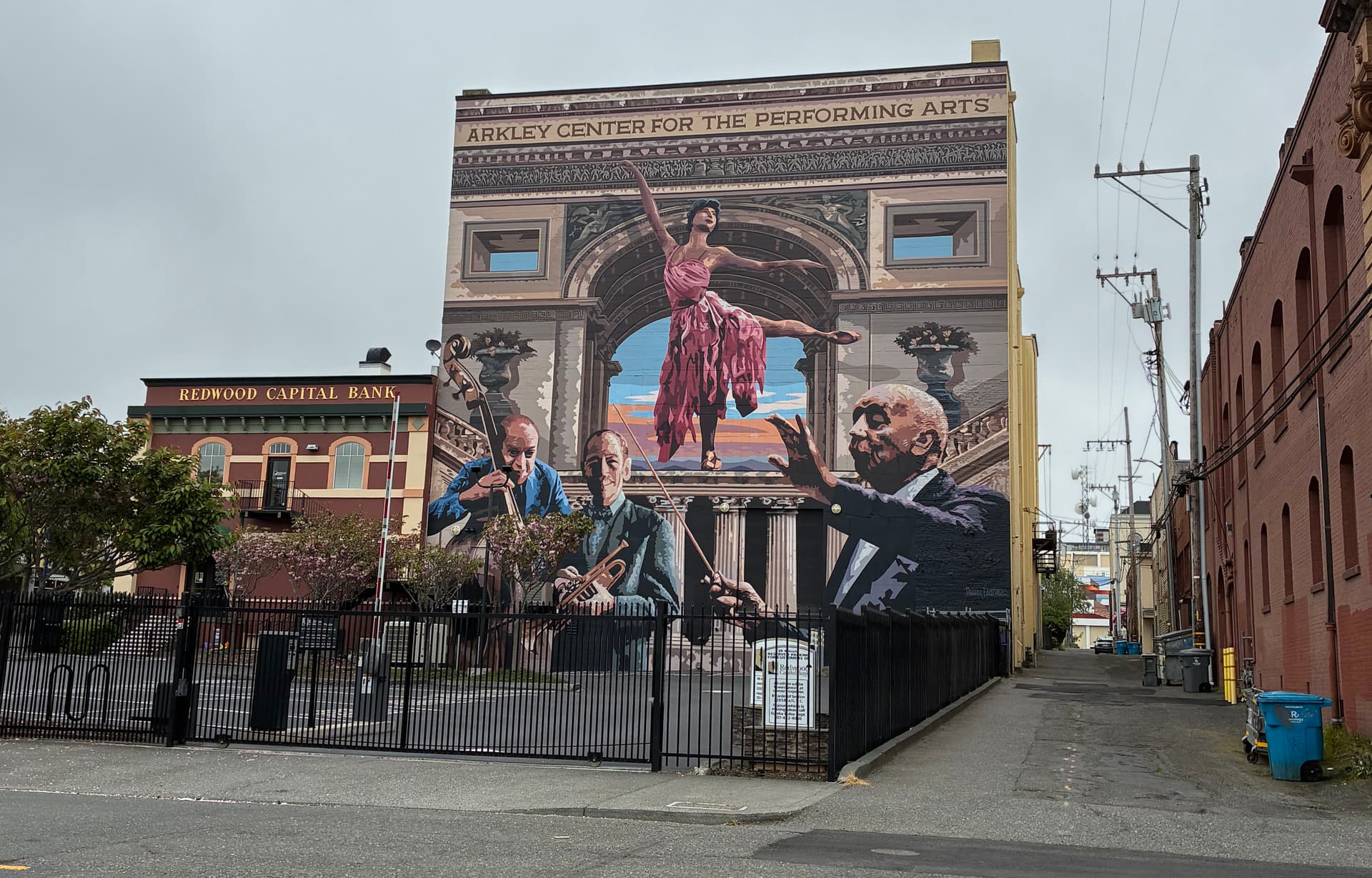
The timing of this celebration is part of the story. In May 2026, Eureka officials were considering naming an alley “Duane Flatmo Alley,” a proposal that would place his name beside his giant mural, “Tribute to Architecture and Performing Arts.” That move shows how deeply his work has already been woven into the city’s geography.
An alley name may sound small, but in a place like Eureka it is a public declaration of memory. It means the city is no longer only enjoying Flatmo’s work in passing, it is starting to mark the map with it. The proposal turns an artist’s legacy into something residents can locate, walk past and explain to someone new in town.
What this says about Eureka and Humboldt
Flatmo’s recognition is really a story about Humboldt County’s relationship with art. Here, murals, installations and handmade oddities are not fringe decorations, they are part of civic identity. Flatmo’s career shows how a single artist can help shape the feel of Eureka, not through a single signature style alone, but through years of work that remain visible in public space.
That visibility matters because it gives the community a shared visual memory. People do not have to know every detail of Flatmo’s biography to know his influence, they see it in the walls, the machines and the odd, inventive objects that seem to belong to Humboldt’s character as much as any building or landmark. His legacy spans childhood, collaboration with Micki Dyson Flatmo, murals, sculpture and kinetic spectacle, but its most important effect may be the simplest one: he helped make Eureka look like Eureka.
A living legacy, still in place
What makes this moment especially meaningful is that Flatmo is being celebrated while he can still reflect on the path that brought him here. The feature frames him not as a distant legend, but as a living local figure whose creations are already part of public memory and still actively shaping how residents understand the city.
For Humboldt, that is the real takeaway. Flatmo’s work has moved from invention to identity, from private imagination to shared landscape. In Eureka, his art is not just remembered, it is part of the ground people stand on.
This article was produced by Prism’s automated news system from verified source data, official records, and press releases, then run through automated quality and moderation checks before publishing. The system is built and supervised by the people who set the standards it runs under. Read our full AI policy.
Know something we missed? Have a correction or additional information?
Submit a Tip