Alice mural captures Jim Wells County's 1930s history and economy
South Texas Panorama turns Alice's 1930s economy into one mural, from cotton and cattle to oil and rail. Its preserved record keeps Jim Wells County visible to schools and memory.
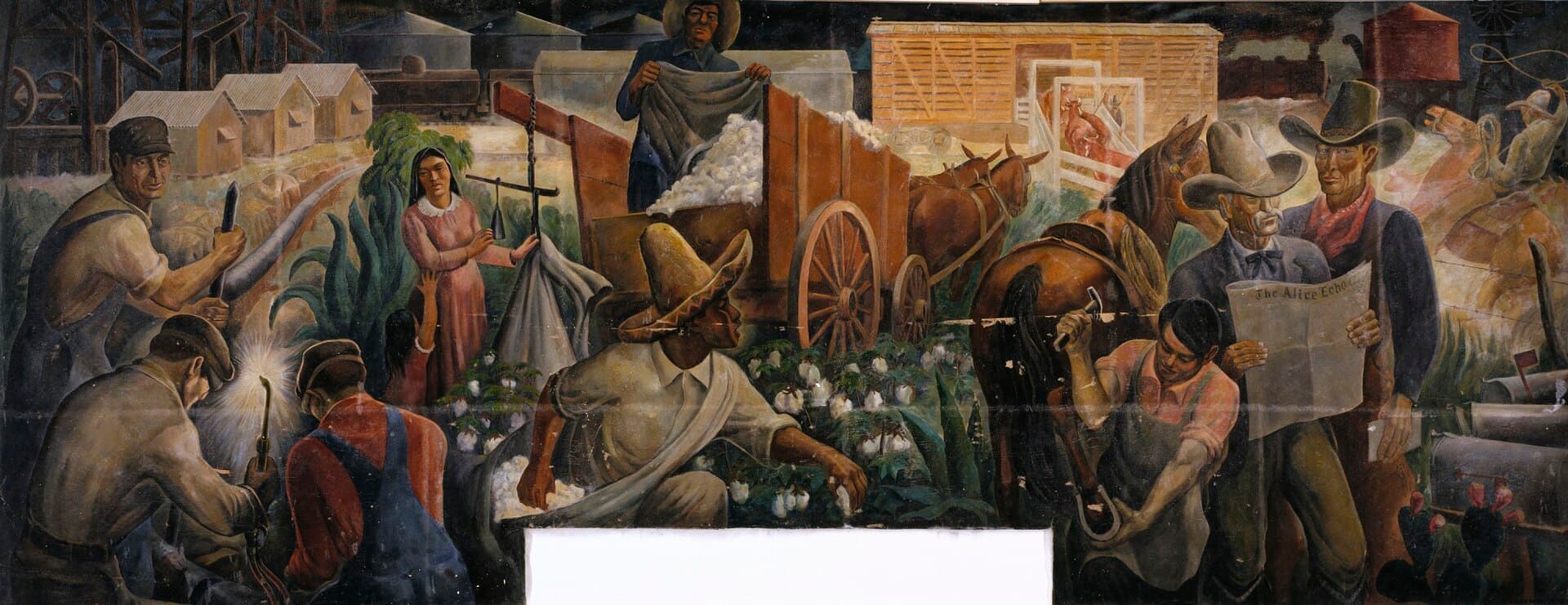
The old post office mural in Alice reads like a ledger of Jim Wells County at the end of the Depression. Warren Hunter’s 1939 South Texas Panorama gathers fields, cattle, rail, oil, and civic landmarks into one public image, turning the county seat’s economy into something a passerby could read at a glance.
What the mural records
The Smithsonian American Art Museum records South Texas Panorama as an oil-on-canvas mural measuring 58 1/4 by 141 3/4 inches. It was transferred from the Old Post Office Building in Alice, Texas, through the General Services Administration in 1968, which is part of why the work survives today as a documented piece of public history rather than a forgotten wall decoration.
The museum’s subject tags show what the mural was meant to hold together: the New Deal Treasury Section of Painting and Sculpture, harvesting, Texas landscapes centered on Alice, oil, craft and smith work, and a Mexican figure group. Those labels matter because they point to a deliberate civic portrait, not a generic scene. The mural was built to show how Jim Wells County worked, who labored in it, and what kinds of communities gave the county seat its shape in 1939.
A visual inventory of Alice and Jim Wells County
Read as local history, the image list is strikingly specific. Texas Escapes describes farming, cotton, cowboys and longhorns, homesteads and churches, the Jim Wells County Courthouse and main street, plus oil derricks, a train, Alice Depot, and grain elevators. That mix places agriculture and ranching beside transportation, energy, and civic life, which is exactly the combination that built much of South Texas during that era.

The courthouse and main street tie the mural to the seat of county government and commerce. The train, Alice Depot, and grain elevators point to a town where rail service and agricultural shipping were part of daily life, while oil derricks capture the county’s industrial side. By placing all of those images in one composition, Hunter gave Alice a public shorthand for how the county fed itself, moved goods, and organized civic identity.
The mural also makes room for the people whose labor underpinned that economy. Harvesting, craft work, smith work, and the Mexican figure group are not decorative extras. They show a workforce that included farm labor and skilled hands, and they reflect the social mix that shaped Jim Wells County’s working life in the late 1930s.
What still defines Alice today
The mural still feels current because it centers the same civic anchors that continue to matter in Alice: the courthouse, main street, and the town’s identity as the county seat. Even as the economy has changed, the image preserves the older architecture of local life, where public institutions, trade, and labor were linked tightly together.
It also keeps alive the memory of a more layered downtown, one where the depot, grain elevators, and rail traffic were central enough to deserve a place on a government mural. Those details help explain why Alice developed the way it did and why its historic core still matters now. When students walk past the courthouse or learn the county’s history in school, the mural gives them a way to connect those places to the industries and people that built them.
Why preserving public access matters
South Texas Panorama matters because it moves Jim Wells County out of private memory and into a national archive. Once a mural leaves a post office wall, it can easily disappear from everyday view. By documenting and preserving the work, the Smithsonian kept Alice’s history accessible to researchers, teachers, and residents who want to understand how a federal art program interpreted a South Texas county in 1939.
That public access has practical value for local schools. The mural is a ready-made teaching tool for showing how the New Deal used art to reflect ordinary work, how agriculture and oil coexisted in South Texas, and how civic identity was built around institutions like the courthouse and post office. It also helps downtown identity, because the image turns familiar places into part of a larger story about who built the community and how.
For community memory, the mural does something few documents can do: it puts the county’s economy, labor, and civic life in one frame. The result is a visual record of Jim Wells County that still speaks to Alice’s history, even after the era of cotton wagons, depot traffic, and oil-field confidence has passed into the archive.
This article was produced by Prism’s automated news system from verified source data, official records, and press releases, then run through automated quality and moderation checks before publishing. The system is built and supervised by the people who set the standards it runs under. Read our full AI policy.
Did this article answer your question?