Jim Wells County cemeteries preserve Alice's railroad-era history
Alice’s cemeteries are more than burial grounds. They trace railroad-era origins, local stewardship, and the records families still use to find Jim Wells County’s buried history.
Alice’s cemeteries preserve more than names on stone. They hold the clearest surviving record of how a railroad town grew into the Jim Wells County seat, and they show how much of that story still depends on markers, volunteer records, and local memory. Alice Cemetery and Collins Cemetery together form a buried archive of land donations, civic organizing, military service, and family lines that predate the county itself.
A cemetery landscape tied to Alice’s earliest years
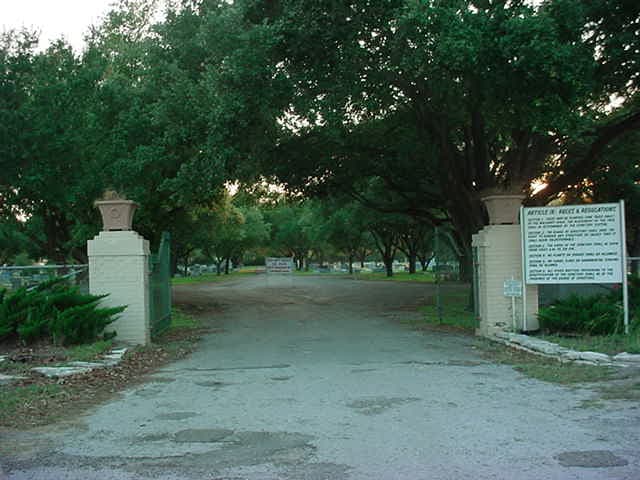
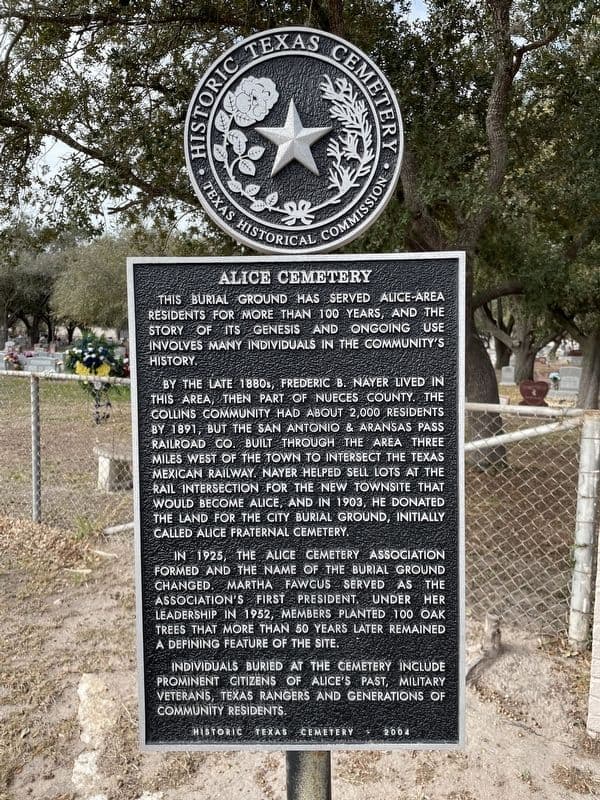
Alice Cemetery’s historical marker places the burial ground at the center of the town’s early development. It says the site has served Alice-area residents for more than 100 years, beginning in 1903 when Frederic B. Nayer donated the land for what was then called Alice Fraternal Cemetery. The marker also identifies the Alice Cemetery Association, formed in 1925, as the group that took on formal stewardship of the grounds.
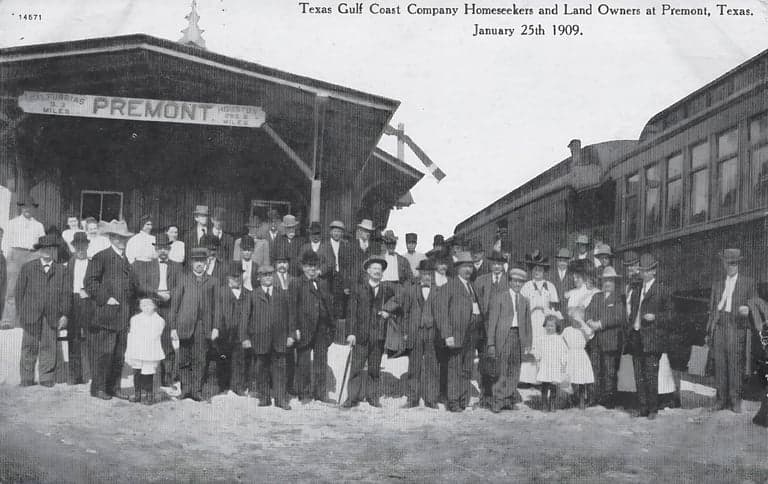
That history matters because Alice itself is younger than the cemetery landscape around it. The city was founded in 1888 and incorporated in 1904, and the town originated in the Collins community three miles east of the present townsite. The railroad story runs through both places: the San Antonio & Aransas Pass Railroad built through the area west of town to meet the Texas Mexican Railway, helping create the new Alice townsite. The cemeteries are therefore not separate from Alice’s civic history; they are part of the same settlement pattern.
What the markers say about who is buried there
Alice Cemetery is not just a family burial ground. Its marker says the people interred there include prominent citizens of Alice’s past, military veterans, Texas Rangers, and generations of community residents. That mix gives the site a civic and military dimension that reaches beyond private genealogy and into public history.
One detail on the marker stands out because it shows active community care, not just passive preservation. In 1952, members of the Alice Cemetery Association planted 100 oak trees, and those trees later became one of the site’s defining features. Martha Fawcus served as the association’s first president, linking the cemetery’s upkeep to a named local leader and to a formal organization that stepped in to protect the grounds. The site’s character, in other words, was shaped by organized local action as much as by time.

Collins Cemetery and the railroad-era town that came before Alice
Collins Cemetery gives the county’s burial history a sharper geographic anchor. The Texas Historical Commission Atlas lists it at 135 S. Flournoy Rd. in Alice, notes that it has two entrances on S. Flournoy Rd., and places it within Alice city limits at the intersection of S. Flournoy Rd. and Sain Dr. It carries Cemetery ID Number JW-C010, which makes it part of the official state record rather than an obscure local reference.
The cemetery’s recorded burial dates run from about 1887 to 2012, showing that it spans the period when the Collins community still existed and the decades after Alice emerged as the dominant town. The atlas also lists a Historic Texas Cemetery designation date of January 4, 2016. That designation matters because it confirms the site’s recognized historic value and gives families and researchers a formal place to start when they are tracing names, dates, or burial locations.
Collins Cemetery also shows how the county’s memory survives in layers. The Texas Historical Commission Atlas records about 1,000 graves there, while Find a Grave lists 2,387 memorial records. Those two figures are not the same kind of count, but together they show the site’s scale and the amount of personal history already attached to it. Another database identifies the cemetery with the names Old Collins and New Collins, reflecting the way local burial grounds often outlive the settlements that formed them.
How Jim Wells County’s cemetery map reflects settlement patterns
Jim Wells County was created on March 11, 1911, but the cemeteries preserve history that reaches well before county organization. That makes the county’s burial grounds useful for understanding how families, churches, ranches, and neighborhoods spread across the area. The Jim Wells County TXGenWeb cemetery list includes sites in Alice, Orange Grove, Premont, Ben Bolt, San Diego, and other parts of the county, showing that burial grounds are distributed across the county rather than concentrated in one city.
That spread turns the cemetery network into a map of settlement. Some graves sit in the county seat, others in smaller communities, and still others in places where the original buildings have vanished but burial markers remain. In Jim Wells County, cemeteries often outlast the businesses, schools, and churches that once defined the surrounding streets or roads, which is why they remain essential for reconstructing local history.
Records families and researchers can actually use
The most practical value of these cemeteries lies in the records attached to them. At Alice Cemetery, Find a Grave lists 3,431 memorial records. At Collins Cemetery, Find a Grave lists 2,387 memorial records. The Texas Historical Commission Atlas adds another layer of access by identifying Collins Cemetery’s location, entrances, cemetery ID, burial-date range, and historical designation.
Those tools do not replace careful family research, but they do make the cemeteries legible to the public. A family member looking for a burial site can start with the cemetery name, compare it with the state atlas, and then use memorial records to narrow down dates and relationships. For researchers, the combination of historical marker text, state documentation, and online memorial indexing shows how much of Jim Wells County’s past is preserved in places that are still physically present and still in use as points of reference.
Why the preservation question still matters
The strongest argument for protecting these sites is that they are not just memorial spaces. They are records of land transfer, civic organization, migration, military service, and the railroad-era settlement that shaped Alice itself. The Alice Cemetery Association, the Texas Historical Commission, local cemetery lists, and memorial databases each hold part of that record, but none of them alone tells the whole story.
That is why the condition of markers, the care of grounds, and the completeness of burial records matter so much in Jim Wells County. When a marker fades or a burial record is lost, the county does not just lose a name; it loses a link to the town’s railroad origins, to the Collins community, and to the generations of residents who built Alice from the ground up.
This article was produced by Prism’s automated news system from verified source data, official records, and press releases, then run through automated quality and moderation checks before publishing. The system is built and supervised by the people who set the standards it runs under. Read our full AI policy.
Did this article answer your question?