La Paz County parks guide maps campsites, fees and amenities across countywide sites
County park fees split by RV hookups, dry camping and holiday surcharges, with La Paz County Park carrying the heaviest rules and riverfront demand.
La Paz County’s park system is built around a simple decision that still catches visitors off guard: do you need an RV hookup, a dry-camping pad, a day-use space or a place to handle a holiday crowd? The county’s rate sheet and facility pages spread those choices across Parker, Cibola, Centennial Park and Bouse, while La Paz County Park absorbs the heaviest river traffic and the most detailed rules. For winter visitors, tube-float crowds and local families planning birthdays or gatherings, the price difference can be the difference between a practical stop and a costly one.
How the county’s park network is organized
La Paz County was established in 1983, making it Arizona’s youngest county, and the Colorado River forms its entire western border. That geography matters because the county is hot, dry and spread out, with annual precipitation ranging from 2 to 20 inches depending on elevation and location. More than 56% of residents live in rural areas, so parks are not just recreation sites here, they are part of the county’s basic outdoor infrastructure.
Parker and Quartzsite are the main population centers, but the park system reaches beyond them. County park listings and rate sheets show facilities in Parker, Cibola, Centennial Park and Bouse, which gives the network a countywide footprint instead of a single riverfront focus. That layout is why the county’s own park pages matter so much to visitors trying to decide where to stay, where to launch a boat and where to keep costs down.
What the rate sheet actually charges
The proposed park-rates document breaks the county system into separate price structures, and those structures tell you a lot about how each site is meant to be used. Cibola Hippy Hole has camping with electric at $25 daily, $100 weekly plus $0.19 per kilowatt hour, and $200 monthly plus $0.19 per kilowatt hour. Its dry-camping rate is $10 daily, $50 weekly and $125 monthly.
Centennial Park uses a slightly different setup, with camping that includes electric and water at $20 daily, $90 weekly plus $0.19 per kilowatt hour, and $175 monthly plus $0.19 per kilowatt hour. Dry camping there is also $10 daily, $50 weekly and $125 monthly. Bouse Community Park follows the same dry-camping pattern and charges $20 daily for camping with electric, $90 weekly plus $0.19 per kilowatt hour, and $175 monthly plus $0.19 per kilowatt hour.
La Paz County Park is priced differently again because its rate sheet uses premier and non-premier RV spaces. The published sheet shows a $40 daily rate in that RV-space category, and the park also posts summer holiday rates of $10 per person per day. That matters on the heaviest weekends, when the park is managing not just occupancy but crowd flow, vehicle count and entry traffic.
The county’s rate rules also make clear what is included and what costs more. Rates include 1 RV or tent, 1 tow vehicle, 2 adults and 2 children 13 and under. Any vehicle that does not fit within the site is charged an additional vehicle fee, and the county says no tents are allowed in RV, group or overflow sections.
La Paz County Park: the riverfront hub with the most rules
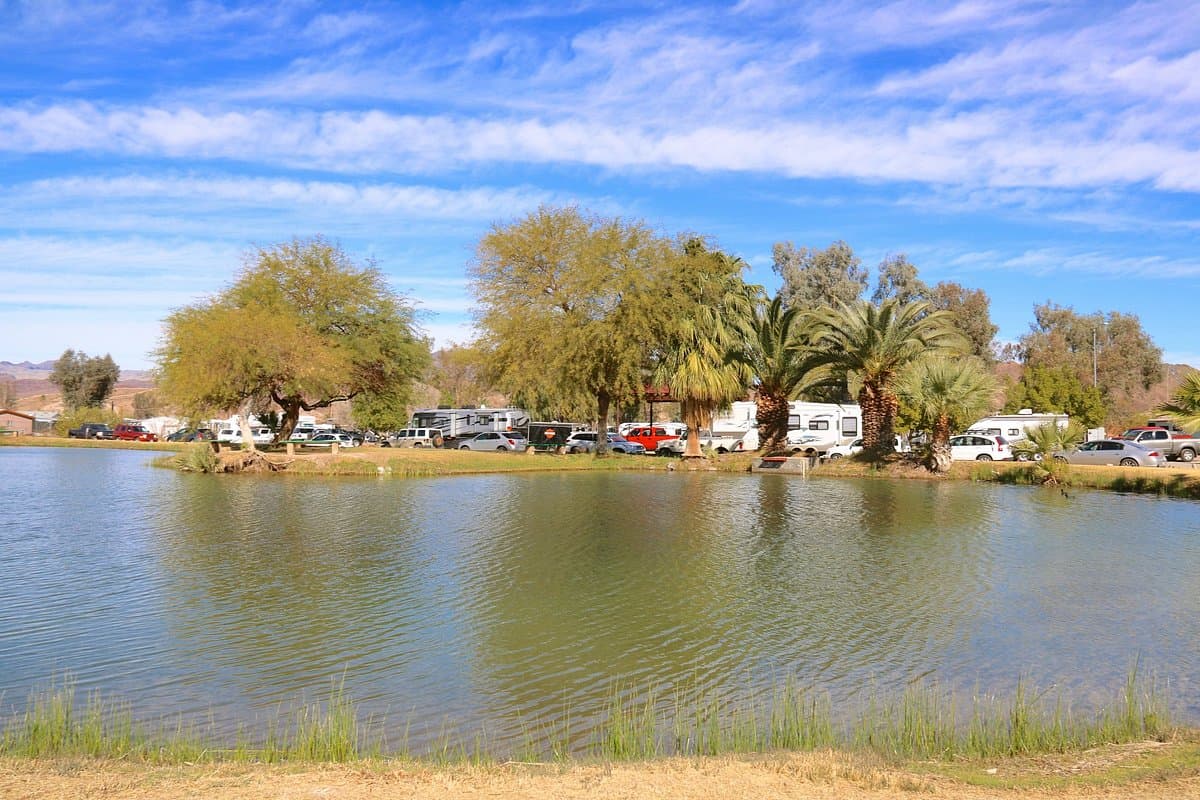
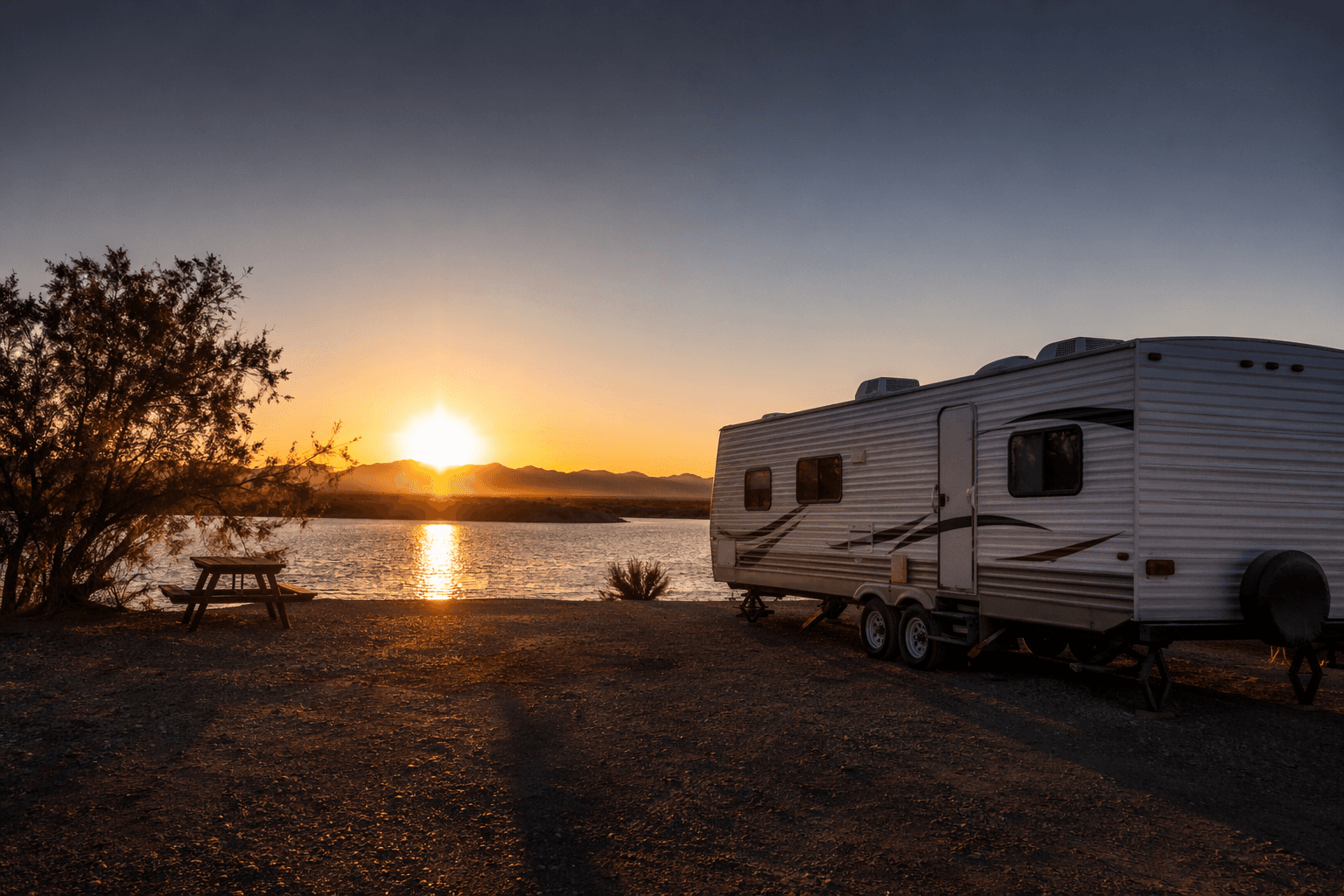
La Paz County Park sits 8 miles north of Parker on Highway 95 along the Colorado River, at 7350 Riverside Drive, Parker, AZ 85344. Visit Parker Arizona describes it as the county’s major riverfront campground and recreation hub, with 114 RV sites that have water, power and cable TV, and some sites that also have phone capability. The same listing says the park includes riverfront ramadas, dry camping, a grass area for group camping, 12 restroom buildings, four with indoor showers, and two launch ramps for watercraft.
The practical side is just as important as the amenities. County park rules set RV check-in at 1 p.m. and check-out at 11 a.m. The park is reservation-based, and if you arrive after hours without a reservation, the county tells you to pay at the self-pay station and go to dry camping instead of claiming an empty site. That rule is the key friction point for peak season visitors, because the park does not function as a casual walk-in campground when demand is high.
La Paz County Park also says plainly that it is not tax-based and relies on park income to support all the parks in La Paz County. That helps explain why special-event entry fees apply on Memorial Day, the Annual Parker Tube Float, Fourth of July weekend and Labor Day. In other words, the busiest holiday weekends are exactly when the park’s funding model shows up at the gate.
The park’s user-facing descriptions add a few more details that matter for day use and family outings. Listings describe picnic tables, a large fire pit, grassy event space and Wi-Fi, and the brochure material points to a 9-hole executive golf course as part of the recreation mix. That combination makes La Paz County Park the county’s most flexible site for a birthday gathering, a day on the river or a short RV stay with full services.
Don T. Pavilion and the county’s public facility role
The other named Parker facility in the county system is Don T. Pavilion, listed at 7250 Riverside Drive, Parker, AZ 85344, just up the road from La Paz County Park. The county posted a public notice for ADA improvements there, funded through a federal Community Development Block Grant from the State of Arizona Department of Housing. That is a useful clue for residents: the parks system is not static, and the county is still using outside grant funding to improve public facilities.
For anyone comparing spaces for a party, community gathering or public event, the pavilion listing matters because it places another county-controlled facility in the same riverfront corridor. The county’s public-facing facility pages show both addresses side by side, which reinforces how concentrated the Parker park cluster is.
Which site fits which need
If you want the simplest decision tree, the county’s park system breaks down this way:
- For RV camping with the most amenities, La Paz County Park offers river access, hookups, showers and launch ramps, but it also comes with reservation rules and holiday surcharges.
- For longer stays on a tighter budget, Cibola Hippy Hole, Centennial Park and Bouse Community Park all offer daily, weekly and monthly rates, with dry-camping options that are cheaper than electric sites.
- For day use or group gatherings, La Paz County Park’s picnic tables, grass areas, ramadas and event space make it the most practical Parker-area option.
- For winter visitors in Quartzsite season, the monthly rates at the outlying parks are the numbers to compare first, especially if you want to stay long enough to avoid repeated check-ins and holiday entry fees.
That is the county park system in practice: a riverfront hub in Parker, community parks spread across La Paz County, and a rate structure built around how long you stay, how much power you use and whether you arrive on a holiday weekend.
This article was produced by Prism’s automated news system from verified source data, official records, and press releases, then run through automated quality and moderation checks before publishing. The system is built and supervised by the people who set the standards it runs under. Read our full AI policy.
Did this article answer your question?