Quartzsite monument honors Hi Jolly, camel driver of Arizona lore
Quartzsite’s Hi Jolly Monument is a quick stop off Interstate 10 with a bigger story: a Syrian-born camel driver, the Camel Corps, and a landmark that keeps drivers in town longer.
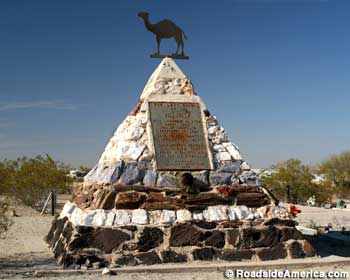
The Hi Jolly Monument is the kind of stop that looks eccentric from the road and then pulls Quartzsite into focus. Set in Hi Jolly Cemetery right off Interstate 10, it gives pass-through traffic a reason to slow down, step out, and meet one of La Paz County’s strangest and most memorable landmarks.
What you see at the cemetery stop
From a distance, the monument reads like a small roadside oddity. Atlas Obscura describes it as a memorial pyramid marker, while Arizona Department of Transportation calls it an unusual tomb in Quartzsite. That visual mismatch is part of the appeal: it looks like a curiosity first, then turns into a specific place with a named person, a local burial site, and a direct tie to Arizona history.
The marker sits where travelers can reach it without a long detour, which matters in a town built around highway movement. Quartzsite depends on people who are already crossing the desert on Interstate 10, and the monument gives them something more than a fuel stop. It is a short visit, but it can turn a quick drive-through into time spent in town, which is exactly how roadside landmarks keep small desert communities in the conversation.
For Quartzsite, that matters beyond the peak winter visitor season. When the crowds thin out, the monument remains a fixed point in the roadside economy, one of those places that still works for a traveler in July, a snowbird in January, or anyone who wants a real reason to pull over.
Who Hi Jolly was
The man behind the monument was Philip Tedro, who became known as Hi Jolly. Arizona Department of Transportation says Tedro was born in Syria and took the name Hi Jolly after converting to Islam and making a pilgrimage to Mecca. The name is linked to Hadji Ali, and ADOT describes Hi Jolly as a mispronunciation of that name. He came to the United States in 1850 as part of a U.S. cavalry experiment using camels in the Southwest.
That backstory gives the monument its weight. Hi Jolly was not just a colorful nickname attached to a grave marker. He was a camel driver, packer, scout, and Arizona desert resident whose life became stitched into the way the state remembers the frontier. An Associated Press reference cited by ADOT described him as the Syrian-born camel driver who became part of Arizona lore during the mid-1800s.
The site honors one of the United States government’s first official camel riders, which is why the monument feels larger than its size. It ties one person to migration, religion, military experimentation, and the hard practicality of crossing the desert.
The Camel Corps gamble
The monument also points back to one of the most unusual federal transport ideas ever tested in the Southwest. Secretary of War Jefferson Davis approved the camel program, and historical summaries identify Major Henry C. Wayne as an officer associated with the experiment. The Army was trying to learn whether camels could handle the desert better than horses or mules, especially in the harsh country of Southwest Arizona.
Roadside America says Davis had a novel idea in 1856: moving freight and people across the desert with camels. The plan never became a lasting military success, but it left behind a memorable cast of characters and a story that still fits the region’s landscape. The Camel Corps failed as a military program, yet in Arizona it became lore, and Hi Jolly became the name that endured.
That is part of why the monument works so well in Quartzsite. The town sits in a landscape shaped by long-distance travel, military routes, and desert logistics. A camel-driver’s grave is not random here; it belongs to the same geography that tested whether an animal from another climate could solve an American transportation problem.
How the monument took shape
Local references give the marker a layered history. A community post says the monument was dedicated on Jan. 4, 1903, and that about 33 years later the Arizona Highway Department cemented a bronze plaque to the tomb. Roadside America places the tomb marker’s erection in 1935 and says it is inscribed “the last camp of Hi Jolly.”
Those dates show how the site developed from a burial place into a roadside landmark with a more formal public face. The Quartzsite cemetery reference says he is buried in Quartzsite Cemetery, where a monument to him and the Camel Corps was dedicated, which reinforces the site’s role as both grave and memorial. However the timeline is read, the result is the same: the monument became a durable part of the town’s historic landscape.
The inscription matters because it turns a plain marker into a destination. “The last camp of Hi Jolly” makes the site sound almost like a final station on a desert route, which fits the larger story of Camel Corps testing, overland movement, and survival in the Southwest.
Why it matters for Quartzsite now
Quartzsite has long been a town people pass through on the way somewhere else. The Hi Jolly Monument interrupts that pattern with a stop that is small, specific, and memorable enough to justify leaving the highway for a few minutes. It gives the town a landmark that is recognizable to road-trippers, winter visitors, and anyone looking for something more grounded than a roadside photo opportunity.
The monument also helps tell the broader story of the Colorado River corridor and the lower desert as a proving ground for transport schemes that never quite worked as planned. That history still has local value because it gives Quartzsite a story that is both unusual and anchored in place. In a county where highways shape commerce, the monument keeps one more set of travelers in town long enough to look, learn, and linger.
This article was produced by Prism’s automated news system from verified source data, official records, and press releases, then run through automated quality and moderation checks before publishing. The system is built and supervised by the people who set the standards it runs under. Read our full AI policy.
Did this article answer your question?