Lake County explains annual property tax cycle and appeal process
Miss the spring appeal window or a homestead exclusion and Lake County homeowners can overpay. The tax clock starts with January 2 valuations and May 15, October 15 due dates.
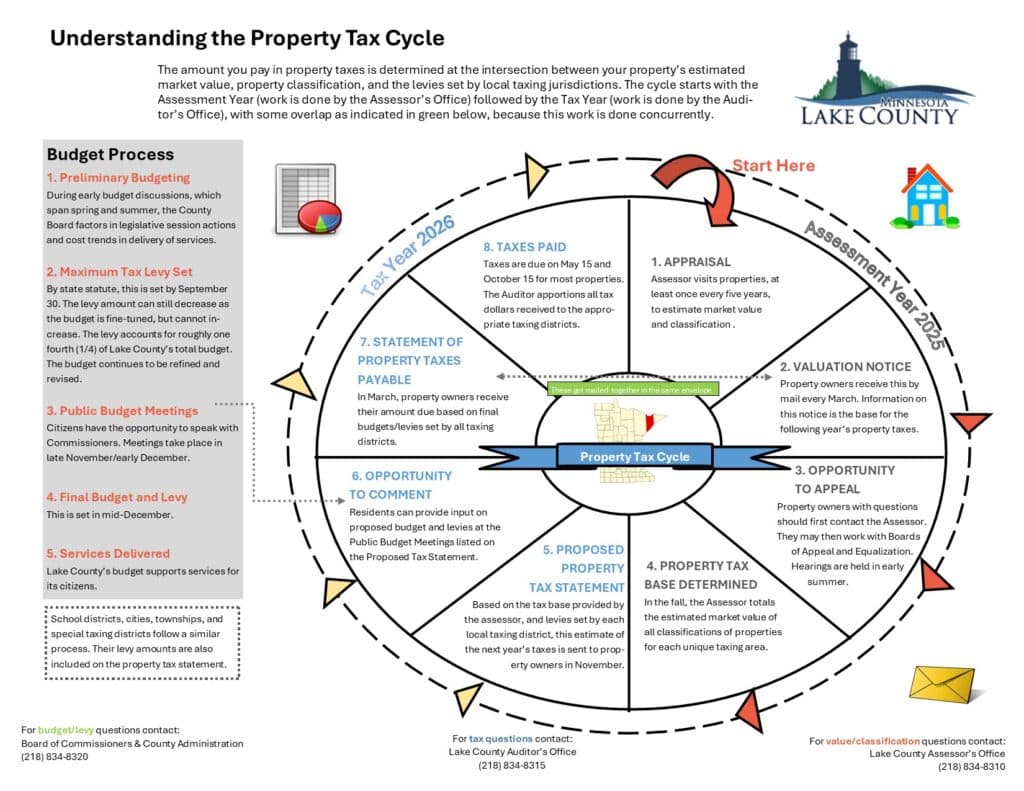
Lake County property owners face a January 2 assessment date and tax payments due on May 15 and October 15. They can lose money in three common ways: missing the spring appeal window, overlooking a homestead or other qualifying classification, or assuming a valuation notice changes the current bill immediately. In Minnesota, the tax cycle moves through local budgets, levies, credits, and state relief before those payments come due.
How the annual tax cycle works
Property taxes in Minnesota are not set in one step. Counties administer the system, assessors value and classify property, and auditors help determine tax capacity and levy calculations, while cities, townships, school districts, and other local taxing jurisdictions set their levies based on budget needs. That means a higher bill can come from several directions at once: a rising assessed value, a different classification, a local levy increase, or the loss of a credit or exclusion.
Property tax statements for the current year and valuation notices for the following year are mailed together in Lake County. That single mailing puts two separate pieces of the tax puzzle in front of you at once: what you owe now, and what the county has assigned to the property for the next tax year. For many homeowners, that is the first and best chance to catch an error before it turns into a bigger bill later.
The January 2 assessment date is the anchor. Property values and classifications are established as of that date each year, then used to determine taxes payable the following year. A valuation change does not usually rewrite the bill you are already paying right away. It is the number that helps shape what comes next.
What the dates mean for your wallet
For most real property in Minnesota, taxes are due May 15 and October 15. Those deadlines matter because they are the last stop for the bill once the valuation, classification, levy, and any credits have been set.
The most expensive mistake is waiting until the payment notice arrives and then assuming the bill cannot still be reduced. By that point, the path to lowering the number is often narrowed to refunds or special programs. The better time to act is when the valuation notice arrives, especially if the market value looks out of line with recent sales or the property’s classification seems wrong.
How to challenge an assessment
If the estimated market value or classification does not look right, gather evidence such as a recent appraisal or comparable sales and contact the assessor’s office. Many valuation issues can be resolved informally before a formal appeal is needed.
The next step is the local Board of Appeal and Equalization. Across Minnesota, those meetings are held annually between April 1 and May 31, often at a clerk’s office or another designated location in the township or city. If the issue cannot be resolved through the assessor first, that board is the place where a property owner can challenge the valuation or classification on the record.
An error in value is one kind of problem; a classification mistake is another. A homestead property, for example, can be treated differently from non-homestead property, and that classification affects the tax bill even if the market value itself is unchanged.
Relief programs that can lower the bill
Programs can reduce taxable value or refund part of the tax bill. One of the most important is the Homestead Market Value Exclusion, a statutory reduction in taxable market value for certain property occupied as a primary residence.
For taxes payable in 2025, the base exclusion increased from $76,000 to $95,000. The upper value that qualifies for the exclusion rose from $413,800 to $517,200. For homesteads valued between $95,000 and $517,200, the exclusion is calculated as $38,000 minus 9% of the valuation over $76,000.
Additional programs apply to blind or disabled classifications. Those classifications can affect how property is taxed, so they are worth checking when a household’s circumstances change. A homeowner who has lived with one classification for years can still miss a savings opportunity if the paperwork is never revisited.
Refunds that can soften the bill after the fact
Minnesota also offers property tax refund programs that can matter even after the tax bill is set. The homeowner property tax refund is now called the homestead credit refund, and it was previously known as the homeowner’s property tax refund or the circuit breaker. It is a state-paid refund designed to help homeowners whose property taxes are high relative to income.
For 2025, Minnesota House Research puts the household income limit for the homestead credit refund at $142,490 and the maximum refund at $3,480. If a household is near the limit, or the bill has climbed sharply, the refund may still matter even when the main tax statement is already out the door.
Renters have a separate change to watch. The renter’s credit began being claimed through the income tax system starting with refunds paid in 2025 for tax year 2024. That shift means renters no longer handle the credit the same way they once did, so the filing path now matters as much as the benefit itself.
What Lake County residents should watch first
The safest way to read a Lake County tax notice is to treat it like a deadline sheet, not just a bill. Check the January 2 valuation date, compare the assessed value with recent comparable sales, confirm the classification, and look for homestead or other relief that should apply before the spring appeal window closes.
By the time May 15 and October 15 arrive, the biggest chances to lower the bill are usually gone.
This article was produced by Prism’s automated news system from verified source data, official records, and press releases, then run through automated quality and moderation checks before publishing. The system is built and supervised by the people who set the standards it runs under. Read our full AI policy.
Did this article answer your question?