North Shore Health Upgrades Radiology Equipment, Promising Faster Scans and Lower Radiation
North Shore Health's just-retired X-ray was already secondhand when the hospital received it. The replacement adds AI that flags collapsed lungs in real time.
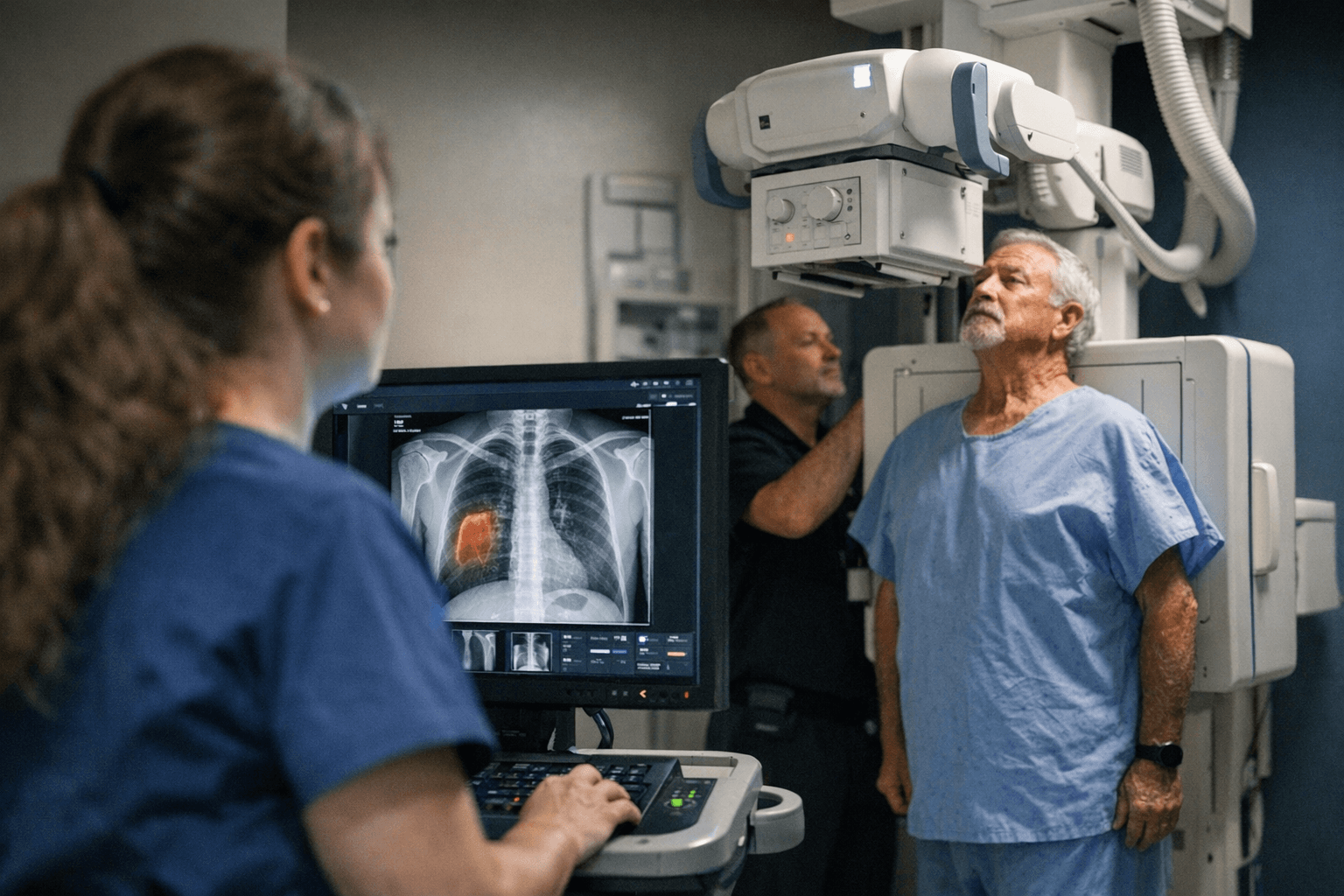
The X-ray machine North Shore Health replaced this month had been secondhand before the hospital ever received it. "It's been a while, and the one we had before this was refurbished when we got it," Radiology Director Brian Hady said of equipment that dated to the 2000s.
The hospital unveiled a new stationary X-ray machine and a portable X-ray unit at its March 19 board meeting, capping what Hady described as a long stretch of dependence on aging hardware. The new system produces sharper images, cuts scan times, and delivers lower radiation doses. It also changes what the radiology department can do in the minutes immediately after a scan.
The AI component is the most direct operational change. The system flags critical findings automatically, targeting pneumothorax, misplaced endotracheal tubes, and similar emergent conditions. "It triggers when it detects either pneumothorax or an ET tube," Hady said. For a critical-access hospital where an on-site radiologist is not always available, that automated alert compresses the window between imaging and clinical response, directly affecting emergency throughput.
The portable unit extends imaging capacity beyond the fixed suite. In-patients and residents in North Shore Health's skilled nursing facility who cannot safely be moved to a dedicated imaging room can now be scanned at bedside, reducing transfer risk and freeing the main suite for other cases.
Geography shaped the decision to buy new rather than refurbished. When a machine fails in Grand Marais, a service technician does not materialize quickly. "If the equipment goes down for whatever reason, we have to wait for a technician to drive all the way up here, and during that time, any patients that are coming in don't have that technology available to them," Hady said. Maintenance response distance was among the vendor criteria he evaluated before the purchase was finalized.
The new machines also support remote reading. Images can be shared digitally with primary care providers outside the region, and radiologists who interpret scans often work off-site. That workflow model allows North Shore Health to maintain diagnostic capacity even when local specialist coverage is thin, a recurring challenge for rural health systems competing against larger urban employers for imaging staff.
Funding the upgrade required navigating the capital constraints that define rural hospital finance. "We're small, and so the funding is limited," Hady acknowledged. The hospital's board raised the Cook County levy 15 percent for 2026, an increase of $284,625, partly to support equipment acquisitions and offset the chronic gaps in Medicare and Medicaid reimbursement that critical-access hospitals routinely absorb.
Staff training and workflow integration followed the board presentation. Hady said the new system represents a high standard for hospitals of all sizes, a benchmark the North Shore Health board chose to invest in rather than defer.
This article was produced by Prism’s automated news system from verified source data, official records, and press releases, then run through automated quality and moderation checks before publishing. The system is built and supervised by the people who set the standards it runs under. Read our full AI policy.
Did this article answer your question?