Our Lady of Guadalupe Church, Medina Cemetery reflect Hispano heritage
A small adobe church and cemetery west of Trinidad still anchor Hispano faith, memory, and family ties in Medina Plaza, where every wall and grave tells a living story.
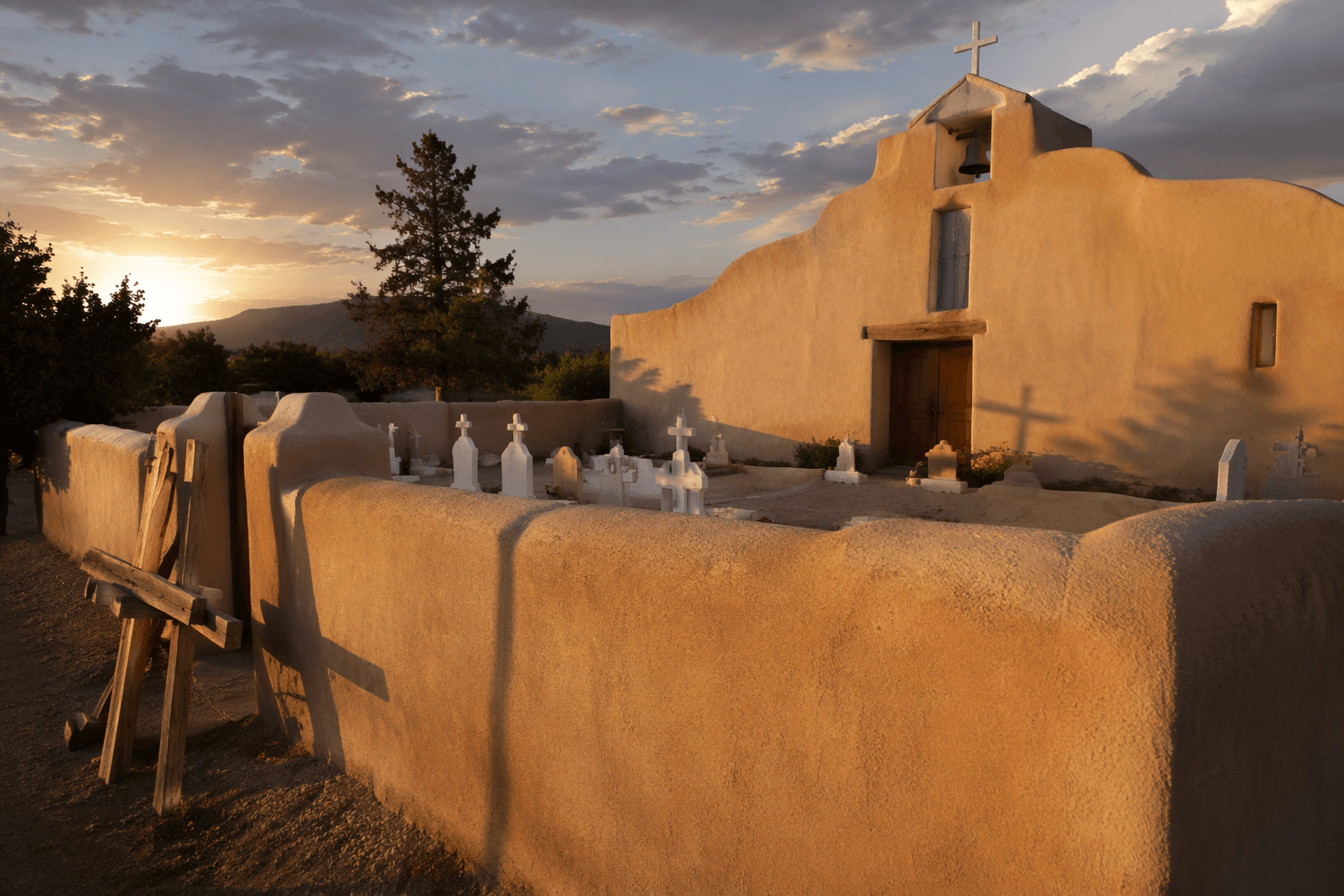
About eighteen miles west of Trinidad, Our Lady of Guadalupe Church and Medina Cemetery still define the heart of Medina Plaza. The adobe church and the burial ground beside it are not separate from community life in Las Animas County, they are part of the way families have marked baptisms, marriages, funerals, celebrations, and feasts in the Purgatoire River Valley for generations.
A placita built by family and place
Medina Plaza, formerly known as Guadalupe, grew from a placita established around 1862 by Agapito Medina, a native of northern New Mexico, and his family. That detail matters because it places the church and cemetery inside a family settlement pattern that shaped much of the rural southern Colorado borderlands. The site reflects how Hispano settlers organized life around land, kinship, worship, and burial in one compact community landscape.
The church and cemetery sit on the western edge of Medina Plaza, in a valley that also holds other historic plaza settlements. Velasquez Plaza is about 1.5 miles to the east, and Cordova Plaza is about 2 miles to the west. Colorado State Highway 12 runs east and west from Trinidad through Medina Plaza to Stonewall, then turns north toward Cuchara, tying the site to a travel corridor that still helps define the geography of this part of the county.
The church as a social center, not just a building
For nearly a century, Our Lady of Guadalupe Church served as the center of Hispano community life. It was where people came for baptisms and marriages, but also for funerals, celebrations, and feasts, which makes the church read less like a stand-alone landmark and more like a place where the full rhythm of family life took shape.
The building itself carries that history in its fabric. The nomination materials describe it as a one-and-one-half-story Hispano adobe church with a front-gable corrugated metal roof, an open wood-frame belfry, thick adobe walls, splayed window openings, remnants of manta de techo cloth, vigas, and an associated cemetery. It dates from 1866 or 1867, placing it among the earliest surviving religious buildings tied to settlement along this stretch of the Purgatoire River Valley.
Language inside the church also tells the story of community change. Sermons were typically given in Spanish, and by the late 1940s English was more commonly used. That shift captures a broader reality in rural Hispano communities: the church remained the same place, but the language of worship changed as families adapted across generations.
A morada, a gathering place, and a marker of identity
From 1902 to 1929, the church served as the morada for the Penitente Brotherhood. That period gives the site another layer of meaning, connecting it to a spiritual tradition that shaped religious practice and local identity in many parts of northern New Mexico and southern Colorado. The church was not just a house of worship; it was also a setting for devotion, gathering, and shared ritual life.
Physical reminders of that history remain visible. A 1958 Colorado Historical Society marker describing the church’s history stood beside the sidewalk leading to the entrance, and the site was documented in 1936 by the Historic American Buildings Survey as the Guadaloupe Mission Church. Those records help show how long the church has been recognized as important, but they also show something else: the place has needed repeated acts of attention to stay legible across time.
Why the cemetery matters as much as the church
Medina Cemetery is not an accessory to the church. It is part of the same cultural landscape, preserving family memory in a way that written records often cannot. In small rural communities, graves carry names, relationships, and faith practices forward when household stories are the main archive left behind.
That is why the cemetery matters to Hispano identity in Las Animas County. It anchors continuity between the first settlers near the Purgatoire River and the families who still recognize the place as theirs, even as the surrounding region changes. The church and cemetery together show how burial grounds, worship spaces, and settlement patterns can work as a single system of memory.
A historic landscape within a larger Hispano corridor
The National Park Service places the site within a broader settlement pattern in the valley, where early Hispano communities clustered along routes that linked plazas, farms, and churches. History Colorado describes the church and cemetery as embodying the cultural traditions and practices of early Hispano settlers in Medina Plaza, which is why the site belongs in any serious understanding of the county’s social history.
Its listing on the National Register of Historic Places on November 15, 2019 formally recognized that significance. But the meaning of the place extends beyond preservation language. It stands as one of the clearest surviving examples of how Hispano families built community in rural Colorado, with adobe construction, religious ritual, and burial traditions all rooted in the same place.
For people traveling through Las Animas County, the site is easy to locate in a practical sense and hard to miss in a cultural one. Highway 12 gives it a visible position in the landscape, but the church and cemetery are best understood by slowing down enough to see how the placita still fits into the valley around it. The landmark is not simply a stop on a heritage trail. It is part of a living rural network of memory that still shapes belonging in Medina Plaza.
Why preservation feels urgent here
The value of Our Lady of Guadalupe Church and Medina Cemetery is that they preserve a way of life that depends on place, family, and shared ritual. The more thinly populated rural plazas become, the more vulnerable that continuity can feel, especially when the people who know the histories by heart are the same ones who tend the grounds and pass the stories on.
What remains at Medina Plaza is therefore larger than a building and a burial ground. It is a working record of how Hispano families made a home in the Purgatoire River Valley, and a reminder that heritage in Las Animas County is not only something to be remembered. It is something that still holds a community together.
This article was produced by Prism’s automated news system from verified source data, official records, and press releases, then run through automated quality and moderation checks before publishing. The system is built and supervised by the people who set the standards it runs under. Read our full AI policy.
Did this article answer your question?