Flattop Butte stone reveals ancient trade routes across the Plains
Flattop Butte is Logan County’s stone archive, a quarry source that helped map ancient movement, trade, and toolmaking across the Plains.

Flattop Butte rises northwest of Sterling as more than a familiar high point on the eastern plains. Its Chadron Formation capstone is the only major bedrock source of high-quality stone between central Kansas and Nebraska and the Rocky Mountain foothills, which is why this Logan County landmark matters far beyond its skyline. Archaeologists know it as Flattop Butte, site 5LO34, and as one of the Plains’ most important lithic sources.
What makes the stone unusual
The material from the butte, known as Flattop chalcedony, comes in a striking range of colors, from opaque white to translucent lavender, with occasional pink and blue flecks. It also flakes exceptionally well, which made it valuable for points and other tools. That combination of visual distinctiveness and technical quality has let archaeologists treat the stone like a fingerprint, linking artifacts found far from Logan County back to a single source on the plains.
Flattop Butte is one of only three known source areas for White River Group silicates. The other two are Table Mountain in east central Wyoming and the White River Badlands in South Dakota. Because those sources can look similar to the eye, researchers have relied on neutron-activation analysis to separate them and track prehistoric movement with much greater confidence.
How archaeologists read the quarry
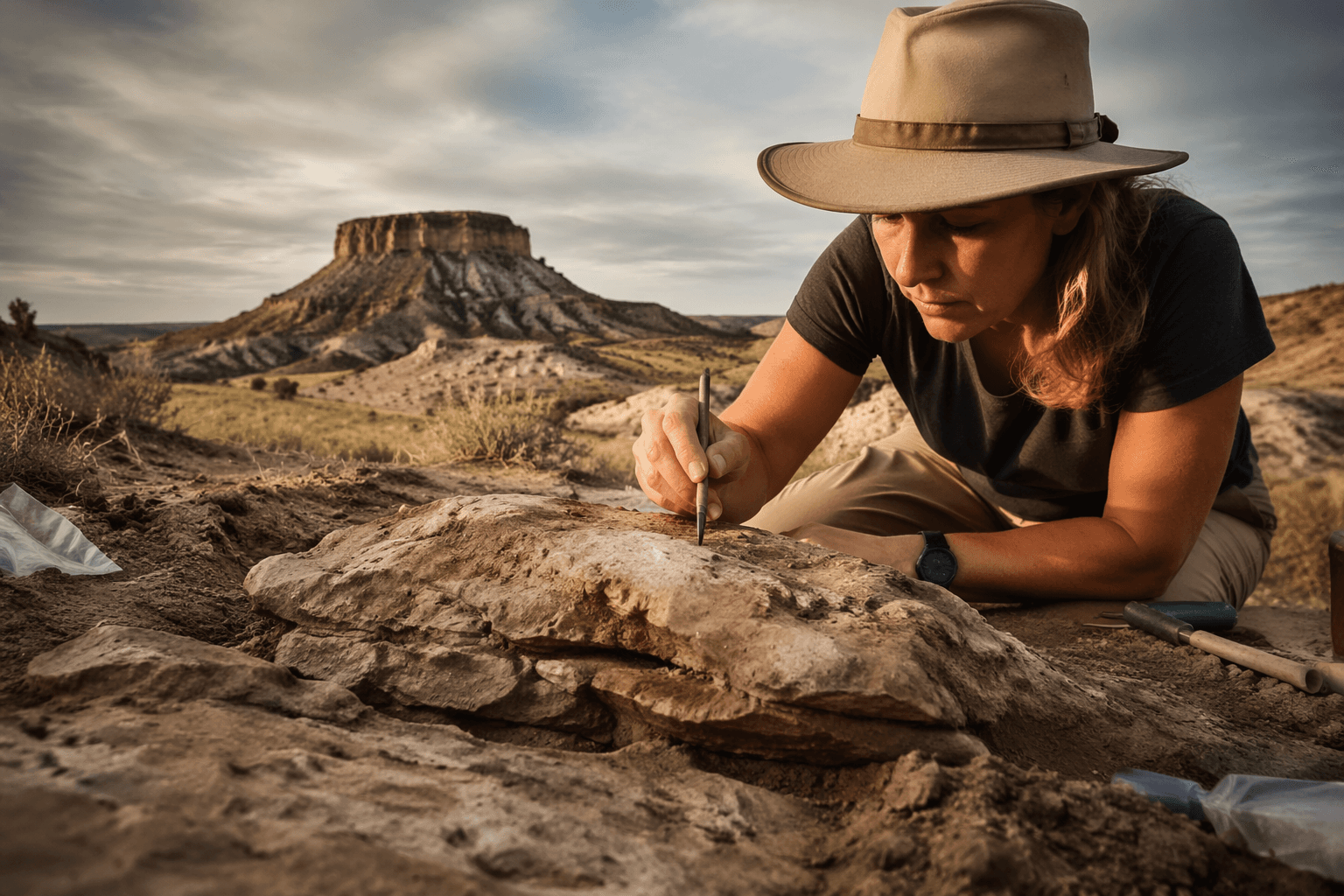
The quarry itself is not just inferred from scattered chips. In 1976, Sally T. Greiser identified more than 200 depressions on top of the butte that she interpreted as prehistoric quarry pits. She also documented flakes, cores, hammerstones, and finished tools across the surface, evidence of both extraction and reduction. The likely method was direct and practical: people appear to have dug down to the caprock and broken out blocks using sticks, bone tools, and wedges.
Greiser’s 1983 preliminary statement gives the site an important place in the history of archaeology on the plains. She wrote that she took on the quarry as a graduate seminar topic, working within the limits of short time, limited funds, and February High Plains weather. She also noted that the quarry was already known in the literature through Carlson and Peacock’s 1974 descriptions of lithic sources in and around Nebraska. That means the quarry was not a hidden discovery, but Greiser’s work helped define its larger significance for procurement, reduction, distribution, trade routes, trade items, quarry specialists, and territorial patterns.
Why the site matters across the Plains
Flattop chalcedony has turned up more than 300 miles from the quarry, with an average distance of about 105 miles to the east or southeast. That pattern shows the stone moving across a very wide region, not sitting still in Logan County. Archaeologist Steven R. Holen argued that such a spread suggests Clovis people knew the butte well and may have used it as a regular stop on migratory routes stretching up to 350 miles.
That kind of evidence changes how the county fits into the Great Plains map. Flattop Butte was not only a place where stone was taken from the ground. It was part of a network of travel, toolmaking, and exchange that linked what is now Logan County with places hundreds of miles away, long before roads, rail lines, or county boundaries defined movement.
A quarry used for millennia
A Colorado State University thesis on chronology, spatial organization, and mobility at Flattop Butte states that Flattop chalcedony has been used for over 13,000 years, since the earliest human entry into the Central Plains region. The same thesis says the quarry had received only cursory archaeological investigation before that work, which makes the site especially important for understanding how much more remains to be learned from eastern Colorado.
That thesis also frames three basic questions that still matter at the butte: when the quarry was used, how quarrying space was organized, and whether the work was tied to routine mobility or special-purpose trips. Those questions matter because a quarry can reveal more than the tools it produced. It can show when people came, how they worked the landscape, and whether they returned repeatedly across generations.
Why eastern Colorado is still underread
A 2021 paper on eastern Colorado archaeology adds another layer to the Logan County story. It says professional understanding of eastern Colorado remains limited in part because 40 percent of Colorado is publicly owned and most professional archaeological work has historically occurred in western Colorado. The same paper notes that artifact collectors have searched eastern Colorado for the past 100 years, building a broader picture of the archaeological record over time.
That history explains why a place like Flattop Butte can still feel underappreciated despite its importance. The site sits in plain view near Sterling, yet it connects Logan County to major questions about how the earliest inhabitants of the Central Plains moved, where they camped, and how they obtained the stone that became their tools.
How to see Flattop Butte differently
If you stand near Flattop Butte today, the surface story is obvious: a butte on the eastern plains, recognizable from the surrounding country. The deeper story is in the stone itself and the traces left on top of the caprock. More than 200 quarry depressions, tool debris, and the wide distribution of Flattop chalcedony together show that this was a working landscape, not just a landmark.
For Logan County, that makes Flattop Butte a place where local geography and continental history overlap. The butte helps explain how people traveled, how they found reliable stone in a region where high-quality tool material was uncommon, and how eastern Colorado fit into the long movement patterns of the Plains. It is one of the county’s clearest reminders that the ground here still holds evidence of journeys made more than 13,000 years ago.
This article was produced by Prism’s automated news system from verified source data, official records, and press releases, then run through automated quality and moderation checks before publishing. The system is built and supervised by the people who set the standards it runs under. Read our full AI policy.
Did this article answer your question?