Semi Hauling Heavy Equipment Gets High-Centered on Sterling Railroad Crossing
A Sterling semi driver used the loader being hauled to free the truck after it high-centered on the Front Street railroad crossing Sunday.
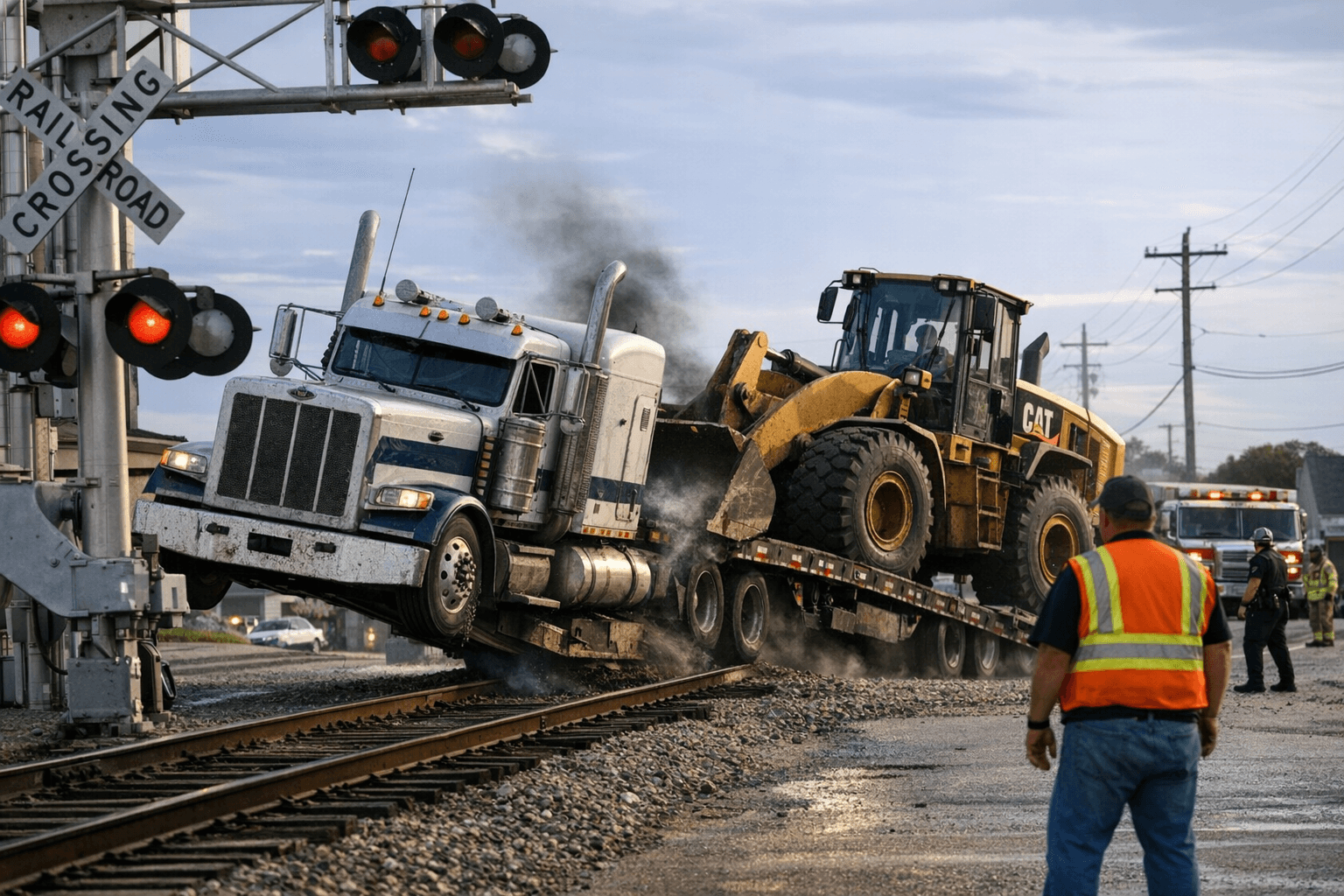
A semi hauling heavy equipment, including a loader, became high-centered on the railroad crossing at Front Street and Factory Street in Sterling on Sunday, leaving the driver to engineer an improvised recovery: offloading the loader from the trailer and operating it to free the stuck vehicle while Sterling Police stood by and rail traffic was notified.
The operation succeeded without further complications.
High-centering occurs when a trailer's undercarriage catches on the raised rail profile at a crossing, leaving the drive wheels suspended and unable to gain traction. It is a particular hazard for low-clearance trailers carrying heavy or oversized loads at crossings where the rail sits above the road surface. The driver's recovery method mirrors a recent incident in Midland, Texas, where a front loader was similarly deployed to rescue a stuck truck on railroad tracks.
The crossing at Front and Factory streets sits along a rail corridor that has defined Sterling since before the city's first major growth period. Union Pacific Railroad has operated through Sterling since at least 1902, when it built its Romanesque Revival depot at 113 N. Front Street, just steps from Sunday's incident. The railroad's presence shaped the commercial district: in 1905, the Sterling Sugar Company built a beet-processing factory directly across the tracks from Front Street, helping fuel a population boom that nearly tripled Sterling's headcount between 1900 and 1910. The depot closed in 1983 as passenger service declined and was added to the National Register of Historic Places in 1986. Several freight carriers still use the corridor; no passenger trains serve the city today.
The outcome contrasted sharply with what rail crossings in the region have produced in other incidents. Logan County has seen at least one fatal highway-rail collision: a semi driver was killed and a BNSF train crew was injured when a truck struck a coal train near Peetz, at the Highway 113 and County Road 74 crossing roughly three miles south of the Nebraska state line. In January 2024, an Amtrak train carrying 69 passengers derailed in Weld County after hitting a semi blocking the tracks near Keenesburg. The following month, a semi stuck on tracks near downtown Colorado Springs was cleared within 45 minutes without a collision.
Nationally, Federal Railroad Administration data tracked by Operation Lifesaver recorded 2,266 highway-rail grade crossing collisions in 2025, with 288 fatalities and 754 injuries across more than 200,000 monitored crossings. Among the least-used safety tools at those crossings are the blue Emergency Notification System signs posted beneath every stop arm: each carries a direct phone number to the railroad company, which can radio an engineer to halt an approaching train. Even with an immediate stop command, a freight train can require more than half a mile to come to rest after striking a heavy vehicle.
Following the Sterling incident, safety officials issued a reminder for drivers hauling oversized or low-clearance loads to verify crossing angles and rail heights before committing to a route, and to locate the ENS sign at any crossing used regularly.
This article was produced by Prism’s automated news system from verified source data, official records, and press releases, then run through automated quality and moderation checks before publishing. The system is built and supervised by the people who set the standards it runs under. Read our full AI policy.
Did this article answer your question?