Army Veteran Founders Move Quantum Radar Startup to New Mexico With LANL Backing
GPS-jammed U.S. drones crashing in Syria put Army veteran Stephen Buchanan on a path to quantum radar; his startup Bandelier Technologies is now moving to New Mexico with LANL backing.
Stephen Buchanan was watching U.S. and allied drones crash outside a base in Syria during a 2022-2023 deployment when the pattern finally clicked. "At first we were like, 'Why can't you guys do your jobs right? And then it happened again and we were like, 'There's something going on here,'" Buchanan recalled. "And the GPS was getting jammed."
That firsthand experience is now the founding logic of Bandelier Technologies, the quantum radar and sensing startup Buchanan leads as founder and CEO. He and a business partner who served alongside him in the Army Green Berets are relocating their families from the East Coast to New Mexico, backed by Los Alamos National Laboratory's Lab Embedded Entrepreneur Program and CerraCap Impact Venture Capital, to build systems designed for exactly those GPS-denied environments.
Bandelier was selected for NM LEEP Cohort 5, a two-year fellowship that embeds startup founders at Los Alamos alongside LANL scientists to accelerate commercialization of national security technologies. NM LEEP Program Manager Molly Cernicek said at the cohort's announcement that Cohort 5's technologies "directly support our national security mission."
For Buchanan, the fellowship was the decisive factor in leaving the East Coast. He said he "would not have made the decision to move his wife and two children — another is on the way — to the Land of Enchantment had it not been for the New Mexico Lab Embedded Entrepreneur Program." He is finishing his Harvard MBA before relocating. After his Army deployments he enrolled at Harvard, where another veteran, Wale Lawal, CEO of Mesa Quantum and a Harvard Business School graduate, visited one of his classes to talk about quantum technology's potential.
"It just really spiked my curiosity" because it was "so different from what everybody else was doing," Buchanan said of Lawal's talk. He approached Lawal after class, who told him about New Mexico startup opportunities; that conversation led Buchanan to apply for LEEP.
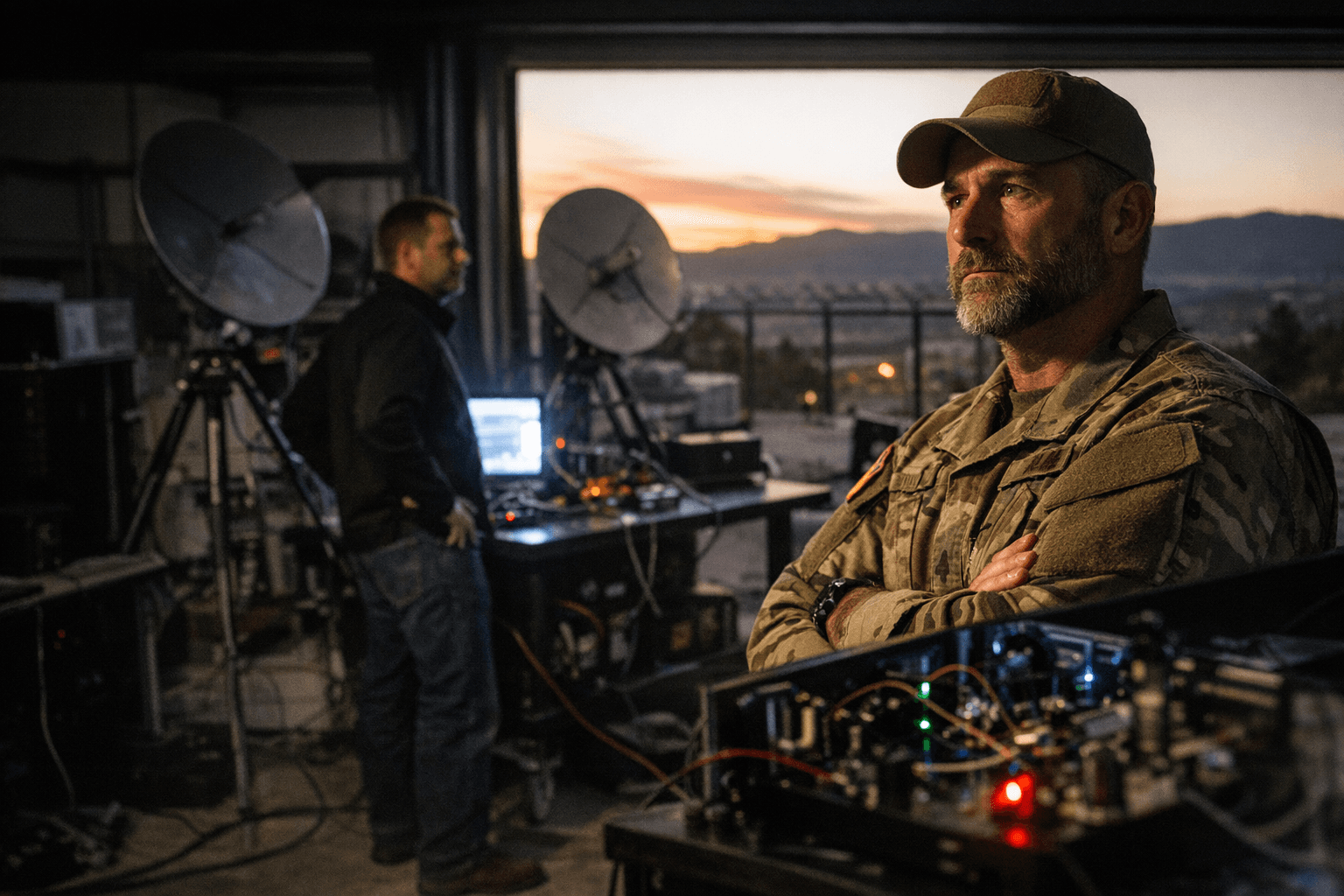
Beyond Syria, Buchanan pointed to Ukraine to make the case for urgency. "If you look at the Ukrainian campaign, they've almost had to discard GPS altogether," he said. "It's jammed, it's spoofed, it's unavailable to them." Bandelier's platform, built on photonic techniques developed at Los Alamos and engineered to operate without quantum memory, is designed to detect targets at long range while functioning in contested environments where classical radar systems fail. That no-quantum-memory architecture is a key differentiator: it allows the system to scale toward field deployment rather than remain confined to laboratory conditions.
The company's ambitions are economic as well as strategic. Asked whether his goal was to sell or build, Buchanan was direct: "We want to build out this big company to manufacture systems in New Mexico, create a ton of New Mexico jobs." He said now is the time for quantum technology to enter "the primetime limelight."
For scientists and researchers already working within the Los Alamos ecosystem, the LEEP structure offers a direct pathway into Bandelier's work. The two-year fellowship is built on embedded collaboration with LANL staff, and Buchanan spent a decade in Special Forces before business school: the company is oriented toward people who understand both the lab and the field. His business partner, who completed multiple combat deployments alongside Buchanan, will lead Bandelier's commercialization strategy as both make the move west.
This article was produced by Prism’s automated news system from verified source data, official records, and press releases, then run through automated quality and moderation checks before publishing. The system is built and supervised by the people who set the standards it runs under. Read our full AI policy.
Did this article answer your question?