Blasting Begins for Border Barrier on Sacred Mount Cristo Rey
Explosions tore through Mount Cristo Rey last month as CBP blasted the sacred Sunland Park peak for a border wall, catching the Catholic Diocese and preservationists off guard.
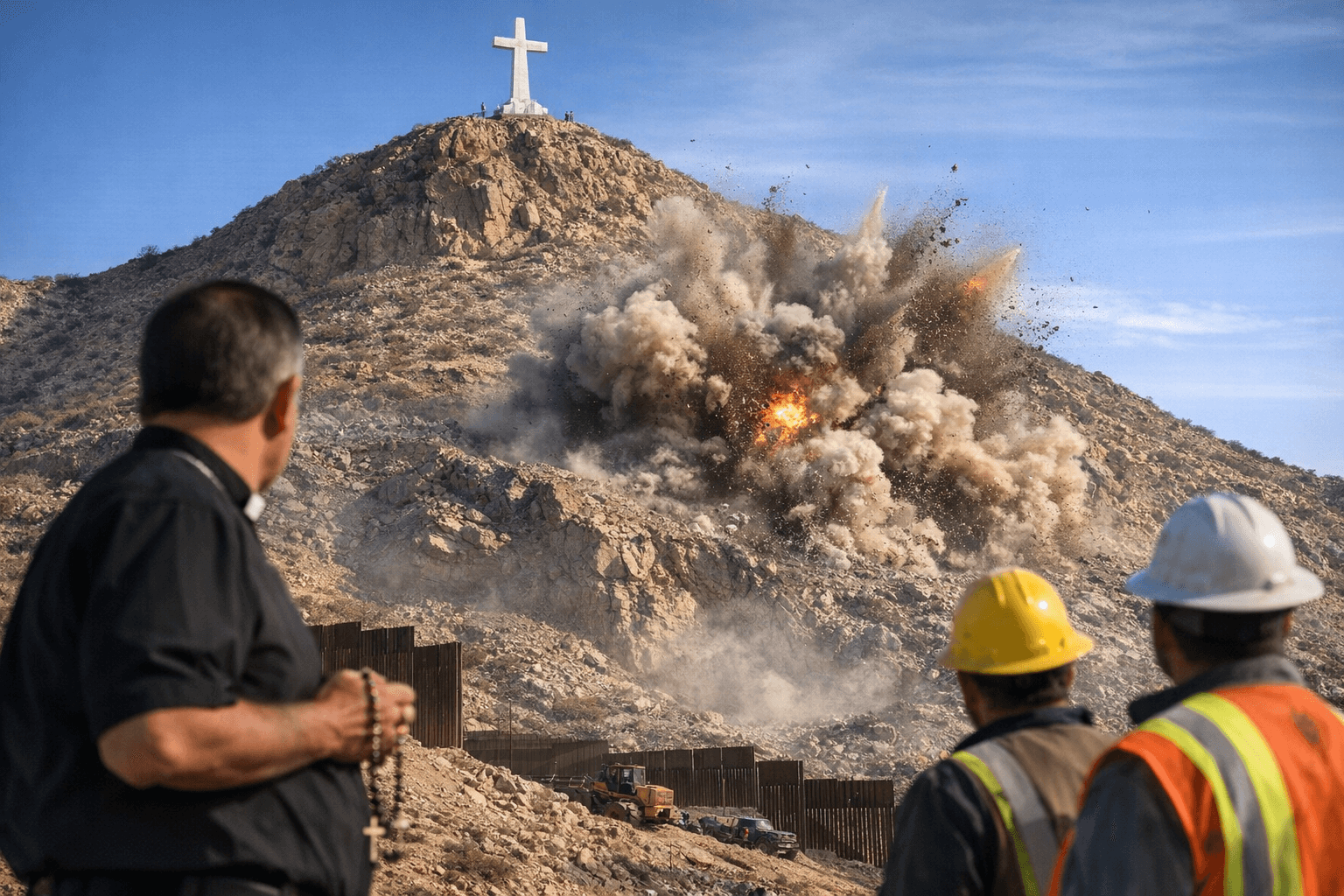
Federal contractors detonated explosives on the south face of Mount Cristo Rey in Sunland Park late last month, advancing a 30-foot steel barrier that will cut 1.3 miles across a mountain sacred to Catholic pilgrims, Chihuahuan Desert wildlife, and border communities spanning three political jurisdictions. Neither the Roman Catholic Diocese of Las Cruces nor Ruben Escandon Jr., spokesperson for the Mount Cristo Rey Restoration Committee, received advance notification of the blasting schedule. Morrow, the Diocese's attorney, confirmed the same gap in communication from federal agencies.
The project, officially designated the El Paso Anapra 16-4 Wall Project, forms part of a $95 million initiative to construct more than 70 miles of primary barrier across the El Paso sector. Funding traces back to DHS 2020 border wall appropriations but sat largely dormant through the Biden administration. Once President Trump returned to office, Mount Cristo Rey became a priority. Then-Homeland Security Secretary Kristi Noem moved to accelerate the timeline on June 3, 2025, waiving more than two dozen federal laws under authority granted by the REAL ID Act of 2005, sidestepping standard environmental review. The finished barrier will consist of steel bollards spaced four inches apart, reinforced with concrete and outfitted with lights, cameras, roads, and detection technology.
The wall looms directly over Anapra, the Ciudad Juárez neighborhood just feet from the blast site, where warning signs had been posted as early as January 2026. After the detonations, CBP uploaded video of the blasts to social media, describing the work as a "face lift" to "secure a historically challenging terrain." The framing drew sharp criticism from residents and advocates on both sides of the border.
Mount Cristo Rey sits at 4,675 feet at the precise convergence of New Mexico, Texas, and Mexico. Its summit has been a place of devotion since Father Lourdes F. Costa, parish priest of the Smeltertown community, erected a wooden cross there in 1934. The 29-foot limestone Christ statue sculpted by Urbici Soler was completed in 1939 and formally dedicated in 1940, and the pilgrimage tradition it anchors is nearly a century old. The Diocese of Las Cruces, which owns approximately 200 acres on the New Mexico side of the mountain, urged CBP to exclude the site from its plans, describing Mount Cristo Rey as a place "where faith transcends borders" and warning that construction would amount to "a significant infringement on religious freedom and the rights of worship, which are protected under both the First Amendment." When CBP opened public comment on the project, 211 of the 224 written submissions, roughly 94%, opposed the wall.
Environmental advocates are pressing parallel objections. Rick LoBello, an El Paso board member of the Texas Lobo Coalition, warned that fragmenting the mountain's terrain would cut off movement of javelina, deer, coyotes, and potentially Mexican wolves through what scientists describe as a critical biological corridor. CBP's own biological survey found no federally listed threatened or endangered species and rated the habitat "low to moderate" in wildlife suitability, stopping short of a full environmental impact assessment. The environmental summary report that was completed in its place has not been made publicly available.
CBP justifies the project by pointing to a documented gap in existing barrier at the western base of the mountain that served as a documented smuggling and migration route. Border crossings in the region fell nearly 80% over the past year. Yet in 2024, the El Paso and New Mexico corridor became the deadliest crossing point for migrants along the entire U.S.-Mexico border, a grim distinction that frames the debate over whether the wall addresses the region's most urgent humanitarian problem.
Escandon had expressed hope that blasting would pause for Good Friday, but this year's pilgrimage on April 3 brought thousands of faithful up the mountain above an active construction zone for the first time in the shrine's nearly century-old tradition.
This article was produced by Prism’s automated news system from verified source data, official records, and press releases, then run through automated quality and moderation checks before publishing. The system is built and supervised by the people who set the standards it runs under. Read our full AI policy.
Did this article answer your question?