OpenAI Arrives at Los Alamos with Armed Guards, Locked Briefcases
OpenAI agents carried locked metal briefcases of ChatGPT o3 model weights into Los Alamos last May, marking the first time a reasoning AI ran on a nuclear supercomputer.

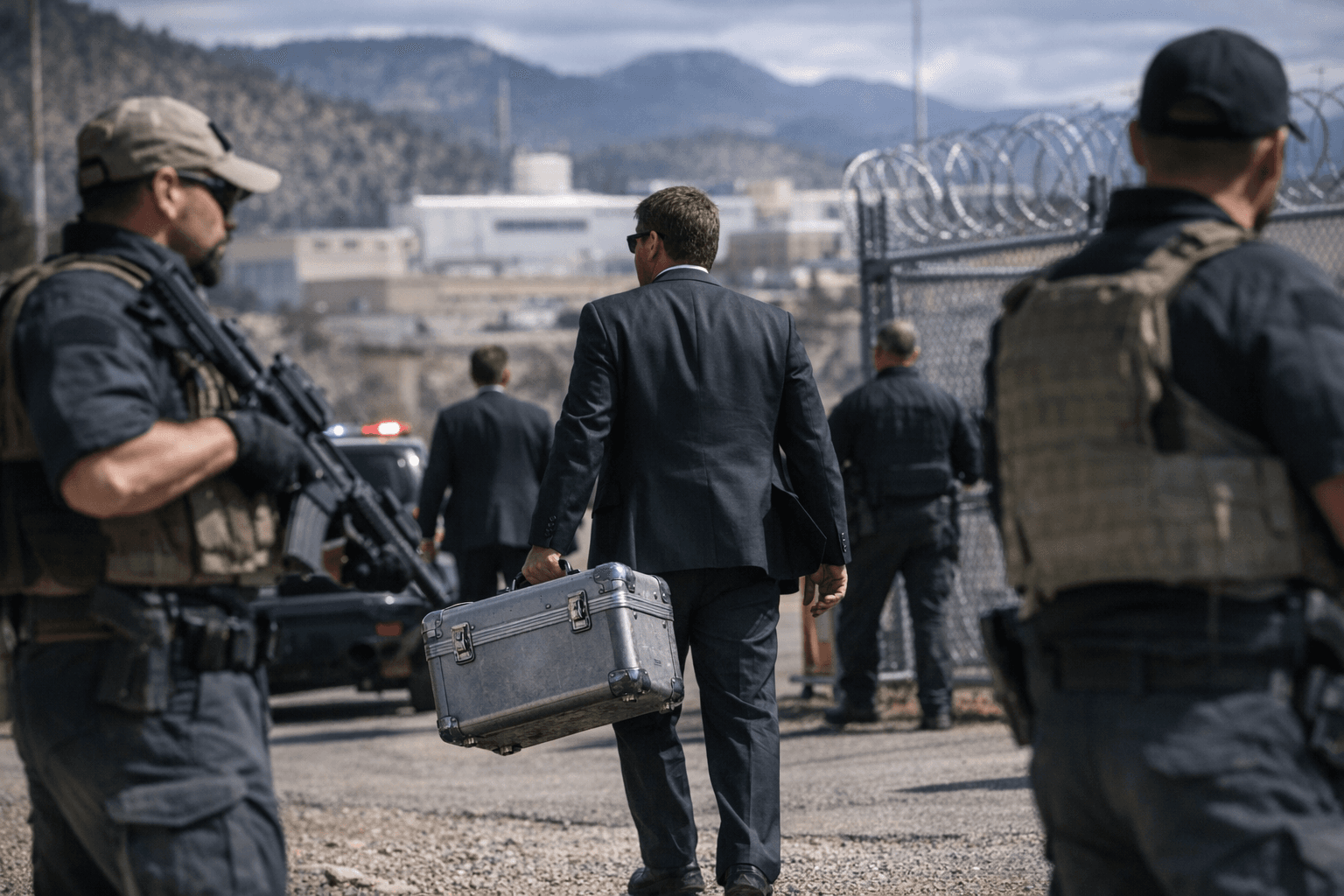
OpenAI representatives arrived at Los Alamos National Laboratory last May with armed security escorts carrying locked metal briefcases. Inside were the "model weights" for its ChatGPT o3 reasoning model, destined for installation on Venado, one of the world's most powerful supercomputers and a machine that now sits on a classified government network.
The delivery carried a striking visual: armed guards transferring software parameters through one of America's most storied national security sites, the birthplace of the atomic bomb. It was the first time a reasoning model of that class had been applied to national security problems on a system of Venado's scale, and the physical handoff was necessary because LANL's computers operate as a closed system, disconnected from the public internet.
Venado itself is a formidable machine. Built in collaboration with HPE Cray and Nvidia, which supplied 3,480 of its proprietary Grace Hopper superchips, Venado is capable of roughly 10 exaflops of computing power, the equivalent of 10 quintillion calculations per second. The system fills dozens of 8-foot-tall cabinets, one of which carries the signatures of technology executives including Nvidia CEO Jensen Huang. As of early 2026, Venado ranks as the 22nd most powerful computer in the world.
OpenAI and LANL had formalized their partnership in January 2025, under an agreement that extended access to up to 15,000 scientists across Los Alamos, Lawrence Livermore, and Sandia National Laboratories. LANL Director Thom Mason framed the stakes plainly: "As threats to the nation become more complex and more pressing, we need new approaches and advanced technologies to preserve America's security."
By August 2025, Venado had moved to a classified network, giving the AI system access to some of the nation's most sensitive nuclear weapons data. Jason Pruet, director of Los Alamos' National Security AI Office, described the potential as generational. "Our hope is that in the next two or three years we will be able to make contributions to the nation that otherwise would have taken us ten or twenty years," Pruet said. Acting NNSA Administrator Teresa Robbins, announcing the classified deployment, called AI "the defining technology of the 21st century."
Researchers who use the system today access it from their desktop computers, interacting with the model much the same way anyone at home queries ChatGPT, with one consequential difference: the answers may now inform decisions about America's nuclear stockpile. The locked briefcases were just the beginning.
This article was produced by Prism’s automated news system from verified source data, official records, and press releases, then run through automated quality and moderation checks before publishing. The system is built and supervised by the people who set the standards it runs under. Read our full AI policy.
Did this article answer your question?