Bradbury Museum Hosts LANL Astronomer for Night With a Nerd
LANL astronomer Chris Fryer, credited with the first 3D supernovae simulations and more than 53,000 scholarly citations, speaks at Bradbury on April 16.
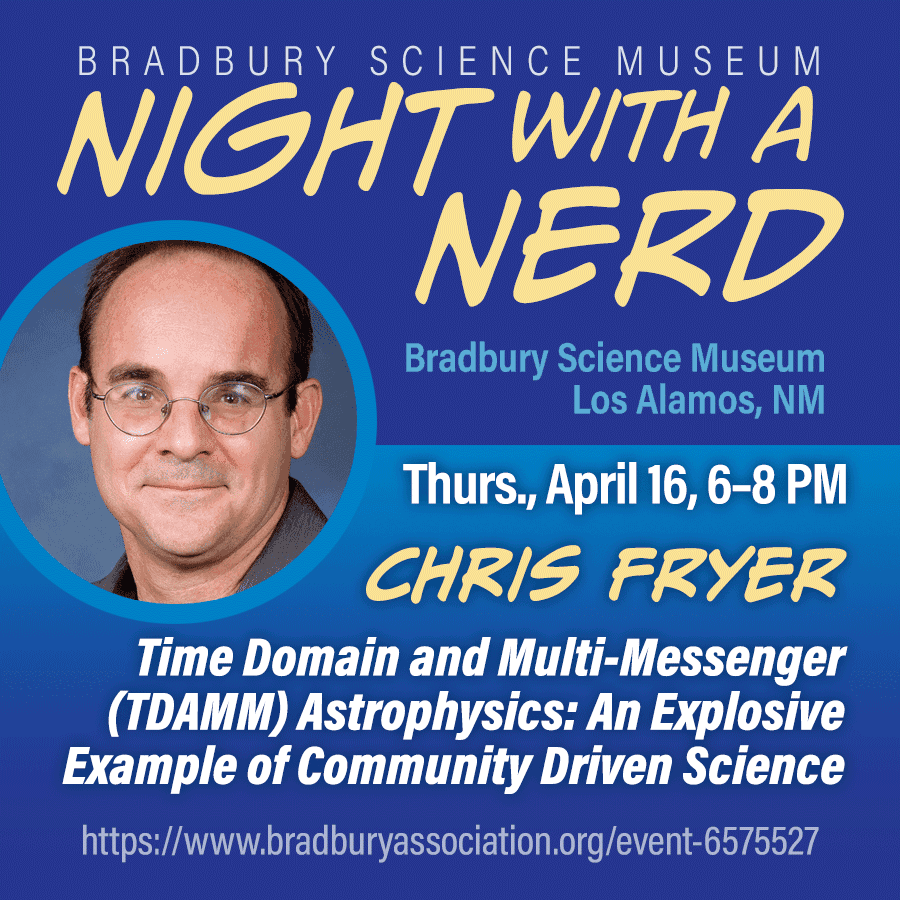
The man who produced the first three-dimensional simulations of a collapsing star will field questions from Los Alamos residents at the Bradbury Science Museum on April 16, and admission runs $10 at the door.
Chris Fryer, a research astronomer at Los Alamos National Laboratory, headlines the Bradbury Science Museum Association's next Night With a Nerd, a 90-minute public science talk running from 6:30 to 8:00 p.m. Fryer's work spans theoretical astrophysics, fluid dynamics, high-energy density physics, and nuclear astrophysics, a portfolio that has generated more than 53,000 scholarly citations and 343 peer-reviewed publications, making him one of the most-cited active scientists on the Hill.
Fryer joined LANL in 2000 as a Feynman Fellow, one of the laboratory's most competitive early-career appointments, and later became a staff scientist. He earned a B.A. in Mathematics and Astrophysics from UC Berkeley in 1992, a Ph.D. in Astronomy from the University of Arizona in 1996, and completed a postdoctoral fellowship at UC Santa Cruz before arriving in Los Alamos. The American Physical Society named him a fellow in 2008, citing "leadership in theoretical and computational high energy astrophysics through multidimensional simulations." The American Association for the Advancement of Science added its own fellowship in 2020. He holds LANL Fellow status as well and is a recipient of the E.O. Lawrence Award.
His April 16 talk centers on time-domain and multi-messenger astrophysics, a field that has reshaped how scientists observe the universe by combining traditional light-based telescopes with gravitational wave detectors and neutrino observatories to reconstruct events like neutron star collisions and stellar explosions. For a community built around computational science, the subject connects LANL's own simulation capabilities directly to some of the most extreme physics in the known universe.
The questions Los Alamos residents are likely to press Fryer on will go well beyond a general introduction. How does LANL's high-performance computing infrastructure define what is possible when modeling supernovae? What can gravitational wave signals reveal that light cannot? Does the physics of stellar collapse share any mathematical territory with nuclear weapons design? And what does nuclear astrophysics tell us about how heavy elements like iron, gold, and uranium were forged inside dying stars?
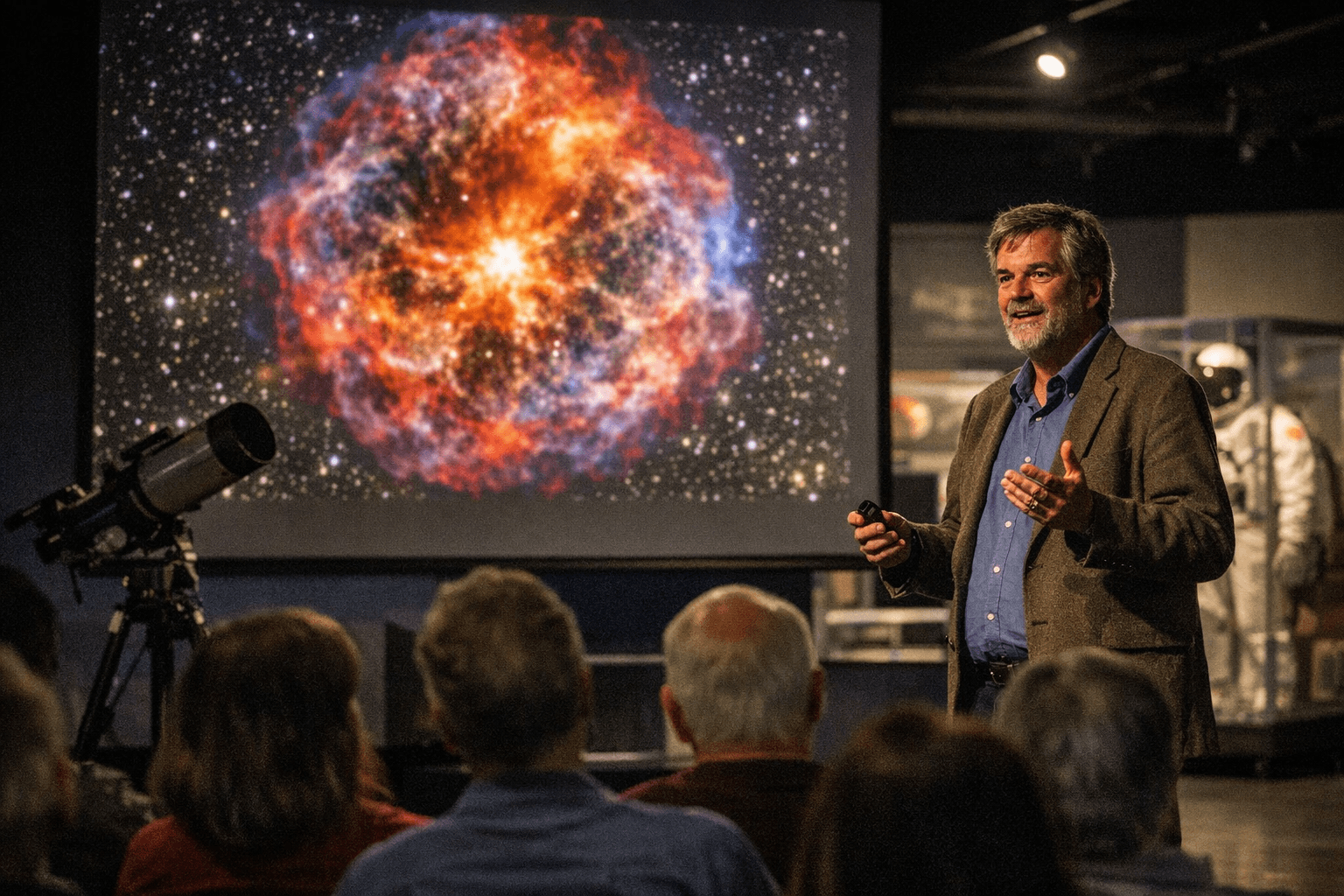
Night With a Nerd has anchored the Los Alamos public-science calendar since at least 2019, when the series launched its first documented run at Fuller Lodge before eventually settling into the Bradbury Science Museum. Past speakers have ranged from Mark Chadwick, LANL's interim deputy director for Science, Technology and Engineering, speaking on Manhattan Project fusion research, to University of Maryland associate research professor Tim Koeth in 2019, to Jim Eckles covering the natural history of White Sands Missile Range in September 2021. The $10 admission and free-for-members pricing has held steady across all documented editions.
BSMA members attend free. Limited childcare is available for advance-registered children, broadening the event's reach to families with young kids. Tickets are available through the Bradbury Science Museum Association and at the door, subject to capacity.
In 90 minutes on April 16, attendees can expect to understand why multi-messenger astrophysics marks a turning point in how humans read the cosmos, what Fryer's simulations revealed about the final seconds of a massive star's life, and how physics computed in Los Alamos connects to signals recorded by instruments thousands of miles away.
This article was produced by Prism’s automated news system from verified source data, official records, and press releases, then run through automated quality and moderation checks before publishing. The system is built and supervised by the people who set the standards it runs under. Read our full AI policy.
Did this article answer your question?