County utility board to hear update on chromium plume cleanup
County utility board members got an update on a chromium plume that still stretches about a mile under Mortandad and Sandia canyons. Cleanup work remains tied up in a state order that shut down injection operations last November.

Los Alamos County utility board members heard that the hexavalent chromium plume beneath the lab area still measures about 1 mile long and one-half mile wide under Mortandad Canyon and the southern edge of Sandia Canyon, even as cleanup work remained caught in a state order that forced a shutdown of injection operations last November.
The plume traces back to cooling-tower releases at Los Alamos National Laboratory’s non-nuclear power plant from 1956 to 1972, when potassium dichromate was commonly used as a corrosion inhibitor. The contamination was first detected in 2004 in a regional aquifer monitoring well above New Mexico’s groundwater standard of 50 micrograms per liter.
Department of Energy materials say there is no immediate threat to human health or the environment, and the plume is not currently near known public or private drinking-water wells. DOE also says Los Alamos County drinking-water wells have shown 0 chromium contamination. The agency’s fact sheet places the regional aquifer about 900 to 1,000 feet below the surface, about 5 miles from the Rio Grande, with roughly 37 monitoring, extraction and injection wells installed in and around the plume.
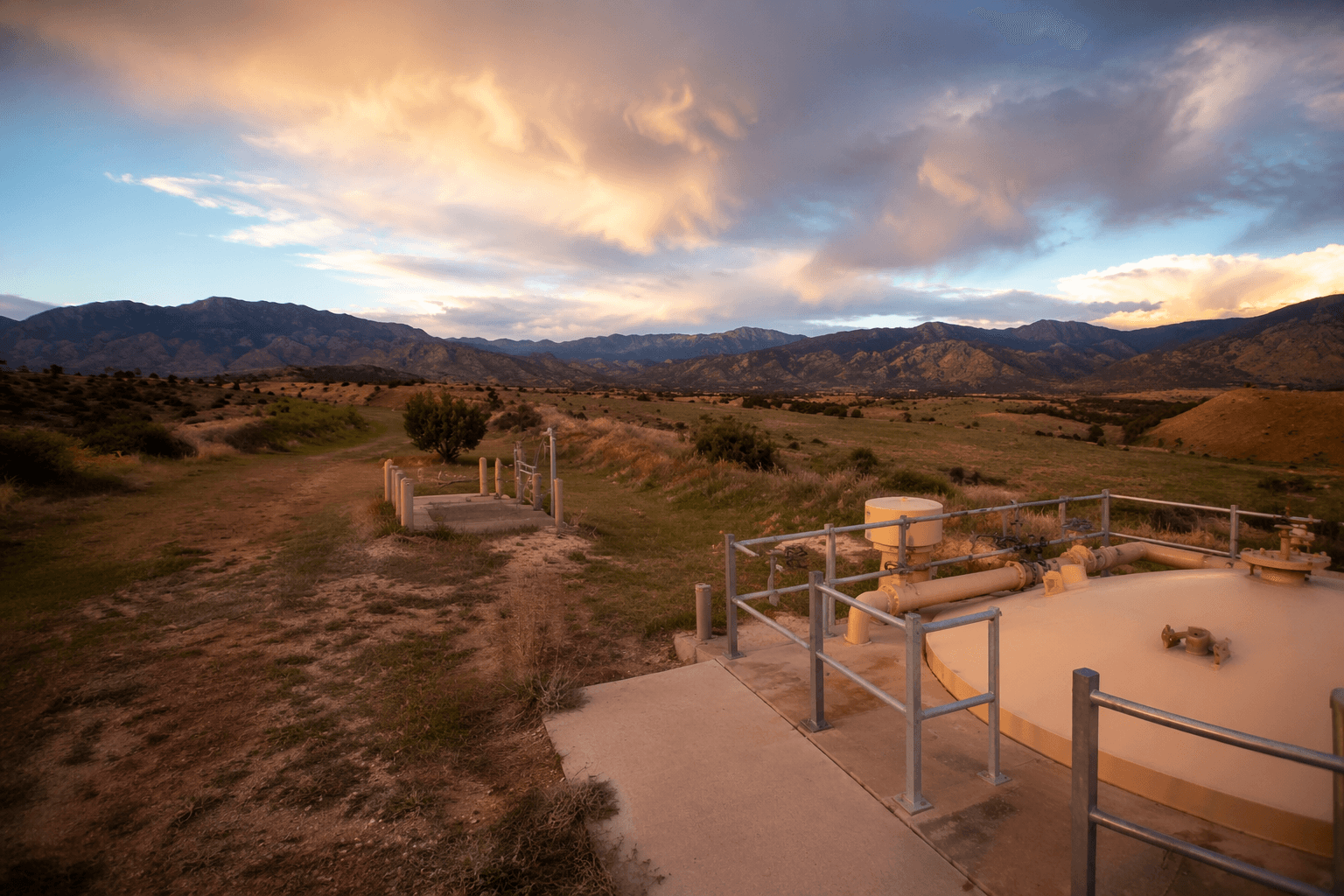
Cleanup has been shaped as much by regulation as by geology. DOE says the New Mexico Environment Department directed it on Nov. 18, 2025, to stop all injection operations for the Chromium Interim Measures system, and DOE turned the system off immediately. The system, approved by NMED in 2015, had resumed partial operation in September 2024 after a shutdown that lasted from March 2023 to September 2024.
DOE says the interim measures work by extracting contaminated groundwater, treating it above ground and reinjecting it to create a hydraulic barrier and control plume migration. An Expert Technical Review Team concluded that the single most important step was to restart interim measures using part of the original system while other studies continued.
The plume has also become a test of intergovernmental oversight. DOE says it is working with NMED, the New Mexico Office of the State Engineer, Pueblo de San Ildefonso and Los Alamos County as additional wells are planned and permitted to better define the contamination and evaluate longer-term remedies. DOE’s independent review summary says the chromium traveled about 3 miles downstream in Sandia Canyon before migrating below ground, underscoring why the county board wanted the update in public rather than leaving it to federal channels alone.
Know something we missed? Have a correction or additional information?
Submit a Tip