Los Alamos lab shows quantum annealers deliver real science results today
LANL researchers used three D-Wave machines and thousands of spins to run the first hysteresis experiments on quantum computers, showing practical science today.

Los Alamos National Laboratory researchers have shown that quantum annealers can do more than promise future computing power: they can already run controlled science experiments on magnetic behavior at a scale that matters. Using three D-Wave superconducting-qubit machines, the team carried out what LANL described as the first hysteresis experiments on quantum computers, with up to thousands of spins.
That matters in Los Alamos because the work points to a near-term use case for a technology often discussed in much more speculative terms. Instead of waiting for a fault-tolerant universal quantum computer, the laboratory used existing analog quantum computers to build systems that behave like physical materials, then measured how those systems responded under controlled conditions. The result opens a path for probing magnetism and other questions in condensed matter physics without leaving the hardware in the “someday” category.
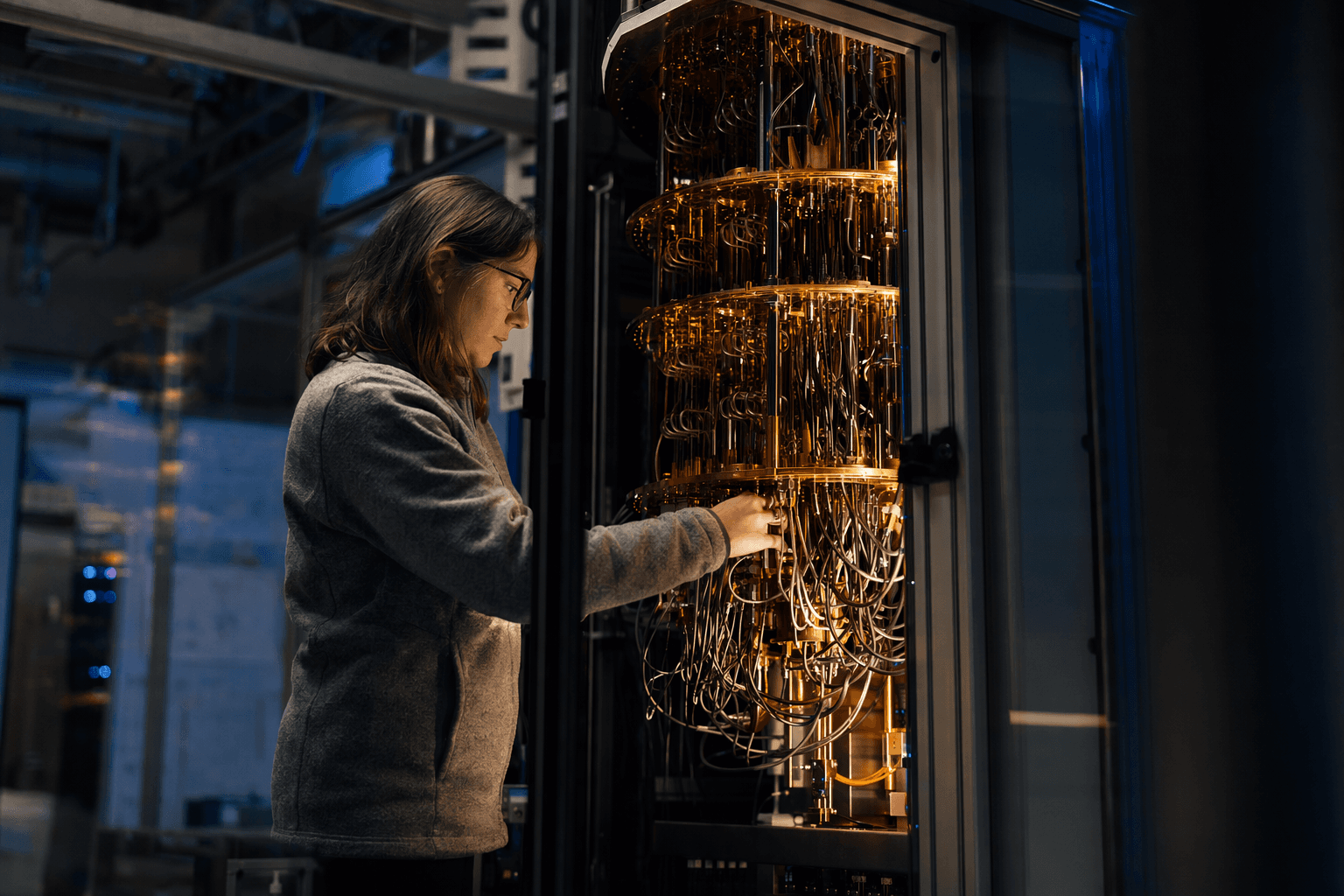
Cristiano Nisoli, who led the project, put the point bluntly: “we can already use existing analog quantum computers ... to get science results today.” The team, funded through a Laboratory Directed Research and Development program, brought together theoretical physicists, experimental physicists, computer scientists and mathematicians to focus on practical applications rather than hype.
The study, published in Science Advances, implemented a general protocol for magnetic hysteresis experiments on programmable quantum annealers and tested it on ferromagnetic and disordered Ising models across multiple graph topologies. The researchers observed hysteresis loops whose area changed nonmonotonically with quantum fluctuations, along with disorder-induced steps and other unexpected features. Those are the kinds of detailed, measurable effects that make the work more than a technology demo. It is a scientific instrument built from a computing platform.
For Los Alamos, the timing is significant. In February, the laboratory formed a quantum computing-focused research center to consolidate work in national security, algorithms and workforce development. In December, it said it would be a principal partner in the renewed Quantum Science Center led by Oak Ridge National Laboratory in Tennessee. That places LANL squarely inside a federal quantum ecosystem tied to the Department of Energy and the National Quantum Initiative, with implications for high-skill jobs, long-term research funding and the lab’s strategic role in U.S. science and security.
In a field crowded with promises about future breakthroughs, Los Alamos has made a different case: quantum hardware already in hand can produce real results now.
This article was produced by Prism’s automated news system from verified source data, official records, and press releases, then run through automated quality and moderation checks before publishing. The system is built and supervised by the people who set the standards it runs under. Read our full AI policy.
Know something we missed? Have a correction or additional information?
Submit a Tip