Retired LANL Scientists Tackle Isotope Shortages Using Molten Salt Solutions
Retired LANL scientists at Molten Salt Solutions just signed deals to supply enriched lithium to two fusion startups, targeting a critical isotope gap with no existing commercial solution.
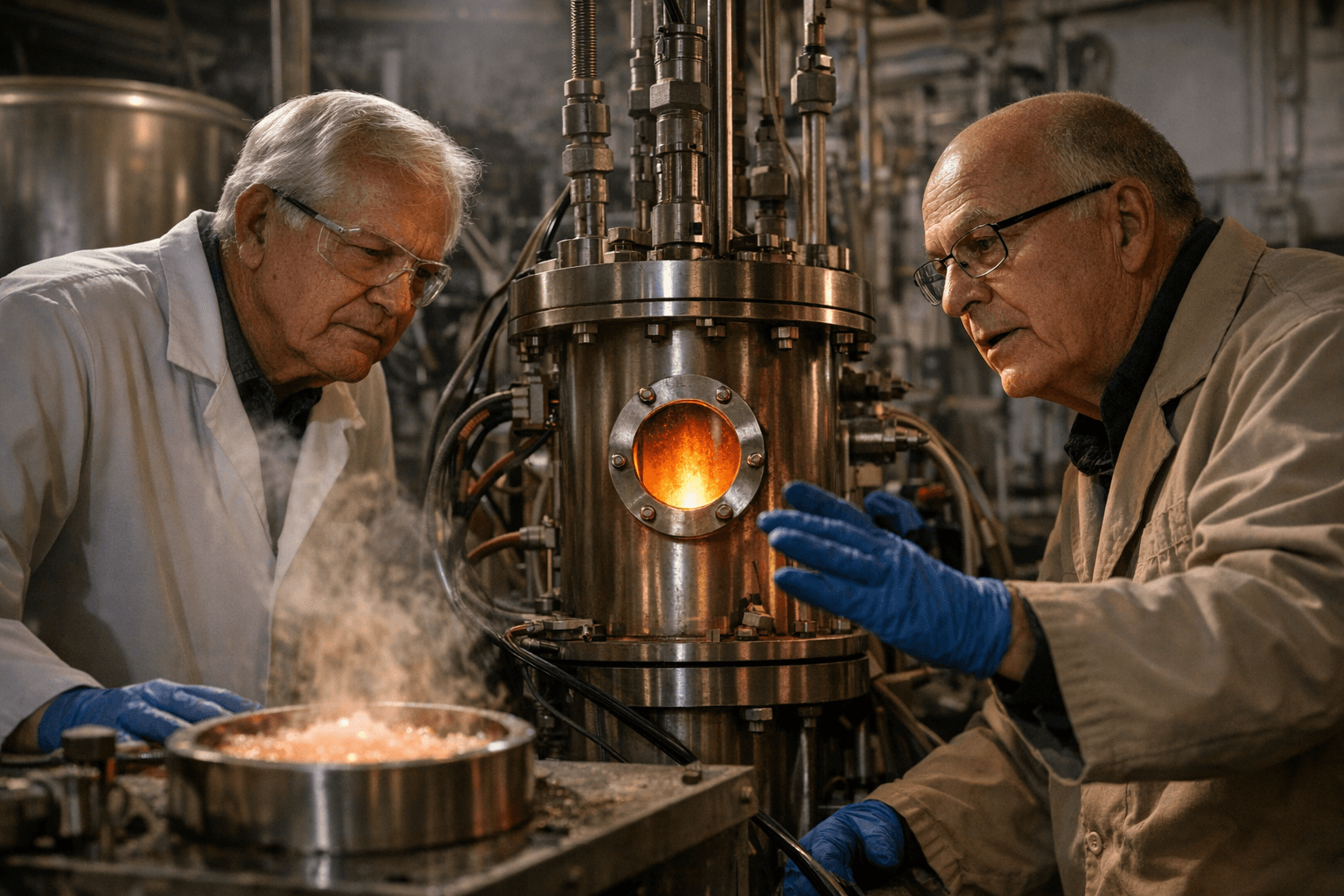
Dr. John Elling, a former Los Alamos National Laboratory chemist, spent decades building on lab science after leaving LANL in 1998. Now the company he founded in 2018, Molten Salt Solutions, has signed strategic supply agreements with fusion startups Type One Energy and Gauss Fusion, in what could be the first commercial-scale enriched lithium isotope supply chain ever assembled.
Elling built Molten Salt Solutions upon breakthroughs made at the lab, pursuing production of lithium-6 for the fusion industry and lithium-7 for next-generation molten salt fission reactors, where the isotope is a critical component of the reactor's coolant.
The isotope problem is not trivial. Investment in fusion is accelerating worldwide, yet developers face a critical materials gap: fusion systems rely on lithium-6 to produce tritium fuel, and today there is no commercial-scale supply. Securing enriched isotopes is a bottleneck for both industries due to the technical challenges, high cost, and limited infrastructure for traditional methods of lithium enrichment.
To solve it, Elling recruited from the community that knows the problem best. He has managed to woo several national lab alumni and top scientists out of retirement to commercialize what he describes as a highly efficient, cost-effective method of separating and purifying these isotopes. As Elling put it: "We have people who retired at the pinnacle of their career at Los Alamos who are gleefully back doing grad student research tasks, washing out test tubes and setting up reactions in the lab."
The technical approach departs sharply from legacy enrichment methods. Today, lithium isotope enrichment relies on a decades-old chemical exchange process that requires thousands of separate processing stages and large industrial systems, a method that is difficult to scale and has never been deployed at the volumes needed to support a commercial energy industry. Molten Salt Solutions is commercializing a technique called high-speed countercurrent chromatography, which has been largely confined to the lab for decades and uses centrifugal force to rapidly separate water and organic layers, effectively performing in a single, integrated system what would normally require hundreds of discrete steps.
The company's proprietary chromatography separation and mass spectrometry technologies enable effective isotope enrichment, while unique metal salt syntheses provide significant safety and cost advantages. Molten Salt Solutions developed and demonstrated the company's proprietary technology with SBIR funding from the National Science Foundation and in collaboration with Los Alamos National Laboratory.
The company's funding has grown alongside its ambitions. An initial $3 million seed round came in 2024. The company is based in Santa Fe and is backed by Future Ventures and True Ventures.
"These agreements reflect a growing realization across the industry that lithium isotope supply is one of the key bottlenecks facing fusion and fission energy," said Elling. "There is tremendous momentum behind the development of fusion power as the ultimate source of clean energy, but the supply chains needed to support them do not yet exist."
If all goes according to plan, Molten Salt Solutions will begin supplying kilograms of lithium isotopes to Type One Energy and Gauss Fusion in 2027, with the goal of scaling to hundreds of tons as the startups conduct larger-scale testing and, ideally, bring their first commercial power plants online in the early- to mid-2030s. For the retired LANL scientists now back at the bench, that timeline gives them something concrete to work toward.
This article was produced by Prism’s automated news system from verified source data, official records, and press releases, then run through automated quality and moderation checks before publishing. The system is built and supervised by the people who set the standards it runs under. Read our full AI policy.
Did this article answer your question?