Gary's coal complex grew into a vast company town network
Gary was built as a company-town network, with roads, rail spurs, stores and schools designed to keep coal, workers and daily life under one corporate roof.
Gary was never just a mine. United States Coal & Coke built it as a corporate landscape, with housing, commerce, roads and rail spurs arranged to serve the coal seam and the steel mills it fed. What grew out of Sandlick Creek and the Tug Fork became one of McDowell County’s clearest examples of how a company could shape where people lived, shopped, worshiped and worked.
How the complex took shape
The scale started early. J. P. Morgan chartered the United States Coal & Coke Company in January 1902, after the company had already begun construction in 1901 on more than 50,000 acres along Sandlick Creek of the Tug Fork, south of Welch. Gary was named for Judge Elbert Gary, a U.S. Steel associate, and the complex quickly became tied to U.S. Steel’s industrial needs.
That linkage mattered because the coal was not being mined for local use. Gary Hollow supplied millions of tons of metallurgical fuel for U.S. Steel mills, and the company’s footprint expanded into a network that linked 12 separate company towns with paved roads and Norfolk & Western rail spurs. Satellite camps associated with Gary included Elbert, Filbert, Ream, Thorpe and Wilcoe, and the system even crossed into Kentucky at Lynch. In the language of industrial history, this was not a single camp but a managed district.
The result was a scale that reshaped McDowell County itself. A Library of Congress source describes Gary Hollow as the largest coal mining operation in the world before decline began in the late 1950s, and another calls McDowell County the “billion-dollar coalfield,” a reminder that Gary sat inside a regional machine built to fuel steel expansion far beyond West Virginia.
A town designed around the mine
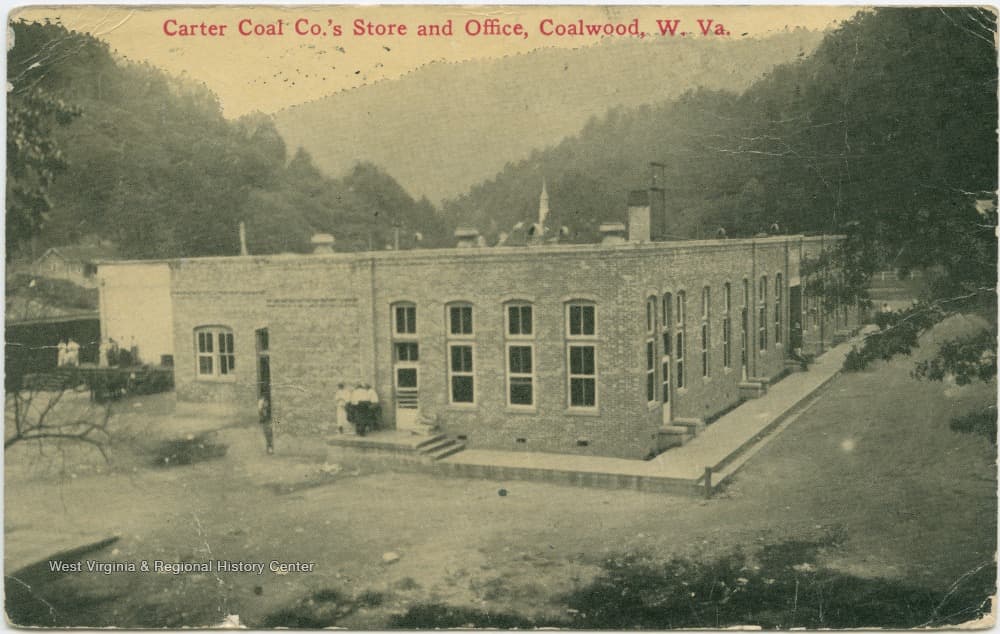
U.S. Coal & Coke did not leave the town’s layout to chance. The company employed in-house architects and engineers to design houses, churches, stores and even baseball diamonds, turning Gary into a planned environment where private life and industrial life were folded together. That design gave the company extraordinary leverage over daily routines, from where miners slept to where their families bought groceries.
By the 1940s, nearly 15,000 people lived in Gary, and the town had the institutions to match that population. There were 27 churches, ten company stores, three independent stores, three restaurants, nine elementary schools, two high schools, a clubhouse, athletic fields, a bowling alley, a barbershop, a pool hall, a country club, a bakery, a dairy and a movie theater. Those numbers show a complete corporate ecosystem, with the mine at the center and everything else organized around keeping workers and families inside the company town’s orbit.
A 1924 photograph from the West Virginia Memory Project, showing the Gary company store and Greek Orthodox Church in the same frame, captures that arrangement in one image. Commerce and immigrant religious life stood side by side, but both were embedded in a town whose physical form had been planned for coal production first and community life second.
The workforce behind the polish
The public face of Gary was orderly enough that the U.S. Coal Commission gave it 90 out of 100 points in 1923 for cleanliness, urban amenities and safety. That score helps explain why Gary became such a useful case study for the coal industry: it looked organized, modern and efficient, even as its labor system remained harsh and tightly controlled.

A 1915 state mines report counted 1,479 hand-loading miners at Gary, and it recorded a strikingly diverse work force. White, African American, Hungarian, Romanian, Italian, Polish and Slavic miners all worked there, a roster that reflects the immigrant labor streams shaping southern West Virginia coalfields in that era. Gary was not a closed local world, but a magnet for labor pulled in from across the Atlantic world and from other parts of the United States.
The workday itself was punishing. A 1908 Lewis Hine caption says miners and drivers went underground at 7 a.m. and stayed until 5:30 p.m., while another notes that Gary mine workers stayed underground more than 10 hours a day and that boys were used as trappers and drivers. Hine’s images of the mine entrance and the trapper boy make the contrast plain: the same town that projected order and cleanliness depended on long shifts, child labor and a rigid hierarchy underground.
What remains visible in McDowell County
Gary’s company-town logic still helps explain the geography of McDowell County. The old network of camps, roads and rail lines tied together places with names that still matter locally, from Elbert and Wilcoe to Filbert, Ream and Thorpe. Gary itself, south of Welch, was the hub of that system, and the company’s expansion into Lynch, Kentucky shows how far beyond a single town the industrial plan reached.
The physical traces are not just in surviving structures. They are also in the way the county’s coal towns were arranged to connect workers to the mine, the store, the church and the railroad before connecting them to anything else. That is the lesson Gary leaves behind: U.S. Coal & Coke did not simply extract coal from McDowell County, it organized a whole daily order around extraction, and the town layout still tells that story.
This article was produced by Prism’s automated news system from verified source data, official records, and press releases, then run through automated quality and moderation checks before publishing. The system is built and supervised by the people who set the standards it runs under. Read our full AI policy.
Did this article answer your question?