McDowell County’s surviving coal company stores anchor heritage loop
McDowell’s best-preserved coal company stores still mark a driveable heritage loop, from reused Algoma to the paired buildings in Jenkinjones and the wooden survivor at Landgraff.
McDowell County’s surviving coal-company stores make a compact, revealing road trip through the county’s company-town past. The route ties together Algoma, Jenkinjones, Caretta and Landgraff, with a side stop in Carswell Hollow, and it shows where commercial cores still survive, where reuse has already taken hold, and where the county’s historic record now lists buildings as gone.
Why this loop matters
McDowell’s National Register inventory still includes a long list of company-store properties, but some of the most familiar names are already in the demolished column: Maybeury, Pageton, Ream and Vivian. That pattern is what makes the surviving buildings so important. They are not just old storefronts, but physical proof of how coal companies shaped retail, office space, transportation and daily life in isolated valleys.
The larger setting is the National Coal Heritage Area, designated in 1996 and described by the National Park Service as a 5,300-square-mile heritage area in southern West Virginia. Its mission is to preserve, protect and interpret coal-mining heritage, and McDowell County remains one of the clearest places to see that landscape still in the field, not just in the archive.
Algoma: the newest surviving company store
Begin in Algoma, where the coal company store and office building was built by the Algoma Coal and Coke Company in the 1930s, replacing an earlier wooden frame store. The nomination calls it McDowell County’s newest extant company store, and it says the building retained the most important characteristics of the company-store property type: design, materials, workmanship, location and association.
That integrity matters because the building does more than sit as a relic. After the mines closed, it was reused as a medical clinic by the Tug River Health Center, giving the structure a second public function in a county where health access has long depended on making the most of existing buildings. At Algoma, look closely at how a coal company’s retail headquarters was adapted into a community service site without losing the footprint and character that make it historically legible.
Jenkinjones: the clearest company-town pair
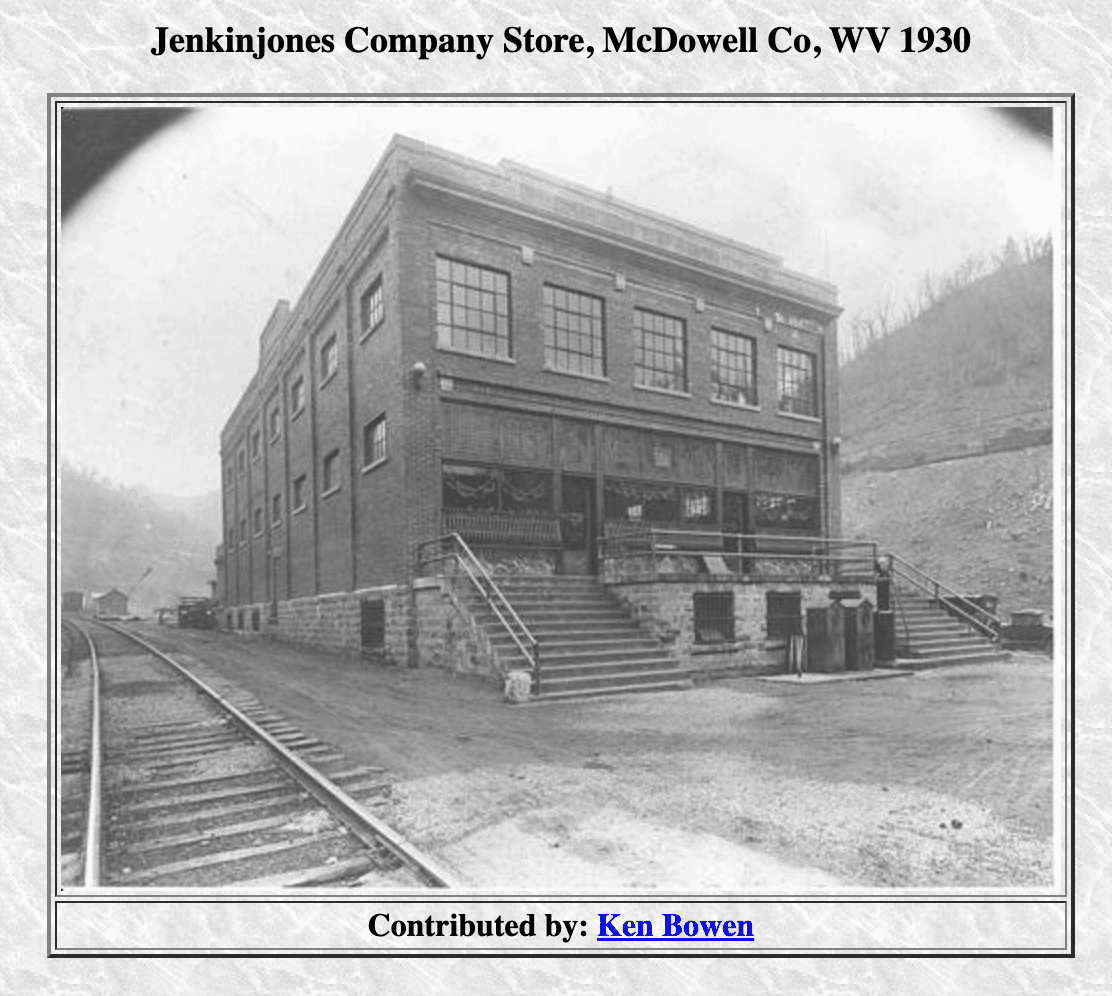
From Algoma, head to Jenkinjones, where the Pocahontas Fuel store and office buildings were constructed in 1917 and stood across from one another near the end of County Route 8. The nomination describes them as the center of activity in a busy but very isolated company-owned community, and that remains easy to see in the way the buildings face one another as a matched pair.
Their two-story massing, flat roofs, metal-frame windows and simple classical detail make Jenkinjones one of the best places in the county to understand how coal companies organized everyday life. This is a stop for reading the architecture as infrastructure: the store handled commerce, the office handled administration, and both occupied the same narrow geography that miners and families had to navigate for work, errands and information.
Caretta: a commercial row that still reads as a town center
Continue to Caretta, where the Carter Coal Company store connects directly to George L. Carter’s company, organized in 1912. The building sits at the intersection of State Route 16 and County Route 12/8, and the nomination says it is the only extant company store in McDowell County that appears to stand as a unit in a row of commercial buildings.
That setting gives Caretta a different feel from the more isolated company-store sites. Instead of a single building in a hollow, this is a place where the coal company store still helps define a street edge and a commercial line, which is exactly the kind of detail that shows whether a coal town still has a visible core or has been hollowed out by decline. If you stop here, look at how the store fits into the row, because the surrounding building pattern is part of the story.
Landgraff: one of the county’s last wooden-frame survivors
Landgraff adds the strongest preservation note in the loop. The Empire Coal Company store is described as one of the few intact wooden-frame company stores remaining in southern West Virginia and one of only two left in McDowell County. Its four entrances, hipped roofs, brick foundation and decorative classical detail make it one of the most distinctive roadside company-store buildings still standing.
This is where the architecture tells the preservation story most clearly. A wooden-frame commercial building from the coal era is far more vulnerable than a masonry structure, so the fact that Landgraff still holds one of the county’s last examples gives the site unusual weight. It is both a heritage asset and a warning about how few comparable buildings remain.
Carswell Hollow: the everyday life stop
For a fuller picture, add the Houston Coal Company Store in Carswell Hollow, usually dated to about 1923. It is often cited as one of the county’s most intact company-store examples, and its social function was broader than retail. Miners collected pay there, bought groceries on credit, picked up mail and waited to learn whether the mine would work the next day.
That daily-life role is what makes the company-store landscape matter beyond architecture. These were the operating centers of isolated communities, where wages, food, communication and the work schedule all passed through the same doorway. In Carswell Hollow, the building helps explain how a coal town functioned from sunrise to shutdown.
What the route shows about McDowell’s future
Taken together, these sites make the county’s preservation question concrete. Some buildings, like Algoma, have already been reused. Some, like Jenkinjones and Caretta, still preserve the shape of company-town commerce. Others, like Landgraff, are among the last of their kind and need attention simply to remain standing.
The county’s coal-store survey was significant enough to be grouped into a National Register multiple-property listing, and that work helped spur the broader preservation discussion behind the National Coal Heritage Area. The result is a route that is useful not just as a scenic drive, but as a way to see where heritage is still intact, where redevelopment has already begun, and where the county’s remaining company stores are now carrying the burden of local memory on their own.
This article was produced by Prism’s automated news system from verified source data, official records, and press releases, then run through automated quality and moderation checks before publishing. The system is built and supervised by the people who set the standards it runs under. Read our full AI policy.
Did this article answer your question?