Welch’s historic downtown tells McDowell County’s origin story
Welch’s downtown is where McDowell County began, from the secret overnight move of the courthouse records to the courthouse, historic district, and tourism hub that still anchor the seat.
Welch is not just McDowell County’s seat. It is the place where the county’s civic center was physically moved, in the dark, by two wagons carrying records from Perryville, now English, to the new town at the confluence of the Tug River and Elkhorn Creek. That history gives downtown Welch a meaning that goes beyond nostalgia: every block around the old business district still reflects the county’s origin story, its coal-era ambitions, and the choices local leaders make now about preservation, tourism, and reinvestment.
The county was built into Welch first
Welch was incorporated in 1893 and named for Isaiah A. Welch, a former Confederate Army captain who came to the region as a surveyor and helped lay out the town. The county seat decision came even earlier, in 1892, before incorporation, and the transfer of the records by James A. Strother and Trigg Tabor remains one of the town’s most telling civic anecdotes. That move is why downtown Welch carries such symbolic weight: the county’s paper trail, its government function, and its identity were all pulled into one small river valley.
The setting matters as much as the story. Welch sits in the narrow Elkhorn Valley, where the town’s central business district was shaped by limited flat land and the meeting of waterways. That geography helped compress commerce, housing, and public life into a tight downtown core, making Welch a compact way to read the larger history of McDowell County.
The historic district is the clearest evidence
The Welch Commercial Historic District is the best starting point for a walk because it shows how the town grew into a county seat with enough economic and civic density to fill a district. The boundary increase on the east side of the 100 block of Wyoming Street adds 8 contributing buildings and 1 contributing site to the district, and the nomination identifies Queen Anne, Commercial Style, American Foursquare, and Tudor Revival architecture. Those styles tell you this was not a one-note coal town; it was a place where merchants, professionals, families, and civic users all occupied the same downtown fabric.

The district’s period of significance begins in 1900, and its areas of significance are commerce and architecture. The broader district was built around commerce and trade, with domestic uses and some social uses folded into the same blocks. That mix is why the streets around Wyoming Street still read as a layered downtown rather than a single-purpose commercial strip, with stores, offices, apartments, and civic functions stacked into a narrow river valley.
The courthouse is downtown’s anchor and its warning
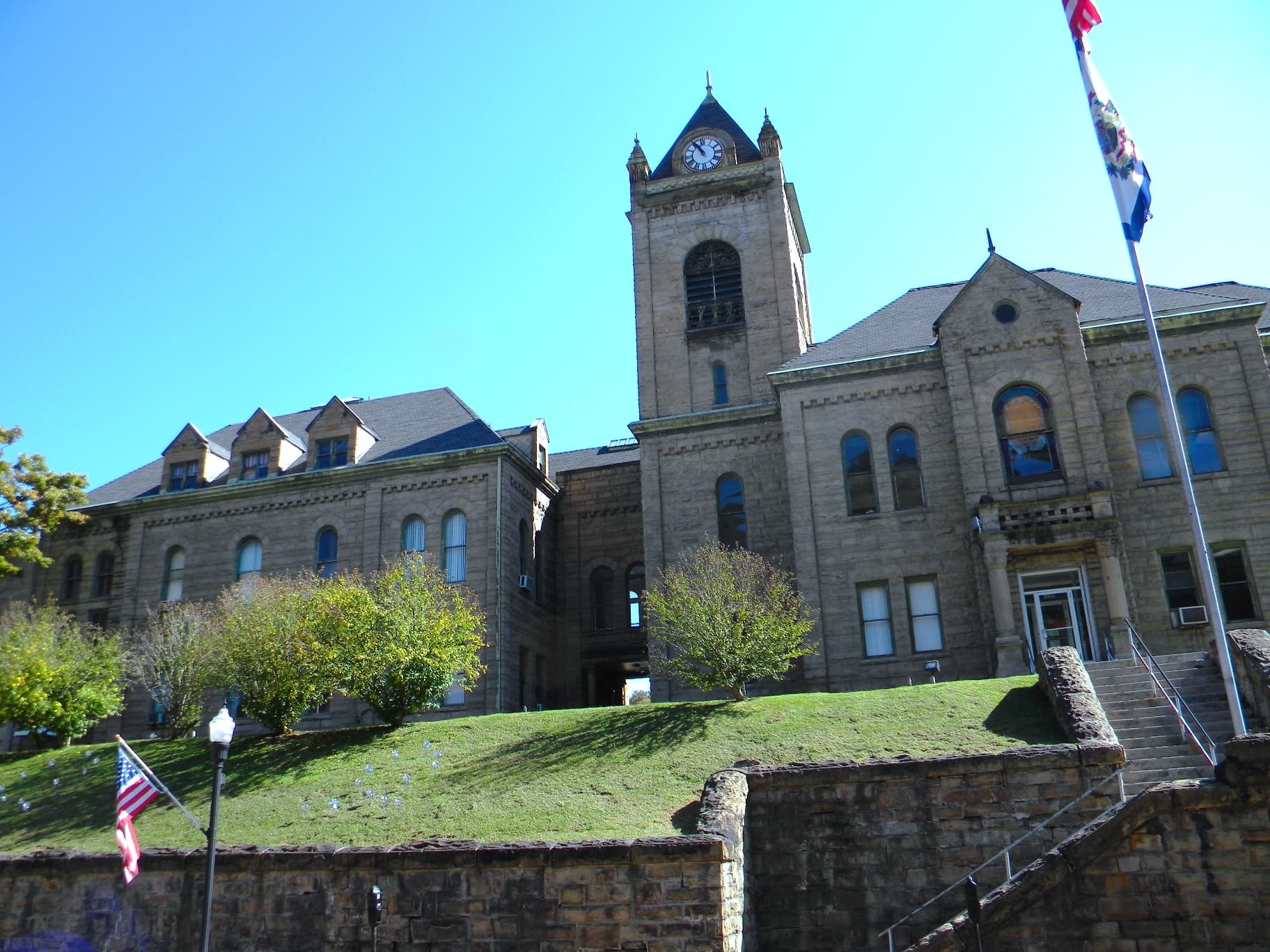
Above Wyoming Street, the McDowell County Courthouse dominates the skyline and gives the walk its most powerful stop. Frank P. Milburn won the courthouse design competition at age 25, beating out input from 12 architects, and the original core, built in 1893 and 1894, measured about 90 by 56 feet. Constructed of quarry-faced Berea sandstone, it later expanded in 1908 and 1909, with additional changes in 1963 and 1979.
The building also carries one of the county’s hardest dates: on August 1, 1921, Sid Hatfield and Edward Chambers were killed on the courthouse steps by Baldwin-Felts detectives. That makes the courthouse more than an architectural landmark. It is a place where McDowell County’s labor history, political conflict, and public memory collide in one visible location.
A downtown walk that connects to the present
Welch also fits naturally into the Coal Heritage Highway route, which sends travelers from I-77 exit 42 onto Route 16 through Sophia, Mullens, and Pineville into historic Welch. The route frames the town as part of a larger coal-heritage corridor, but Welch is the point where that wider history becomes walkable, with the courthouse hill, the business blocks, and the district boundary all within a small area.
The McDowell County Convention and Visitors Bureau operates from the Jack Caffrey Arts and Cultural Center in historic downtown Welch, which is one of the few clear signs of active reuse in the center of town. The bureau promotes McDowell County’s trail connections, including Indian Ridge, Warrior, and connectors to Pinnacle, Pocahontas, and Spearhead in Virginia. That mix of tourism promotion and cultural space matters because it puts a public-facing institution right inside the historic core, where preservation can support more than memory.
Why this downtown still matters now
McDowell County still faces the long aftereffects of coal decline, weak public investment, and the hard work of rebuilding basic infrastructure. Residents have also grown skeptical of political promises, which makes concrete assets like the courthouse, the historic district, and the visitors bureau more important than broad talk of revival. In Welch, the best evidence of future potential is not a slogan. It is the fact that the county seat, the commercial district, and the tourism office are still clustered in the same historic downtown that once received the county records by moonlight.
That continuity matters even more after the Welch Daily News closed in March 2023, adding to McDowell County’s news desert. In a place with fewer daily record keepers, the built environment has become a form of public memory. Welch’s downtown still tells residents where McDowell County came from, and it now also shows how much of that civic inheritance depends on what gets preserved, occupied, and funded next.
This article was produced by Prism’s automated news system from verified source data, official records, and press releases, then run through automated quality and moderation checks before publishing. The system is built and supervised by the people who set the standards it runs under. Read our full AI policy.
Did this article answer your question?