Welch's Pocahontas Theatre endures as a historic downtown landmark
Welch's Pocahontas Theatre has survived fire, reinvention and a name change. Its returned Wurlitzer keeps McDowell County's moviegoing history active downtown.

The City of Welch took over operations of the movie house in 2021 and brought back the Pocahontas name, turning a familiar downtown building into a working link between the county seat’s past and present. That change matters because the theatre is not just a preserved facade, it is one of the clearest places where Welch’s commercial core, civic identity and entertainment history still meet.
A downtown landmark built for Welch’s boom years
The original Pocahontas Theatre opened on Christmas Day in 1928, when Welch was still shaped by the reach of coal money and the pace of downtown life. It cost $100,000 to build, seated 1,264 people and opened with a Wurlitzer pipe organ valued at $20,000, figures that show the scale of the investment and the confidence behind it. The theatre’s own history page calls it the finest theatre and organ in Appalachian Coal Country, a claim that helps explain why the building became so closely tied to Welch itself rather than fading into the background as just another old movie house.
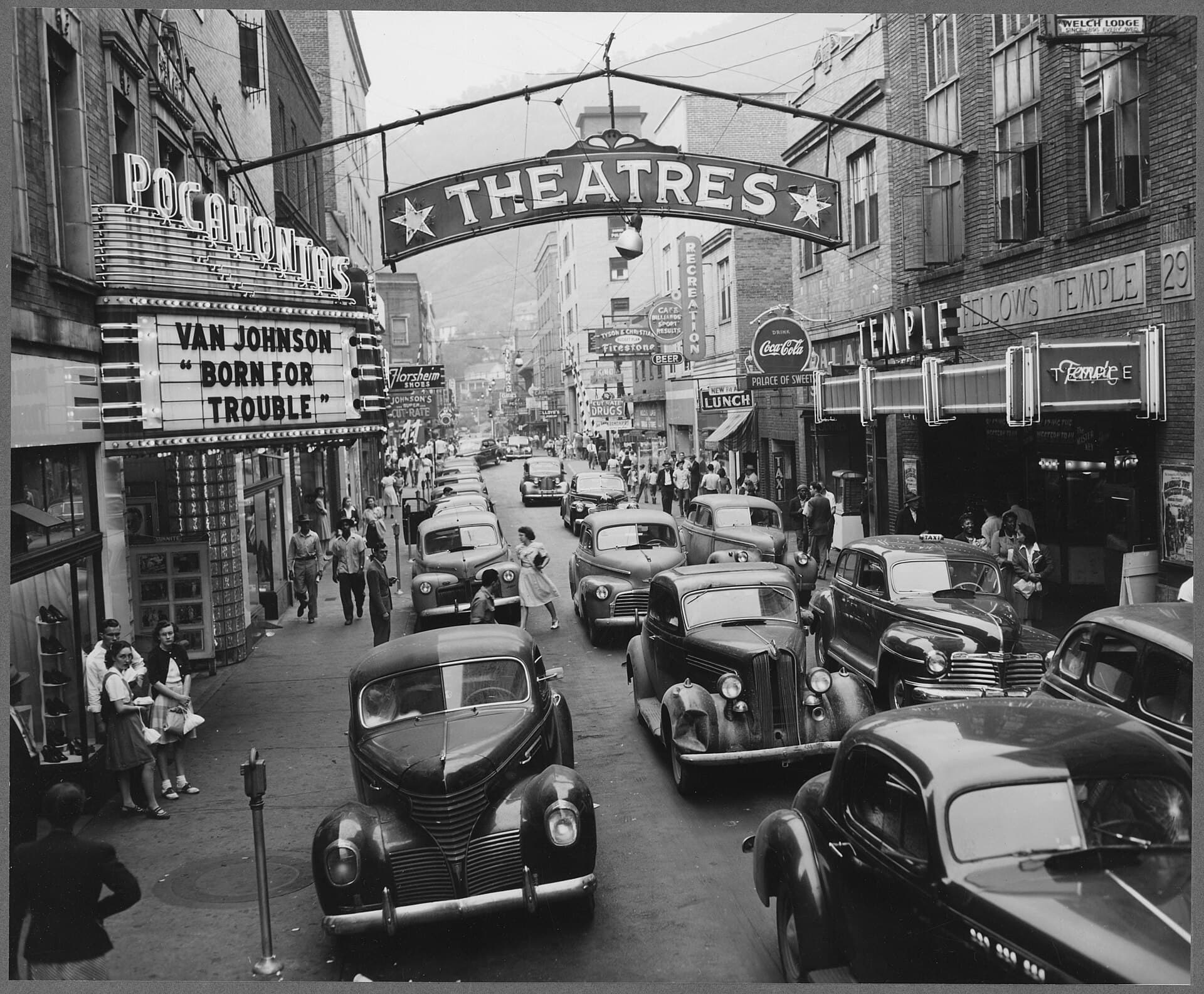
A National Archives photo from the 1940s preserved the Pocahontas marquee in the era the theatre history describes as the heyday of CoalTown, USA. That image places the building squarely in the center of downtown life, when a movie palace was also a gathering place, a marker of local pride and a signal that Welch was a county seat with its own public rhythm. In that sense, the Pocahontas has always been more than a screen and seats. It has stood as part of the town’s visible identity on the street.
Fire, loss and the long road back
The theatre’s sharpest break came on August 23, 1980, when the original building burned beyond repair. The last movie shown that night was The Shining, a detail that gives the loss a fixed point in local memory and marks the end of an era for generations who associated the old Pocahontas with downtown evenings and shared outings. Once the original structure was gone, Welch lost not only a building but one of its most recognizable social spaces.
The community did not stay without a moviegoing anchor forever. A new movie complex opened in 2003 as the McDowell 3 Cinema, giving residents a place to watch films again and helping keep that part of downtown life from disappearing entirely. Then, in 2021, the City of Welch assumed operations and began a rebranding effort that restored the Pocahontas name. That sequence, fire, replacement, and revival, is what makes the theatre such a strong local case study in institutional resilience. It shows how a small city can keep a landmark alive by adapting the building’s role without severing it from its past.
The Wurlitzer that came home
The most distinctive part of the Pocahontas story is the return of its original 1928 Wurlitzer. Jason Grubb found the instrument in Missouri in 2021, and he, Mayor Harold McBride and volunteers arranged to bring it back so it could reconnect the old and new Pocahontas theatres. That detail matters because it makes the organ more than a display piece. It is a recovered artifact from the same cultural world that produced the original movie palace.
The organ is now on display in the lobby, and the city hopes to restore it fully. Even in that unfinished state, it carries a strong public meaning. The return of a Wurlitzer valued at $20,000 when the theatre first opened speaks to preservation as a practical act, not a nostalgic one. Welch did not simply save a name from the past. It brought back a physical instrument that once defined the sound of a night at the movies in McDowell County.
What the theatre contributes now
The theatre’s importance today is easiest to see in what it keeps downtown Welch doing. It still brings people into the commercial core, still gives the county seat a recognizable public venue, and still offers a place where local identity is attached to an active institution instead of a memory. The Pocahontas name, the rebuilt operation and the organ in the lobby all reinforce the same point: this is a landmark that continues to function.
- It anchors downtown foot traffic by drawing visitors back into Welch’s center.
- It gives the city a visible venue for screenings and public life.
- It ties current use to the original 1928 theatre through the Wurlitzer and the restored name.
- It strengthens county identity by keeping one of McDowell County’s best-known historic sites active rather than dormant.
That combination is why the Pocahontas Theatre endures as a test case for Welch. It shows that preserving a landmark can do more than protect a memory. It can help keep a downtown legible, useful and unmistakably local.
This article was produced by Prism’s automated news system from verified source data, official records, and press releases, then run through automated quality and moderation checks before publishing. The system is built and supervised by the people who set the standards it runs under. Read our full AI policy.
Did this article answer your question?