Menominee County sees nearly half of households unable to afford basics
Nearly half of Menominee County households, 48%, cannot cover basics. A single adult now needs $13.06 an hour just to meet the county’s survival budget.

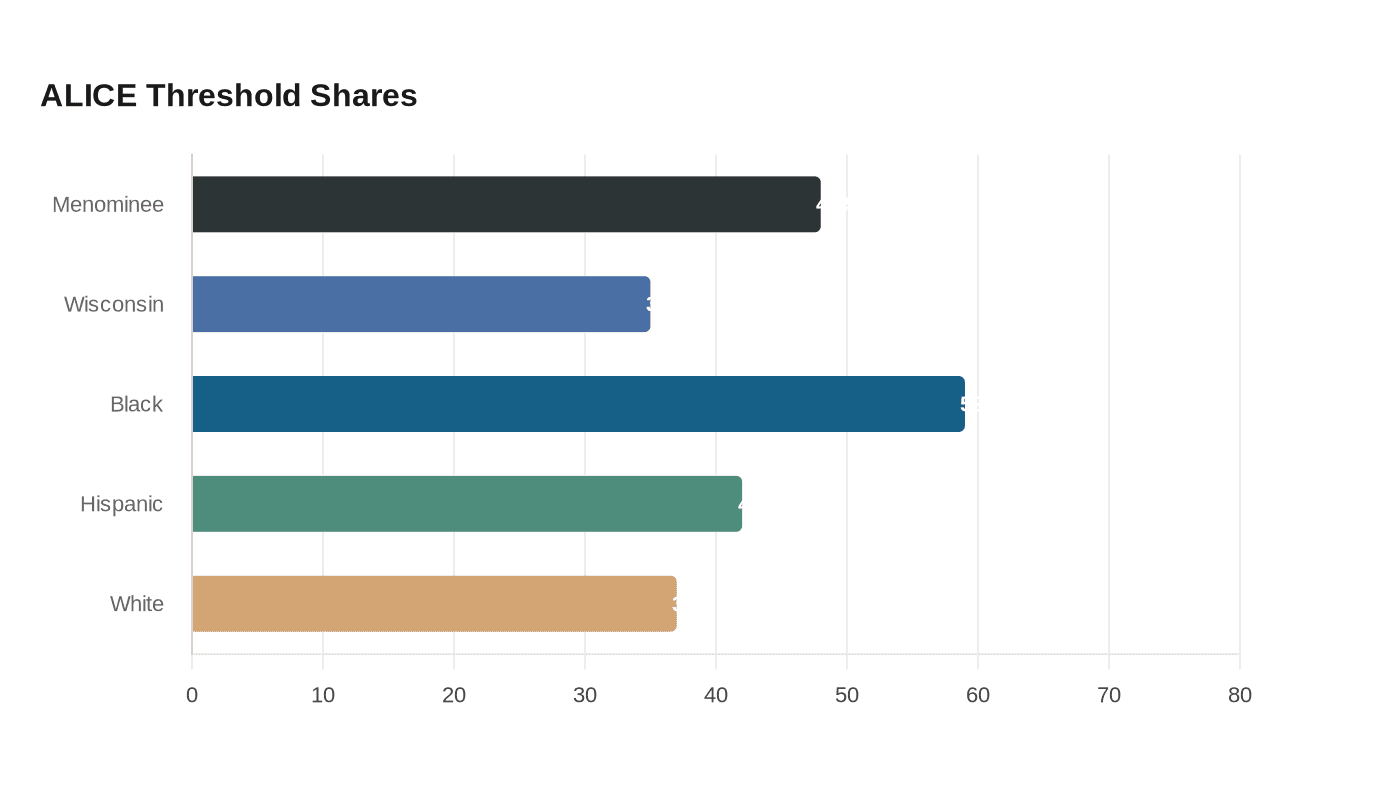
Menominee County households unable to cover the basic cost of living rose to 48% in the 2026 State of ALICE report, up from 47% in the prior count. In a county with 4,256 residents and 1,336 households, that leaves the line between working and stable feeling especially thin.
The 2025 Menominee County ALICE snapshot put the county’s median household income at $59,528, well below Wisconsin’s $74,631. Labor force participation was 50.5%, compared with 65.2% statewide.

ALICE stands for Asset Limited, Income Constrained, Employed, and the label fits households that earn too much to qualify as poor but too little to afford housing, child care, transportation, food, health care and utilities. In Menominee County, the survival budget in 2023 was $26,124 a year for a single adult, or $13.06 an hour full time, and $70,272 a year for two adults with one infant and one preschooler, or $35.14 an hour full time.
In 2023, 631 households were below the ALICE threshold, while 31% were classified as ALICE and 16% were in poverty.
Shawano Area United Way Executive Director Uriah Williams warned the data reflects 2024 conditions and that current pressures in 2026 may be even sharper as housing and child care costs keep rising faster than wages. The agency offers direct help through its Diaper Bank, Community Dinners and Volunteer Income Tax Assistance sites. It processed more than $500,000 in free tax returns for local families in 2025, distributed more than $240,000 in grants to local social service agencies since 2020, and provided diapers and wipes to more than 150 infants last year.
Statewide, the 2026 Wisconsin ALICE report put 35% of households below the ALICE threshold in 2024. It also found the burden falls unevenly across race and age, with 59% of Black households and 42% of Hispanic households below the threshold, compared with 37% of white households.
This article was produced by Prism’s automated news system from verified source data, official records, and press releases, then run through automated quality and moderation checks before publishing. The system is built and supervised by the people who set the standards it runs under. Read our full AI policy.
Did this article answer your question?