Menominee Heritage Museum preserves county history in former church
A former Menominee church now houses county artifacts and photographs, with summer visits, free-will donations, and a small gift shop.
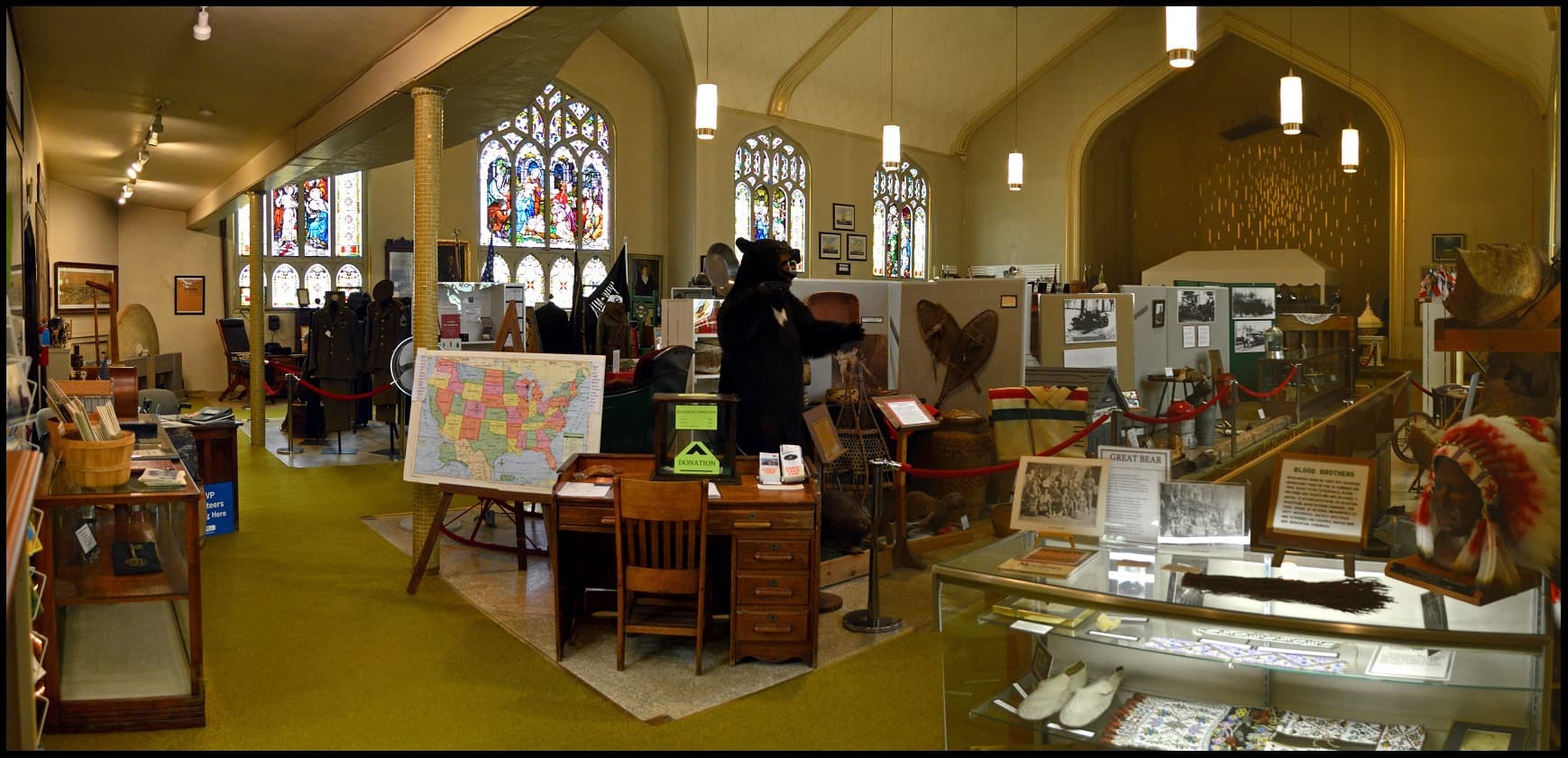
The Menominee Heritage Museum gives Menominee County a history room inside a building people already know. Former St. John the Baptist Catholic Church, at 904 11th Avenue in Menominee, Michigan, now holds artifacts and photographs from the county’s past, so the landmark itself becomes part of the story it preserves. That pairing matters because the museum is not a neutral gallery; it is a local place with its own parish memory, reused as a community archive.
A church building with its own history
The Menominee County Historical Society acquired St. John the Baptist Catholic Church in 1976 and converted it into the Menominee Heritage Museum. Before that change, the parish used the building until mergers in 1972, which gives the site a clear before-and-after in the county’s institutional history. The current structure replaced an older church that was demolished in 1921, and the new St. John the Baptist Church was built in 1921-22 in the Late Gothic Revival style.
That architectural history adds weight to the museum experience. The building was added to the National Register of Historic Places in 1995, giving it a preservation status that goes beyond local nostalgia. When you walk in, you are stepping into a church that first served parish life, then became a museum, and now functions as one of Menominee County’s most visible repositories of memory.
What the museum collection tells you about the county
The museum’s value is not limited to the objects on display. The historical society says visitors can learn about fur traders, immigrants, loggers, Menominee Indians, and other people who shaped the area, which places the museum squarely inside the county’s larger social story. The collection ties together frontier trade, industrial development, and tribal history in a way that reflects how Menominee County actually grew.
That matters in a county where history is not one story but several overlapping ones. The Menominee Indians are not a side note in the museum narrative, and the logging era is not treated as a detached industrial chapter. Instead, the museum frames county identity as a mix of cultural continuity, migration, resource work, and settlement, all preserved in one place that still feels grounded in the community it describes.
A preservation effort that began long before the museum opened
The museum did not appear out of nowhere in the 1970s. The Menominee County Historical Society was established on January 17, 1967, by president Michael J. Anuta, vice president Frank Budmats, secretary Violet Pawlowski, and treasurer William Ferstrum. That founding date shows the museum grew out of an organized local preservation effort, not a quick reuse project.
The society’s mission is to gather, preserve, and disseminate the history of the area for residents and travelers alike. The museum is part of a broader preservation footprint that also includes an adjacent research center and an outdoor learning center, which means the site works as more than a display space. It functions as a small campus for local memory, where people can look, study, and learn in connected spaces.
What to know before you visit
The museum is open to the public during the summer months, making it a practical stop for families, local residents, and visitors passing through the county. The historical society asks for a free-will donation to help cover operating expenses, and the museum also has a small gift shop for souvenirs. Those details matter because the site is meant to be accessible without turning preservation into a high-cost outing.
If you are planning a visit, the basics are straightforward:
- Location: 904 11th Avenue in Menominee, Michigan
- Access: open to the public during the summer months
- Support: free-will donation requested to help offset operating expenses
- Extras: a small gift shop on site
The combination of a donation-based model and a modest shop suggests a museum sustained by community backing as much as by formal stewardship. That is consistent with the historical society’s long timeline and with the building’s second life as a public archive rather than a closed collection.
How it fits into Menominee County’s wider heritage landscape
The Menominee Heritage Museum sits within a county that already has other major history stops, especially in Keshena. The Menominee Indian Tribe of Wisconsin says the Menominee Cultural Museum in Keshena is open year-round on weekdays and offers group tours by appointment, giving the county a tribal heritage site with regular public access. Nearby, the Menominee Logging Camp Museum stands out as another major draw, with Travel Wisconsin describing it as the largest and most complete logging museum in the United States and noting that it holds more than 20,000 artifacts.
Taken together, those sites show that Menominee County’s memory institutions are dense for a relatively small place. The heritage museum in Menominee, the cultural museum in Keshena, and the logging camp museum all preserve different parts of the same regional story, from tribal life to industrial expansion to the everyday work of settlement. The former church on 11th Avenue fits that landscape by preserving county history in a building that already has history of its own, which is exactly why it remains worth the trip.
This article was produced by Prism’s automated news system from verified source data, official records, and press releases, then run through automated quality and moderation checks before publishing. The system is built and supervised by the people who set the standards it runs under. Read our full AI policy.
Did this article answer your question?