Jacksonville museum preserves Morgan County African American history
Jacksonville’s museum gives Morgan County a year-round starting point for Black history, with the Asa Talcott Home, Diamond Grove Cemetery and Woodlawn Farm extending the story.
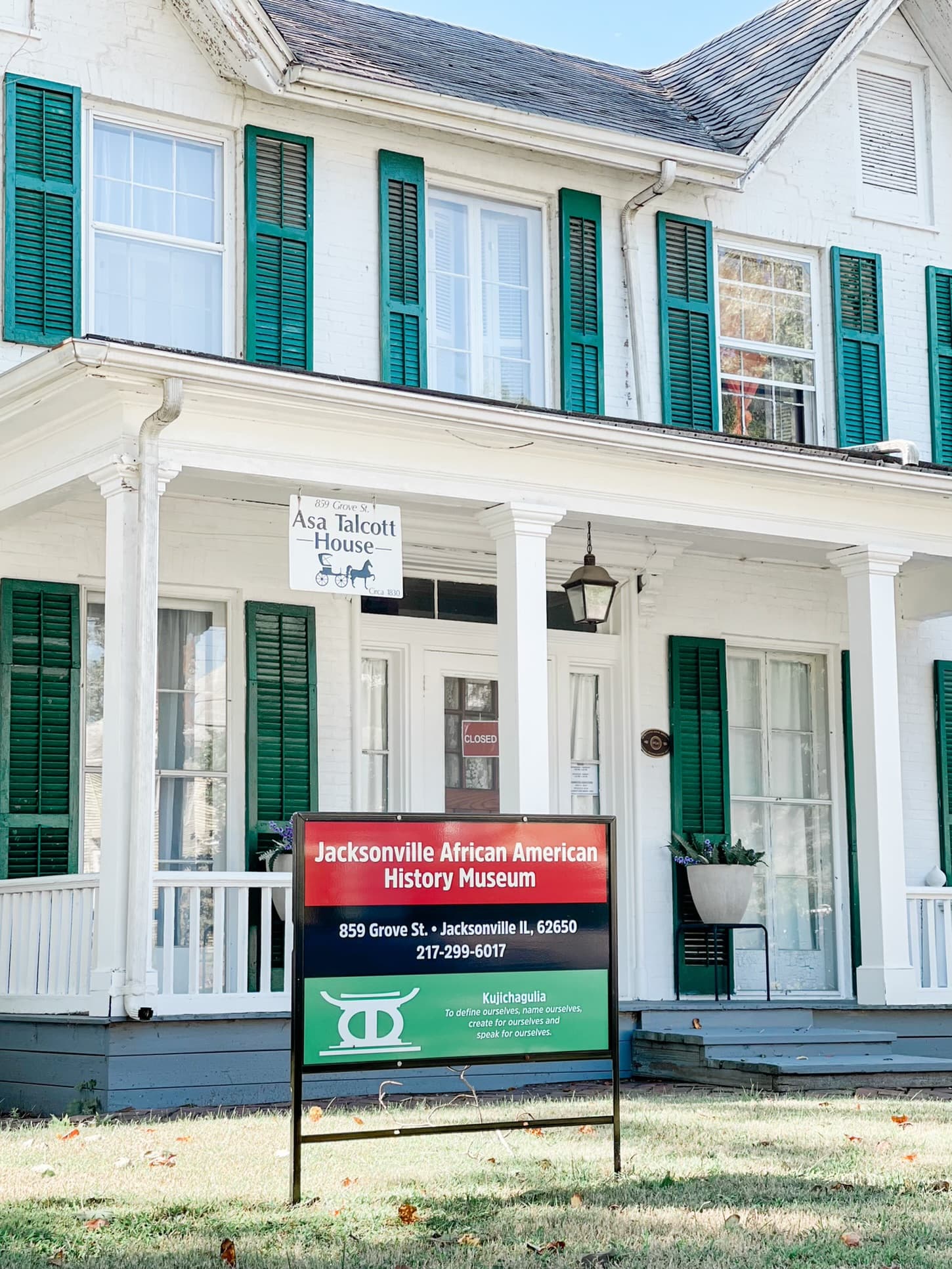
Jacksonville’s African American History Museum gives Morgan County a place to meet its Black history in person, not just in a plaque, textbook chapter or once-a-year heritage program. Listed as an attraction on the official Jacksonville tourism site, the museum at 859 Grove St. is open by appointment Monday, Wednesday and Saturday from 1 p.m. to 4 p.m., making it a practical stop for families, schools and newcomers who want the county’s fuller story.
Why this museum matters now
The museum does more than display objects. Its website describes it as an archived collection of local African American history, stories and cultural landmarks tied to notable residents, events and historic sites in and around Jacksonville, which means it is built to connect names and places that often get left out of standard community narratives. The site also calls the museum “Proud educators of Black history,” a phrase that fits its role as both a visitor stop and a civic memory project.
That matters in a county seat like Jacksonville, where public institutions help shape what gets remembered. Tourism materials already place the museum alongside an African American History section and Black History content, showing that this is an ongoing interpretive thread in local culture rather than a one-time celebration. For residents, that turns the museum into a reliable entry point for understanding how Black life has shaped Morgan County through family histories, church life, education, migration and local leadership.
What the museum adds that other markers do not
A plaque can tell you a name. A textbook can summarize a date. The museum can hold those fragments together and connect them to the people who lived them. Because it is a public-facing attraction, not a private collection or occasional exhibit, it offers a place where visitors can ask how local Black history fits into the broader county story and why some of those stories were pushed aside for so long.
That omission is part of the museum’s origin story. In July 2022, when the museum was newly opened, Art Wilson, its founding executive director, said that learning Black history while growing up in Jacksonville in the 1960s “seemed impossible” because it was not taught in schools or reflected locally. His experience explains why the museum’s work is not just archival but corrective: it fills in gaps left by institutions that once failed to teach or preserve this history.
The museum’s online launch reinforced that mission with the message, “Our stories matter. Our history matters.” That statement is more than branding in a county where Black history has often been treated as a side note. It points to a place where residents can encounter the county’s past on Black terms, through Black experience, instead of only through the dominant civic story.
How to plan a visit
The museum is at 859 Grove St., Jacksonville, IL 62650, and visits are by appointment on Monday, Wednesday and Saturday from 1 p.m. to 4 p.m. That schedule makes planning important, especially for school groups, church groups and families trying to build a weekend outing around multiple heritage sites. Because the museum is listed as an attraction on Jacksonville’s tourism site, it can be folded into a broader day of local history without feeling like a detour.
A useful approach is to treat the museum as the first stop on a countywide route:
1. Begin at the Jacksonville African American History Museum to get the local frame.
2. Move to the Jacksonville Public Library’s Special Collections Room, which the library describes as a logical place to begin learning about Jacksonville and Morgan County history.
3. Add other heritage sites tied to Black history and abolition, including the Asa Talcott Home, Diamond Grove Cemetery and Woodlawn Farm.
That sequence helps turn scattered sites into a connected story. Instead of seeing isolated landmarks, you start to see how Black history runs through Jacksonville’s institutions, neighborhoods and rural sites.
Trace the trail beyond the museum walls
A local convention post identifies the Jacksonville African American History Museum inside the Asa Talcott Home as a verified stop on the Underground Railroad. That places the museum within a larger heritage landscape, not simply as a standalone exhibit space. Jacksonville tourism materials also point to a Black Heritage Trail experience, inviting visitors to walk through hidden passages and learn the region’s African American history.
Diamond Grove Cemetery deepens that route. Searchable local history resources identify it as a Jacksonville, Morgan County cemetery, and Jacksonville tourism has promoted a Diamond Grove Cemetery Tour. Another event listing describes a guided cemetery tour of Underground Railroad conductor grave sites at Diamond Grove Cemetery, 1601 Lincoln Road, which makes the site an important place to understand abolition-era memory in stone and landscape.
Woodlawn Farm adds another layer in rural Morgan County. The site says it celebrates the courage of those involved with the Underground Railroad and presents mid-1800s farm life as a living museum and self-supporting historic site. That combination of preservation and interpretation shows how Black history in Morgan County is not confined to one building in town; it extends across county roads, family property and preserved landmarks.
Use the library and local history groups together
The Jacksonville Public Library’s Special Collections Room gives residents another concrete way to investigate the same history the museum interprets. The library says the room includes material on the history and people of Jacksonville and Morgan County, and its guide notes that resources range from books and maps to microfilm, online indexes and databases. That makes it one of the best places to move from memory to documentation.
The museum also fits into a wider local public-history ecosystem that includes the Morgan County Historical Society and Jacksonville Area Museum programming. Each institution handles a different piece of the county’s past, but together they help answer the same question: whose stories have been missing from local memory, and where can you still find them?
For Morgan County, that answer now starts at 859 Grove St. and spreads outward to the library, the cemetery, the Asa Talcott Home and Woodlawn Farm, where Black history is present, named and still being preserved.
This article was produced by Prism’s automated news system from verified source data, official records, and press releases, then run through automated quality and moderation checks before publishing. The system is built and supervised by the people who set the standards it runs under. Read our full AI policy.
Did this article answer your question?