Jacksonville’s Wall Dog murals turn downtown into history trail
Jacksonville’s 10 Walldog murals now function as a walkable downtown route, turning two festival summers into a permanent history trail.
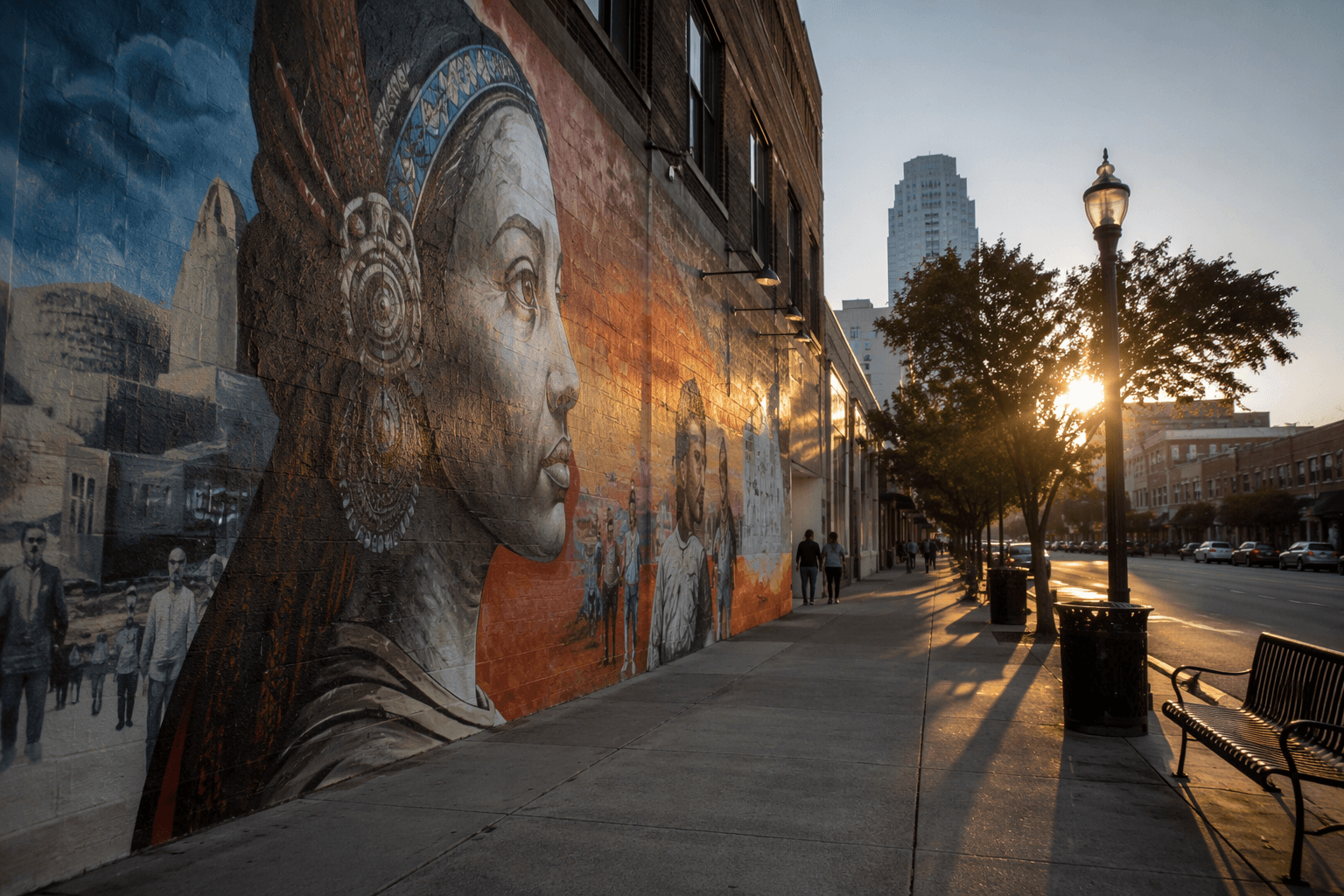
The Wall Dog murals are one of downtown Jacksonville’s most visible public assets because they outlast the festivals that created them. Jacksonville Main Street says the projects came out of the summers of 2006 and 2019, when professional sign painters known as Letterheads or Walldogs made heritage-based murals in the historic central business district. For Morgan County, the real question now is what that permanent trail delivers after the crowds are gone.
From festival project to fixed downtown route
The murals are not scattered public art in the abstract. The Clio heritage guide describes them as ten paintings placed at different locations around downtown Jacksonville, on the sides of buildings on and around the downtown square. That layout matters because it turns a one-time event into a route that people can walk, with each wall tied to a local story instead of generic decoration.
The collection’s starting point is the Welcome to Downtown Jacksonville mural, which Clio identifies as the opening stop for the trail. The same tour says the murals were completed in one week, with artists working day and night to finish the project. That compressed production schedule left Jacksonville with something that now operates as a fixed downtown asset rather than a seasonal spectacle.
Where the Walldogs came from
The movement behind the murals began in 1993 in Allerton, Iowa, according to The Walldogs’ own history page. What started as a community event with Walldog artists successful enough to inspire other festivals became a broader public-art model that spread into town centers across the Midwest and beyond.
NPR Illinois described Walldogs in 2010 as mural builders that spruce up towns, a simple phrase that fits the practical role these projects play in civic branding. The model has been used elsewhere in Illinois too. In Arcola, the city says a Walldog project in June 2012 brought more than 130 artists from the United States, Canada, New Zealand, Scotland and Australia and produced 15 historic murals. Jacksonville’s version fits that same pattern: outside artists, local stories, and downtown walls turned into public history.
What the Jacksonville trail shows on the ground
Jacksonville’s murals are built around specific subjects from the city’s past. Clio says the ten murals each depict different historical events that took place in Jacksonville, making the trail as much an interpretive system as an art display. That approach gives downtown a built-in narrative, with each building carrying part of the city’s memory.
One of the clearest examples is the Welcome to Downtown Jacksonville mural. Clio says it was created by Cameron Bortz, who came from Pawcatuck, Connecticut, for the 2006 project to add more history to the town. The walkable route also includes images such as the Big Eli Ferris Wheel mural and the West Side of the Square in 1910 mural, which help tie the square to the broader story of Jacksonville’s business and civic life.
Jacksonville’s official and tourism-facing listings reinforce that role. Jacksonville Main Street presents the Walldog murals as an attraction, and Enjoy Illinois lists downtown Jacksonville’s Walldog murals among the places to visit. That is a telling institutional choice: the city is not treating the murals as archival leftovers, but as a downtown experience it wants people to seek out.
What the murals deliver now that the festivals ended
The public value of the trail is no longer the event itself. It is the way the murals steer attention to downtown Jacksonville on ordinary days, when the artists are gone and the festival tents are packed away. A route of ten murals concentrated around the square gives visitors a reason to walk storefront blocks, and that is where the economic and civic value tends to show up.
The likely beneficiaries are the institutions and businesses tied to the square: Jacksonville Main Street, downtown merchants, nearby offices, and the city agencies that use the murals in place-making and tourism promotion. Jacksonville also has a larger mural presence, with one Jacksonville-focused tally putting the city at more than 60 murals created by local and international artists. The Walldog trail is the heritage-focused core of that larger art inventory, and it helps give downtown a recognizable identity that other districts can point to.
That matters because downtown investment decisions often follow visibility. A mural trail does not replace storefront leasing, event programming, or capital improvements, but it can support them by making the district more legible to people on foot. In Jacksonville, the murals connect the historic central business district to a self-guided visit pattern that can spill into shops, restaurants, and other downtown stops.
How to walk the trail
The simplest way to see the Wall Dog murals is to start at the Welcome to Downtown Jacksonville mural and follow the paintings around the downtown square. Clio’s route places the works on building sides around the square, so the experience is less like visiting a single destination and more like tracing a loop through Jacksonville’s commercial core.
- the Welcome to Downtown Jacksonville mural as the starting point
- the Big Eli Ferris Wheel mural
- the West Side of the Square in 1910 mural
- other historical panels placed on and around the square
A useful walk through the trail should include:
Because the murals were designed as heritage projects, the trail works best when treated as a downtown history walk rather than a quick photo stop. That is what makes it durable. The festivals ended, but the walls remain, and the city still gets to decide whether that permanent collection is just scenery or a downtown tool that keeps drawing people into Morgan County’s county seat.
This article was produced by Prism’s automated news system from verified source data, official records, and press releases, then run through automated quality and moderation checks before publishing. The system is built and supervised by the people who set the standards it runs under. Read our full AI policy.
Did this article answer your question?