Fairbanks Firefighters Rescue Woman Who Fell Through Chena River Ice
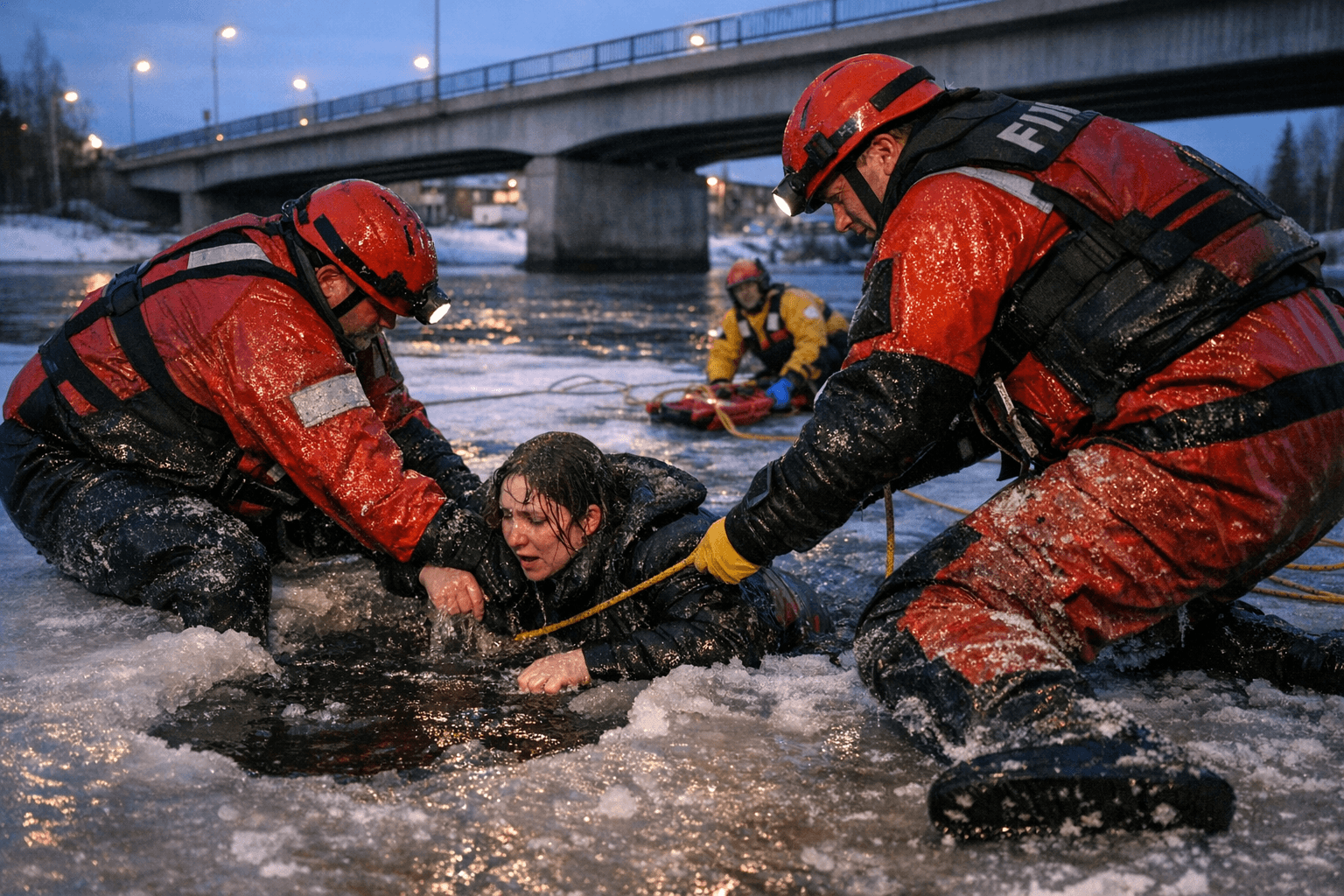
A woman fell through Chena River ice steps from the Cushman Street Bridge, rescued by Fairbanks firefighters as spring quietly hollows out what still looks solid underfoot.

Fairbanks Fire Chief Andrew Coccaro got a call Friday afternoon that captures what spring ice does to even the most familiar waterways: a woman had fallen through the Chena River near the Cushman Street Bridge, steps from a perfectly usable footbridge.
Firefighters pulled her out and transported her to Fairbanks Memorial Hospital as a precaution. Coccaro confirmed she sustained no serious injuries, but his account of the incident pointed to a gap between how people perceive ice in late March and what that ice actually is.
"The victim was crossing the river that had been, obviously, frozen throughout the winter," Coccaro said. "We don't know why the person decided to use the river and not the bridge or the footbridge or another sidewalk."
The answer, at least in part, is that ice which held all winter looks the same as ice that is failing. On the Chena, that failure arrives earlier than on most Alaska rivers.
National Weather Service Senior Service Hydrologist Heather Best explained why. "The Chena River has a lot of groundwater so it typically will start to lose ice cover or be weakened ice cover before some of the other rivers around here like the Tanana," Best said.
Additional heat sources compound the problem. A power plant along the Chena's banks keeps one section of the river from ever freezing solidly, even at the coldest point of winter. Road snowmelt drains into the river and adds warmth from the margins inward. Ice thickness becomes highly variable as a result, thinning fastest where the current moves quickest and along the banks, where snowpack insulates the water below rather than allowing it to freeze from the top down.
Those dynamics are not unique to the Chena. On the North Slope, the same mechanics govern sea ice, river crossings, and tundra trail conditions through shoulder season. Warming from below, variable current, and runoff inputs all degrade ice from the inside out before surface appearance changes. Best advises staying on established trails, watching for steam rising from the ice surface (a sign of active melt below), and treating any discolored or softened patch as unsafe regardless of how recently the route held weight.
The margin for error on the North Slope is far narrower than in Fairbanks, where firefighters arrived quickly with gear staged close by. Along the Colville drainage, near Utqiagvik, or on sea ice off the barrier islands, response time is measured in hours, not minutes. Carrying a flotation device and a throw bag, and traveling with someone who knows how to deploy them, is the practical difference between a precautionary hospital transport and a far worse outcome.
The Fairbanks Fire Department issued a public warning Friday: stay off the Chena River as spring temperatures continue to rise. The physics behind that warning do not announce themselves before the surface gives way.
Know something we missed? Have a correction or additional information?
Submit a Tip
