Iñupiat Heritage Center Preserves Arctic Culture, Language in Utqiagvik
At the top of the world, the Iñupiat Heritage Center keeps an ancient culture alive through whaling traditions, language classes, and living art.
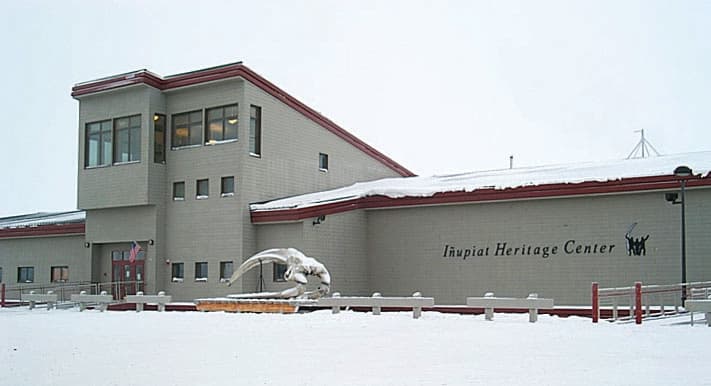
At the top of the world, in Utqiagvik (formerly Barrow), the northernmost city in the United States, a building on North Star Street holds something irreplaceable: the living memory of the Iñupiat people. The Iñupiat Heritage Center, dedicated in February 1999 and owned by the North Slope Borough on behalf of the whaling villages of the North Slope, was built with a purpose its mission statement captures plainly: "The Iñupiat Heritage Center (IHC) brings people together to promote and perpetuate Iñupiat history, language and culture."
That mandate extends far beyond a museum's walls. The center is part gallery, part workshop, part classroom, and part community hall, and it operates as an affiliated area of New Bedford Whaling National Historical Park in Massachusetts, one of several partner institutions that together tell the story of commercial whaling in the United States. The North Slope Borough's stewardship of the IHC reflects its broader commitment to what its mission describes as "healthy communities, economically, spiritually and culturally."
A Place of Living Culture
What separates the IHC from a conventional museum is its emphasis on practice over preservation alone. Exhibits and artifact collections document history, a library provides research depth, and a gift shop connects visitors to Iñupiat artisans. But the center's most distinctive space is the Traditional Room, where Iñupiat cultural life continues in real time.
Every February and March, whaling crews arrive at the Traditional Room to build, repair, and prepare their skin boats for the spring hunt. During marathon sewing sessions, the wives, female friends, and relatives of whaling crews sew the amiq, the skin covering, onto the umiaq, the traditional skin boat. The process can take all day and night. These are not demonstrations for tourists; they are essential preparations for a subsistence practice that has sustained Iñupiat communities across the Arctic for centuries.
When the long summer days arrive, the character of the Traditional Room shifts. Demonstrations of Iñupiat dancing, traditional games, and the blanket toss fill the space, connecting younger generations and visitors alike to practices that carry deep cultural meaning. The North Slope Borough describes this cycle plainly: "This dynamic interaction between the Iñupiat and their environment fosters the awareness, understanding and appreciation of the Iñupiat way of life from generation to generation."
Exhibits Rooted in the Seven Communities
The IHC's exhibit collections were developed through direct consultation with members of seven North Slope communities, a process that produced village profiles highlighting the traits and history of each community while showing the variation between inland and coastal Iñupiaq lifestyles. The research notes describe the resulting exhibit as "unique and world-class," a characterization that reflects both the depth of community involvement and the cultural specificity of what visitors encounter.
This approach, grounding exhibits in the perspectives of the communities themselves rather than outside interpretive frameworks, is central to the IHC's identity as a place of cultural revitalization rather than mere documentation. As the North Slope Borough states directly, "The Heritage Center provides a place for cultural revitalization efforts."
Learning That Spans Generations
The IHC's educational programming extends well beyond school field trips, though those are included. Ilisagvik College, the tribally controlled community college serving the North Slope, holds classes at the IHC covering Iñupiaq language, sewing, art, and dance. These classes sit at the intersection of higher education and cultural transmission, offering structured pathways for community members to deepen their knowledge of ancestral practices.
The center also sponsors the Barrow Arctic Science Consortium's public lecture series, bringing scientific perspectives on the Arctic environment to North Slope residents alongside cultural programming. Together, these offerings represent what the IHC describes as life-long learning opportunities, a recognition that cultural continuity requires engagement across every stage of life, not just childhood.
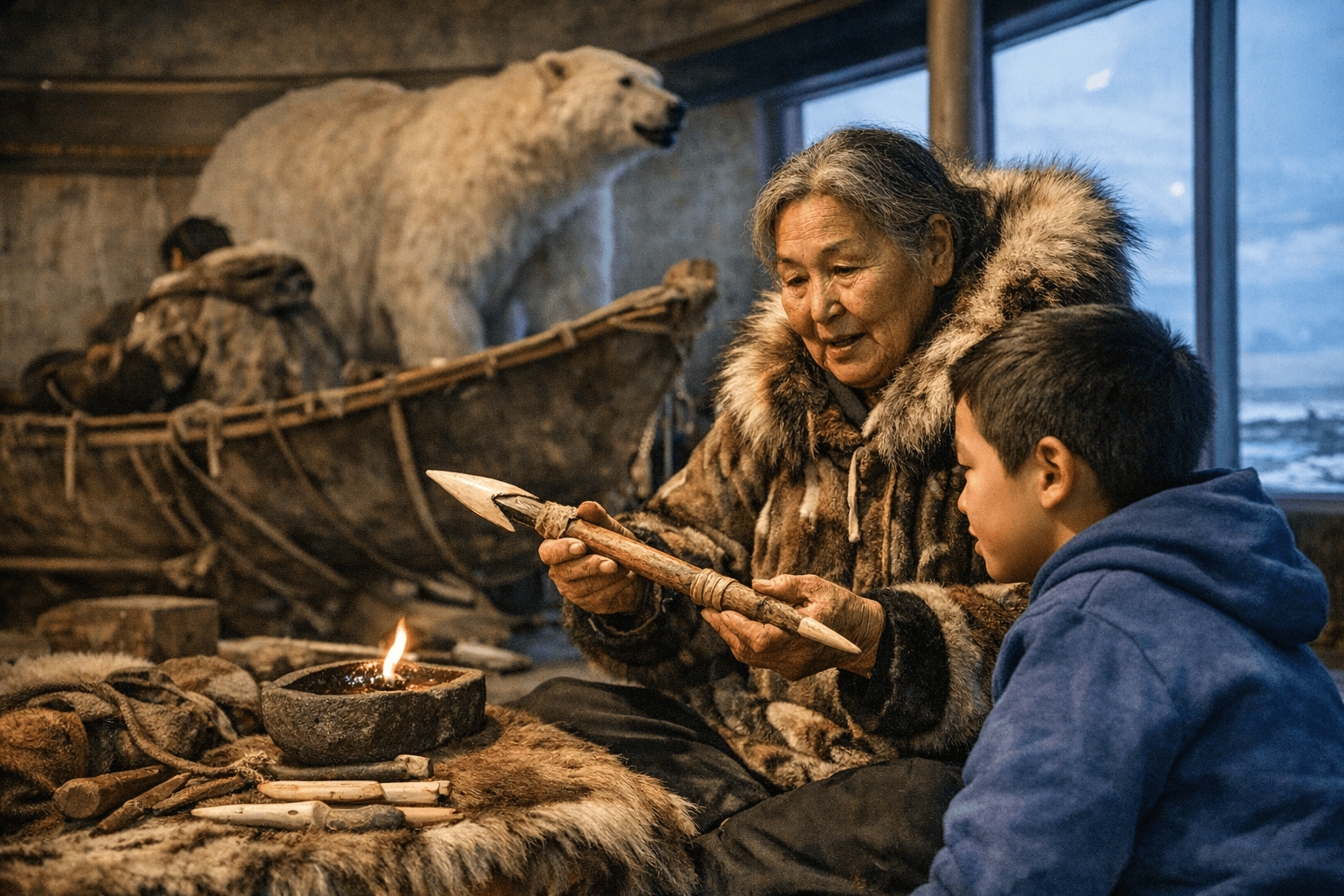
The Elders-in-Residence and Artists-in-Residence programs provide another layer of living connection. By hosting elders and working artists within the center's space, the IHC ensures that knowledge transfer happens through direct relationship, the way it always has in Iñupiat communities, not only through formal instruction.
Supporting Iñupiat Artists and the Broader Borough
Beyond its cultural programming, the IHC plays a practical economic role on the North Slope. "The Heritage Center promotes tourism and supports Iñupiat artists by providing a place in which to work on and showcase arts and crafts," the North Slope Borough states. For artists in one of the most remote cities in North America, that combination of workspace and visibility matters enormously.
The center's multi-purpose room and classroom are available to rent for a wide range of events, from outreach classes to borough department meetings, making the IHC a functional civic hub as well as a cultural one. This dual role reflects the borough's understanding that cultural health and community infrastructure are not separate concerns.
Getting to Utqiagvik
Utqiagvik sits on the Arctic Ocean and can be reached via commercial and charter flights from Anchorage and Fairbanks. The city is cool to cold year-round, a fact worth planning around for visitors traveling from Outside. The IHC is located at 5421 North Star Street, though visitors should confirm the current address and hours by calling the center directly at (907) 852-0422 before making the trip.
Admission, as listed by a travel source, runs $10 for adults, $5 for students, and $5 for children, with seniors and children age six and under admitted free. These figures should be confirmed with the IHC directly, as pricing and seasonal hours may have changed.
The North Slope Borough can also be reached at 907-852-2611 or info@north-slope.org, with its offices at 1274 Agvik Street, P.O. Box 69, Utqiagvik, AK 99723, for those seeking broader information about borough programs and community resources.
Why It Matters
Languages disappear. Boat-building techniques go untaught. The specific knowledge of how to sew an amiq through a night-long session, or how the inland Iñupiaq lifestyle differed from that of coastal communities, can vanish within a generation if institutions do not actively work to sustain it. The Iñupiat Heritage Center exists precisely because that loss is not inevitable. Since its dedication in February 1999, it has offered the North Slope's Iñupiat communities a place to do what the borough's own words describe most simply: share, practice, and remember.
Know something we missed? Have a correction or additional information?
Submit a Tip
