North Slope Borough Assembly meets monthly, handles budgets and contracts
The Assembly is where North Slope budgets, contracts and tax rates are decided, and its first-Tuesday calendar shows when residents can press issues before a vote.
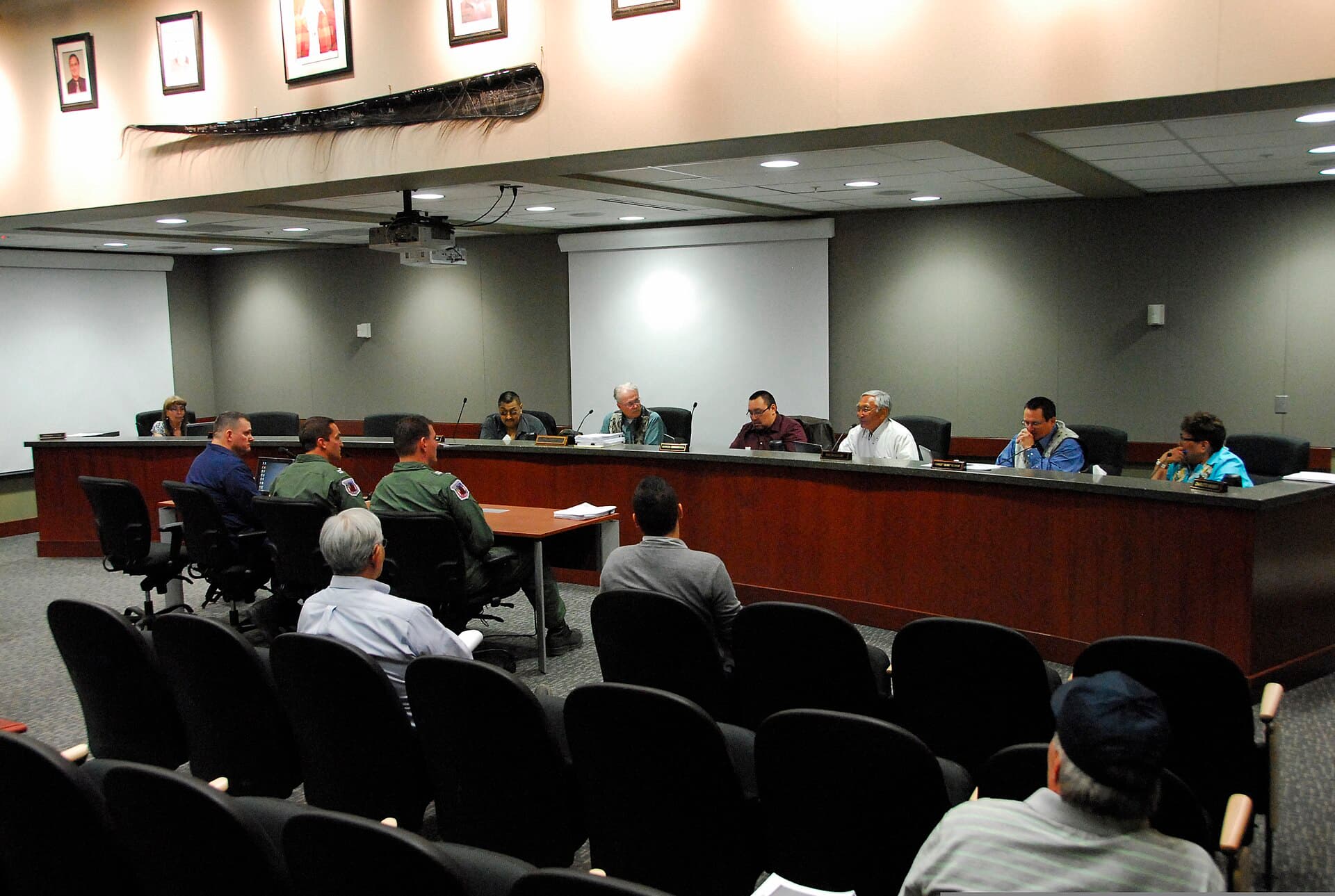
The North Slope Borough Assembly meets on the first Tuesday of every month, with regular meetings and public hearings scheduled at 1:30 p.m. on the monthly calendar. If a borough contract tops $300,000, if school funding is being set, or if a mill levy is under discussion, the Assembly is where that decision lands. It gives residents a clear point of contact when a complaint needs to become public business.
What the Assembly actually controls
The Assembly enacts laws, appropriates funds for the North Slope Borough School District and departmental budgets, awards contracts over $300,000, establishes mill levies, acts as the Board of Equalization, and confirms appointments of department directors.
If a classroom, road, utility, public safety service, or village program depends on borough money, the Assembly has a hand in the outcome. Under the borough’s municipal charter, the mayor presents the annual budget to the Assembly for consideration.
When to watch the calendar
The monthly meeting cycle is the easiest entry point for residents who want to follow a decision as it develops. The 2025 Assembly schedule puts the borough’s routine business on a predictable rhythm.
The calendar also shows that the Assembly does more than hold one recurring meeting each month. In 2025, budget hearings were set for April 2, 3 and 4. In 2026, budget hearings were scheduled for April 8, 9 and 10, and the calendar also included a joint meeting with the North Slope Borough School District on January 30, 2026.
How a concern reaches an assembly vote
A complaint does not become borough action on its own. It has to be translated into an ordinance, a budget request, a contract issue, a tax matter or a confirmation item. Residents should track the meeting notice, the agenda and the minutes.
1. Start with the right issue.
If the problem is money, look at the budget and the department tied to the service. If the problem is tax-related, it may fall under mill levies or the Board of Equalization. If it is about a hire, it may involve a department director confirmation.
2. Bring the facts that make the issue actionable.
A resident should be ready with the community name, the department or school involved, the date of the problem, and any document number, contract amount, or budget line that applies.
3. Follow it through the public record.
The Clerk’s Office maintains ordinances, resolutions and minutes, and it gives notice of the time and place of future Assembly meetings. That is the paper trail that shows whether a concern became an agenda item, a hearing, or a vote.
Why the budget numbers matter
The borough’s annual budgets put the Assembly at the center of spending decisions. In the FY 2017-2018 final budget, projected operating revenues were $376,157,285. In the FY 2019-2020 final budget, Mayor Harry K. Brower Jr. presented a balanced annual budget with projected operating revenues of $402,359,380. In the FY 2020-2021 final budget, projected operating revenues rose to $413,861,293.
Mayor Josiah B. Aullaqsruaq Patkotak also presented the FY 2025-2026 annual budget to the Assembly for consideration under that same charter-based process.
Why geography raises the stakes
North Slope Borough governance happens in a region where North Slope communities are only accessible by air, and the Dalton Highway, known as the Haul Road, parallels the Trans-Alaska Pipeline from Fairbanks to Prudhoe Bay while mainly serving as a freight corridor to the oil fields.
Assembly decisions about budgets, contracts and public services affect how supplies reach villages, how schools operate, how departments maintain services, and how quickly residents in places such as Utqiagvik and Prudhoe Bay see a decision turn into action.
Where to check responsibility
The quickest way to track who is responsible for what is to start with the Clerk’s Office record of ordinances, resolutions and minutes, then match that to the meeting schedule. If the issue involves a budget line, the final budget documents show the mayor’s proposal and the Assembly’s role in considering it. If it involves a contract above $300,000, a mill levy, or a Board of Equalization matter, the Assembly is the decision point residents need to watch.
This article was produced by Prism’s automated news system from verified source data, official records, and press releases, then run through automated quality and moderation checks before publishing. The system is built and supervised by the people who set the standards it runs under. Read our full AI policy.
Did this article answer your question?