North Slope Borough Wildlife Agency Balances Subsistence Traditions, Community Safety
North Slope Borough's wildlife agency runs polar bear patrols in six villages, monitors bowhead whales and caribou for subsistence, and handles oiled wildlife calls day and night.
Subsistence is not an abstraction on Alaska's North Slope. It is the bowhead whale shared across Utqiaġvik after a successful hunt, the caribou herds that Anaktuvuk Pass hunters have tracked for generations, the seals that sustain communities from Point Hope to Kaktovik. Protecting that way of life, and the people who live it, is the core mandate of the North Slope Borough's Department of Wildlife Management (DWM).
"The Department of Wildlife Management is dedicated to empowering Borough residents to actively participate in the stewardship of local wildlife and fisheries," the department states. "Our mission is to maintain these natural resources at sustainable levels, ensuring that traditional subsistence practices can continue for generations." That mission plays out across an enormous, roadless region through a blend of scientific rigor and deeply held Indigenous knowledge, anchored by staff and community members who understand both.
Conservation Through Tradition and Science
The DWM's approach is deliberately dual-tracked. Through rigorous scientific studies, the department documents and advocates for the subsistence needs of North Slope Borough communities. As industrial activities expand and climate change reshapes Arctic ecosystems, the department remains committed to preserving healthy wildlife populations and integrating traditional knowledge with scientific research.
The species the department monitors reflect the full breadth of North Slope subsistence life: bowhead whales, caribou, fish, ice seals, beluga whales, walrus, migratory birds, wolverine, and polar bears, among others. Accurate harvest numbers from all villages remain critical as the borough works with state and federal subsistence resource regulators. Harvest documentation helps enable local control of wildlife management in meeting the community's nutritional and cultural needs, and that could not happen without the cooperation of hunters across the Slope.
The department is also explicit about where that harvesting authority must be defended. It advocates for community interests in regional, state, and federal policy decisions, a function that carries real stakes when agencies in Juneau, Washington, D.C., or international commissions set harvest parameters affecting Iñupiat families.
Polar Bear Patrols: Non-Lethal Safety in Six Communities
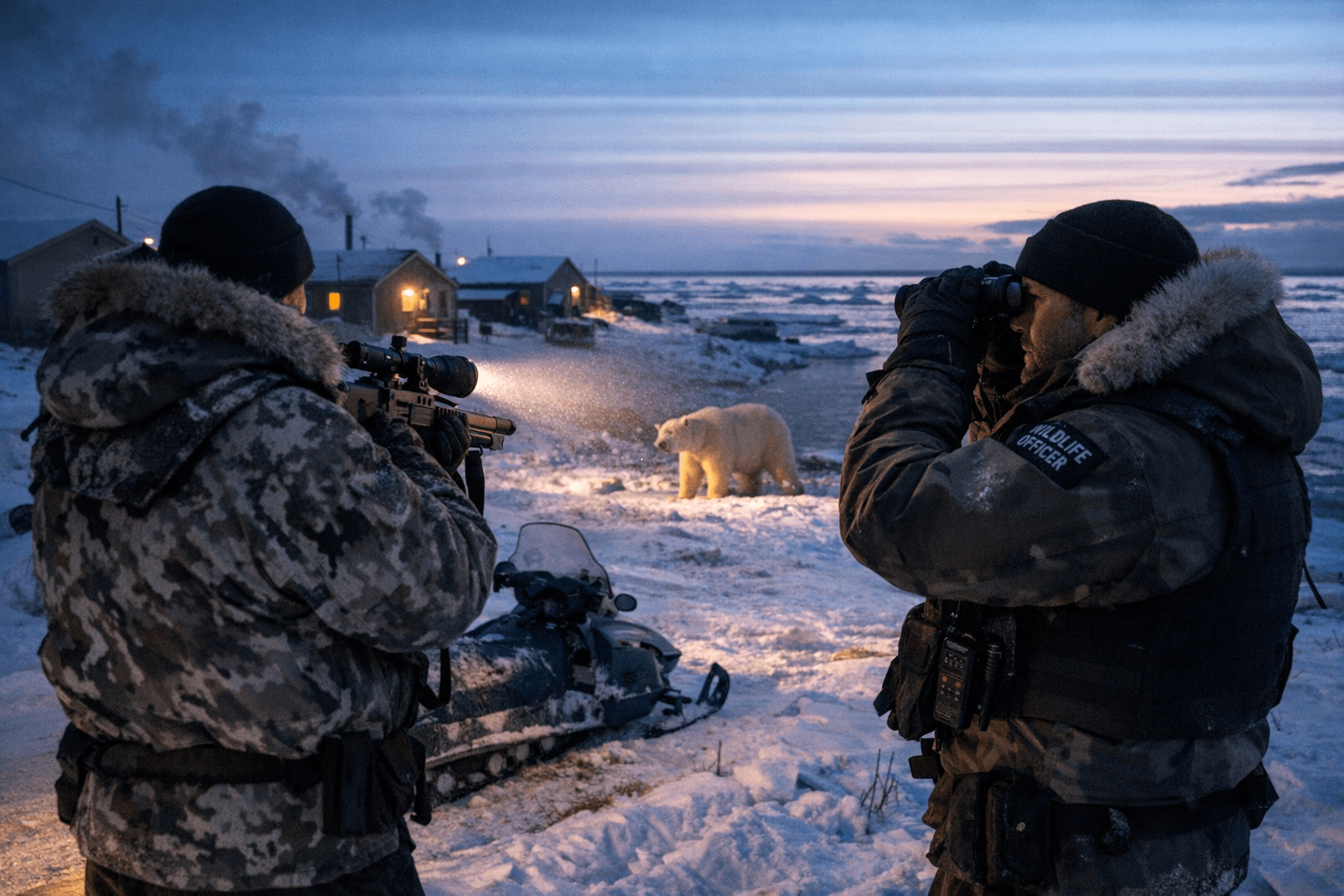
One of the DWM's most visible and consequential programs puts local residents on the front lines of human-wildlife conflict. The North Slope Borough and the U.S. Fish and Wildlife Service work together under a cooperative agreement to implement a polar bear patrol program in Alaska's North Slope communities. The primary objective is to improve public safety and conserve polar bears by reducing human-bear interactions that could potentially result in injury or death to humans and polar bears.
Beginning in 2010, the USFWS and NSB entered into a cooperative agreement to fund and carry out community-based polar bear patrols in the North Slope villages of Utqiagvik (formerly Barrow), Kaktovik, Nuiqsut (Cross Island), Point Hope, Point Lay, and Wainwright.
Patrollers are local residents hired by the NSB to monitor villages for bears and respond to human-bear conflicts that occur within the community. The program provides communities with necessary tools for managing human-polar bear interactions through attractant management and outreach to enhance public knowledge about bear safety.
When a bear is spotted, the response escalates as needed. Specially trained village patrollers haze polar bears using a series of nonlethal steps to encourage the bears to move away from areas where people walk and live. Interactions can be as simple as a patrol vehicle driving up to scare the bear away. Other times a spotlight or horn may be needed. In some scenarios, cracker shells or bean bags are used to encourage a stubborn bear to leave.
Typically, there are three full-time, permanent employees and four to five seasonal patrollers hired for the fall patrol season, running August to November, and on call 24 hours a day in some communities.
The results speak to decades of sustained effort. There has not been a person killed or attacked by a polar bear in Alaska since 1993. Much of this can be attributed to the hard work of the patrol program to keep both bears and people safe.
As more polar bears have been using onshore areas in recent years, this has become an increasingly important method for reducing human-bear interactions. The recent increases in brown bear activity near camps, cabins, and villages have also warranted brown bear patrols.
The DWM also distributes bear safety materials to the public. A brochure titled "You are in Polar Bear Country" is handed out to residents and visitors in Kaktovik to provide outreach on polar bear safety. The department uses the program to simultaneously protect communities and advance conservation science: through non-lethal hazing techniques, the Borough has reduced the number of polar bears entering coastal villages and thereby reduced the number of animals killed in the interest of public safety. The community-based project promotes support for polar bear conservation and also protects area residents.
The North Slope Borough was recognized as a 2011 Recovery Champion by the U.S. Fish and Wildlife Service for its conservation efforts with polar bears, identified as a leader in conserving the polar bear and the Steller's and spectacled eiders through management and outreach.
Reporting Oiled Wildlife: A Round-the-Clock Response Line
The North Slope's proximity to active oil and gas operations means exposure risk is real for the marine mammals, seabirds, and fish that subsistence hunters and communities depend on. The DWM maintains a dedicated wildlife emergency response function to address this directly.
If you find any fish, marine mammals, birds, or other wildlife that have been exposed to an oil spill, contact the North Slope Borough Department of Wildlife Management at (907) 852-0350 during the day, or (907) 750-5486 during evenings and weekends. The same lines serve marine mammal strandings: if you find a marine mammal on the North Slope that is not looking healthy or is acting strange, contact the Department of Wildlife Management at those same numbers.
The department's attention to contaminants runs deeper than emergency response. The DWM began its now internationally recognized intensive study of contaminants in 1995, led by Dr. Todd O'Hara, due to growing concerns of local residents regarding the effects of environmental contamination on their traditional subsistence foods and wildlife resources. Dr. O'Hara reviewed and expanded earlier work to eventually include documenting the nutritional benefits of North Slope traditional subsistence foods, starting with the bowhead whale.
The department actively works on the enhancement of North Slope wildlife response plans, procedures, readiness, and capacity to respond to oiled animals. This commitment to preparedness is especially significant given that subsistence foods are not optional supplements for North Slope families. They are nutritional, cultural, and spiritual necessities.
Advocacy, Funding, and the Long Game
The DWM operates well beyond the boundaries of the Borough in advocacy work. The department engages from the local to the international level, representing NSB interests at scientific conferences, before federal agencies including the Bureau of Land Management, the Environmental Protection Agency, and the Bureau of Ocean Energy Management, and at international commissions governing shared species like polar bears and bowhead whales.
Securing diverse funding to support ongoing and future projects is a stated strategic priority. The department pursues grant proposals targeted specifically at subsistence species and the issues that matter most to North Slope residents, working to ensure that funding gaps do not interrupt programs communities depend on, from patrol operations to species monitoring to contaminant studies.
The borough works with tribes, cities, corporations, schools, and businesses to support a strong culture, encourage families and employees to choose a healthy lifestyle, and sustain a vibrant economy. That cross-sector approach reflects a deliberate philosophy: wildlife management on the North Slope cannot be separated from economic, spiritual, and cultural community health. As the Borough puts it directly: "The North Slope Borough is committed to having healthy communities, economically, spiritually and culturally."
How to Connect with the Department
Billy Adams, Deputy Director of Wildlife, oversees operations alongside Subsistence Research Coordinators and program staff who administer programs across the Borough's communities. Adams supports the North Slope Borough Department of Wildlife Management's Polar Bear Deterrence Program in collaboration with the U.S. Fish and Wildlife Service and World Wildlife Fund.
The DWM also collects wildlife and environmental observations directly from the public. If you have a wildlife observation about animals or plants, or an environmental observation about freeze-up, thaw, ice, or weather conditions, you can submit that information to the department. It helps build a better understanding of wildlife on the North Slope and can alert staff to unusual sightings.
For wildlife emergencies, oiled animals, or marine mammal strandings, call (907) 852-0350 during business hours or (907) 750-5486 on evenings and weekends. The borough's commitment to communities, subsistence traditions, and the ecosystems that sustain both is as enduring as the Arctic itself, and the Department of Wildlife Management is the institution built to protect all three.
Know something we missed? Have a correction or additional information?
Submit a Tip
