Teen Killed, Two Injured in Easter Sunday Crash in Wells County
An Easter Sunday crash in Indiana killed a 19-year-old passenger. On North Slope's gravel roads, where air medevac is often the only option, speed is even less forgiving.
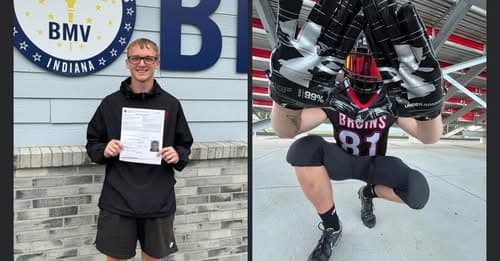
Speed ended Gavyn D. Orlando's life before he turned 20. The 19-year-old was riding in the rear seat of a white 2018 BMW on Easter Sunday when the driver lost control at high speed near the Blackford-Wells county line in Indiana, crossed the center line, and struck a utility pole with enough force to snap it in half. Orlando was pronounced dead at the scene. He had turned 19 just thirteen days earlier. The driver and a second passenger were hospitalized with non-life-threatening injuries; one of them was ejected from the vehicle.
The Wells County Sheriff's Department lists speed as a contributing factor in its ongoing investigation. No charges had been announced as of early reporting.
The crash carries a direct warning for families on the North Slope, where the consequences of a high-speed loss of control on rural roads can be more severe and where recovery from any serious crash begins with an aircraft, not an ambulance around the corner. The North Slope Borough Search and Rescue Department operates airborne medevac missions across nearly 95,000 square miles. The NSB Fire Department delivers emergency medical care through ground and air transport, but in communities like Kaktovik, Anaktuvuk Pass, Point Hope, and Wainwright, air response takes time that an ejected passenger may not have.
Teen drivers are the highest-risk group on any road, regardless of geography. Per mile driven, 16-to-19-year-olds are nearly three times more likely to be involved in a fatal crash than drivers 20 and older, according to CDC data. Alaska's Graduated Driver's License program, enacted by the state legislature in 2004, has been shown to reduce teen crash risk by as much as 50% when fully applied. The Center for Safe Alaskans offers hands-on driving support and community programs specifically designed for real-world Alaska conditions.
Alcohol is a documented factor in North Slope Borough injury patterns. The Native Village of Barrow established a Tribal Court in 2001 specifically to address drug and alcohol abuse among juveniles, applying traditional cultural values to intervention. Riding with an impaired driver remains one of the most preventable causes of teen traffic death in the country.
The NSB Police Department, the second-largest municipal law enforcement agency in Alaska, rotates officers through all borough communities and the seven outlying villages. Its 24-hour dispatch, reached at (907) 852-6111, is the borough-wide emergency contact. Families seeking guidance on local youth safety programming can reach the NSB Health and Social Services Department at (907) 852-2611.
Before any North Slope teen drives unsupervised, families should work through this checklist:
1. Confirm all Alaska GDL requirements are complete, including supervised driving hours in winter and low-visibility conditions.
2. Seat belts on before the vehicle moves, for every occupant, every trip; ejection from a vehicle sharply raises fatality risk.
3. Set a firm rule against riding with any impaired driver, including peer drivers, with no exceptions.
4. Know the curfew ordinances for your specific community within NSB and make sure your teen knows them, too.
5. Discuss what safe speed looks like on gravel roads, ice patches, and unpaved surfaces, where stopping distances are longer and traction is unpredictable.
6. Establish a check-in schedule before your teen leaves; in villages where the emergency response is airborne, early notification is not a formality.
Sources:
Know something we missed? Have a correction or additional information?
Submit a Tip